Hanbok by Lee Rhee-Za: an exhibition in the seminar rooms of the Royal College of Art, Kensington Gore SW7 2EU.
Review by Peter Corbishley
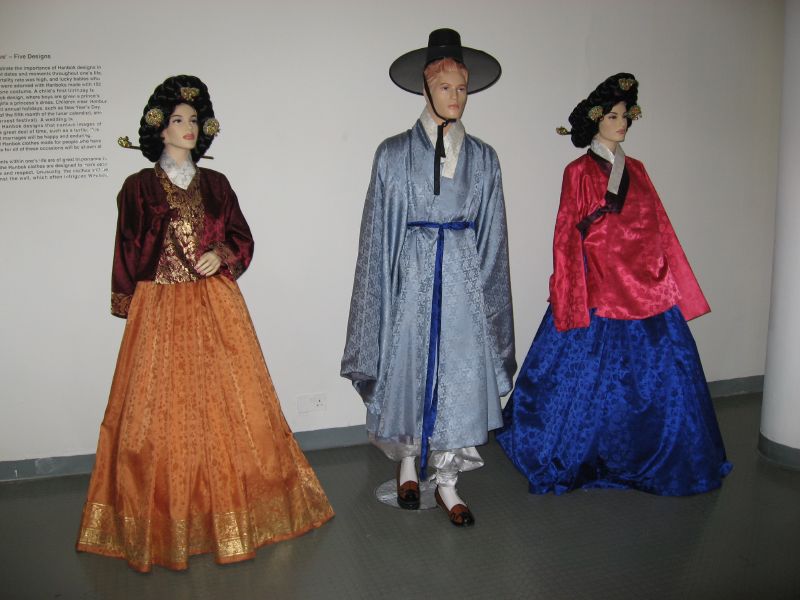
In fact this is three, or perhaps, at least at the opening event, three and a half, exhibitions rolled into one. The first was a display of copies of garments typically worn in the Joseon Court. These garments were made to look rather odd by being displayed on models with European looks and of European sizes (above). At the opening they also rather concealed what thereby became ‘half’ of an exhibition running around the edge of the room, namely hanboks for children, and for the 5 periods of life from cradle to grave. The incongruity of the Joseon dynasty garments was not countered by any clear signage as to what garment was what, or as to how social distinctions were displayed on the garments.
 The two other parts of the exhibition were, firstly, sets of pieces of delicate small squares of material embroidered together to form larger patch-work like quilts (left). Interestingly the coloured front to the brochure of the exhibition refers to one of the pieces on display which the artist made while overcoming cancer. In the exhibition brochure the ‘quilted’ type pieces are referred to as ‘handcraft’ work, but ‘handcraft’ does not properly call up the delicacy of much of the work displayed.
 The central part of the exhibition are sets of ‘hanboks’ designed by Lee Rhee-Za to be worn a number of recent ‘state’ occasions such as the visit of the Queen Elizabeth II, King Carlos, President Bush or on the opening of the Olympic games. These costumes were less innovative than the hanbok designs that moved away from the simple use of embroidery as decoration or traditional themes, such as the Taegukgi or the Olympic rings (right), and used the skirt of the dress as a backdrop for a ‘scene’ (below).
Worth a visit, but given the size of the space less crowding out by European versions of Joseon military and civil servants would have given circulation space for visitors to move around the more modern hanboks with better signage as to who wore what and when, though some photographs did help. Presumably, too, as this group of hanboks seemed to have largely been made before the 1990’s someone like Andre Kim has also done something with the ‘hanbok’.


Links: