A retrospective of Lee Bul’s work is coming up at the Hayward Gallery. We are promised that she will bring “cyborgs, mirrored labyrinths and a Zeppelin” to the newly refurbished South Bank space.
Lee Bul: Crashing
Hayward Gallery, 30 May – 19 August 2018
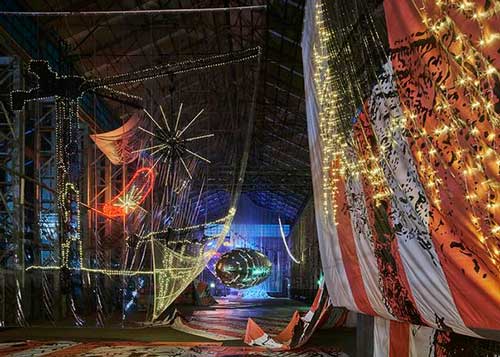
Lee Bul: Willing To Be Vulnerable, 2015–2016. Installation view at the 20th Biennale of Sydney, 2016. Heavy-duty fabric, metalized film, transparent film, polyurethane ink, fog machine, LED lighting, electronic wiring; dimensions variable. Photo: Algirdas Bakas. Courtesy: Studio Lee Bul.
From 30 May to 19 August 2018, Southbank Centre’s Hayward Gallery presents an ambitious exhibition of one of the most acclaimed contemporary artists from Asia, Lee Bul (born in 1964 in Seoul, South Korea).
This mid-career survey explores the full range of Lee Bul’s pioneering and thought-provoking work from the past three decades, underscoring the visceral and experimental impulses of her work. The exhibition includes new works, including one especially commissioned installation, and a recent series of silk velvet paintings, which will be shown alongside her most recent series of mixed media works in which Lee Bul combines organic and architectural elements. Coinciding with the Hayward Gallery’s 50th anniversary, the exhibition will celebrate the 1960s iconic Brutalist architecture with a striking new site-specific installation that will accentuate the exterior of the gallery, responding to the building’s history.
Lee Bul has received much international recognition for her inventive and provocative practice. Encompassing painting, sculpture, performance and installation, her multifaceted output explores utopian theories rooted in elements of science fiction, folklore, social and art history, urbanism, futurism, architecture and bioengineering.
Lee Bul’s upbringing was strongly shaped by South Korea’s evolution from a military dictatorship to a democracy under constant confrontation with neighbouring North Korea. Her works subtly reflect on history and politics, the trauma of Korea’s division and the challenges of globalisation and technical progress.
The Hayward Gallery exhibition features documentation from the artist’s early performances, in which she would unexpectedly appear in public spaces, such as airports, wearing monstrous soft-fabric forms with sprouting appendages that resemble body parts. Through these guerrilla-like actions Lee Bul addresses many important issues including the oppression of women in Korean society, and beyond, and the ways in which popular culture in both the East and West shapes and manipulates our understanding of ‘feminine’ beauty.
The show will highlight the different ways in which Lee Bul has responded to salient issues of her time with works that fuse different materials, genres, disciplines and traditions. Her pivotal work Majestic Splendor (1991- 97) — an installation of rotting fish embroidered with sequins which had to be removed from MoMA’s exhibition in 1997 for its intense odour — will feature in the Hayward Gallery show as evidence of the artist’s attempt to unsettle our understanding of beauty and value. This work, along with many others in the exhibition, showcases Lee Bul’s longstanding interest in experimenting with organic materials closely related to the body such as human hair, mother-of-pearl, leather and silk.
Crashing includes sculptural works from her iconic Cyborg (1997- ) and Anagram (1999- ) series which question if humans and nature might achieve perfection by merging with machines. Much of her art has also focused on the human body and architecture, and Lee Bul’s work often poses important questions of intimacy, gender, class and race.
The concept of landscape is a key element of Lee Bul’s practice and in 2005 she began constructing models and maquettes (followed later by full-scale installations) of utopian urban settings inspired by modernist architectural designs. These complex sculptures and the related works on paper and canvas constitute an imaginative topography of utopian successes and failures.
Installed in the Lower Galleries will be Civitas Solis II (2014), an immersive room that disrupts and disturbs our sense of space through its mirrored surfaces and labyrinthic forms. With her work Willing To Be Vulnerable (2015-16), here represented by a giant foil Hindenburg Zeppelin, she goes back to her investigation of utopian ideas which often stay unrealised or, like in this particular case, turn into a disaster. The Zeppelin which Lee Bul is presenting this exhibition will be installed in the newly refurbished Upper Galleries as part of an enthralling environment in which the artist is exploring horror and hope.
The exhibition will also present Lee Bul’s intricate preparatory drawings and sketches which provide an insight into the artist’s creative process, and the ways in which Lee Bul develops and explores the different strands of her artistic practice, as well as her recent, immersive, and often reflective, architectural sculptures and environments.
Ralph Rugoff, Director, Hayward Gallery said: “We are particularly delighted to present this pioneering artist during the Hayward’s 50th anniversary year. Lee Bul’s ongoing engagement with utopian modernism pairs perfectly with the democratic aspirations of the Hayward’s own adventurous architecture. The special site-specific commission that she will be creating will strikingly transform the exterior of the building in a manner that is both pointed in its historical references and visually charged.”
Stephanie Rosenthal, Exhibition curator said: “Through this exhibition we hope to take visitors on a journey of utopian exploration; the show is designed to transport the visitors to another reality, place and time. I am particularly interested in the way Lee Bul’s work addresses both the aspirations of democracy and its potential failure and I think approaching these topics is more relevant than ever today.”
Lee Bul: Crashing is curated by Dr Stephanie Rosenthal, formerly chief curator at Hayward Gallery and now Director of Martin-Gropius-Bau in Berlin, and opens ahead of Hayward Gallery’s 50th anniversary on Wednesday 11 July 2018. The exhibition will be accompanied by a fully-illustrated catalogue with texts by Stephanie Rosenthal, Yeon Shim Chung, Michaël Amy and Laura Colombino.
The exhibition will be accompanied by a series of talks and events, including a symposium, Willing To Be Vulnerable: Women, Resilience and Art in Korea on 1 June 2018. This event brings together a number of leading Korean and international art historians, theorists and artists to explore different facets of Lee Bul’s oeuvre, and reflect on the impact and development of Korean art and culture in a global context from the 1990s to the present day. This symposium is co-organised by Hayward Gallery and The Courtauld Institute of Art. Co-produced by Korean Cultural Centre, UK.
The exhibition at Hayward Gallery is generously supported by The Korea Foundation, Swarovski and The Henry Moore Foundation. It will tour internationally to Martin-Gropius-Bau, Berlin 28 September 2018 to 5 January 2019.