Jennifer Paun, who organised and hosted KCCUK Director Seunghye Sun’s valedictory talk at the University Women’s Club, gives her impressions of the evening.
On the evening of Tuesday 24 March 2026, it was a great pleasure for me to welcome Dr Seunghye Sun to the University Women’s Club for her lecture, K-Everything with AI: Rethinking Cultural Diplomacy. Held in the elegant surroundings of the Club library and also broadcast via Zoom, the event drew an audience of approximately fifty guests and proved to be a deeply memorable and enriching occasion.
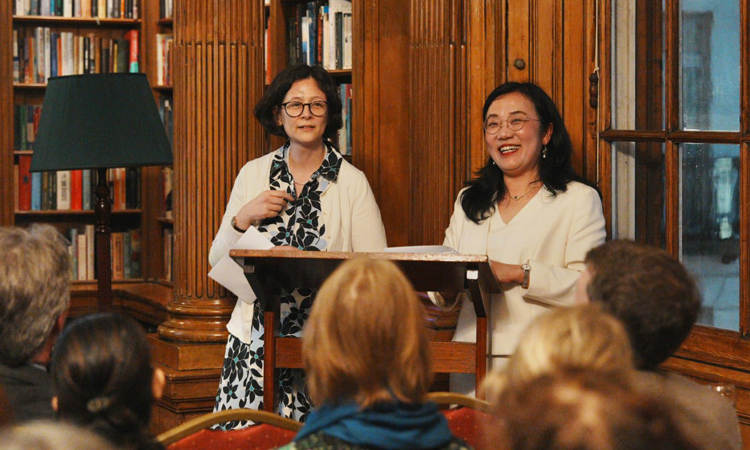
As I remarked at the opening of the evening, it seemed certain that this would be an occasion of real thought, beauty, and inspiration. For me personally, it was a particular honour and a genuine joy to introduce Dr Sun. Some introductions are made easy because the achievements of the speaker speak plainly for themselves. Others feel almost impossible, not because there is too little to say, but because there is so much that one feels no words can quite do the person justice. This was one of those moments. Dr Sun is not merely distinguished, though she most certainly is that, nor merely accomplished, though her accomplishments are truly remarkable. She is something rarer still: a woman whose intellect is deeply impressive, but whose humanity leaves the most lasting impression of all.
From the outset, Dr Sun spoke with exceptional intelligence, refinement, and grace. With clarity and warmth, she invited her audience to look beyond the familiar global success of individual elements of Korean popular culture and instead to understand K-Everything as something far richer: an emotional, aesthetic, and relational ecosystem. In doing so, she presented Korean culture not merely as a collection of celebrated exports, but as a living, expressive tradition of international significance.
One of the most compelling aspects of the lecture was Dr Sun’s treatment of artificial intelligence. She did not present AI as something cold, mechanical, or detached from human feeling. Rather, she described it as a possible companion in cultural interpretation: a means through which empathy, participation, and understanding might be deepened rather than diminished. This gave the evening not only intellectual distinction, but also an unusual tenderness. Her reflections suggested that technology, in the right hands, may serve not only efficiency and innovation, but also memory, beauty, and our shared humanity.
Dr Sun also spoke movingly of a new model of cultural diplomacy: one that moves beyond representation and display towards relationship and shared experience. This idea felt especially powerful in a world so often overshadowed by war, division, and hatred. What she offered was not simply an argument about culture, nor merely a technical reflection on AI, but something more hopeful: a vision of how culture, imagination, and human creativity might bring people together, restore understanding, and cast a gentler light into the world. Her lecture suggested that Korea is uniquely placed to contribute to emerging international conversations in AI, culture, heritage, and storytelling, and she illustrated this through examples of experimental initiatives linking heritage and artificial intelligence, emotion and sound, and the use of large language models to foster more resonant cross-cultural understanding.
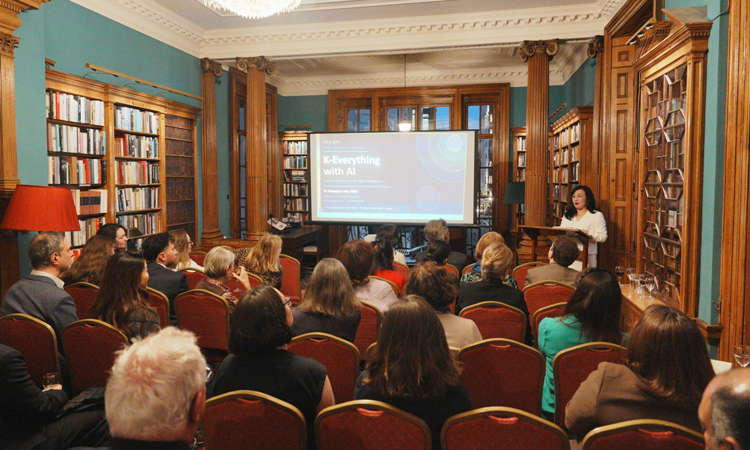
One of the most affecting moments came towards the close of the lecture, when Dr Sun spoke with disarming sincerity about her hope that she had conveyed something meaningful to her audience, and that Korean culture might become a point of connection. In that beautiful room, as we had sat together and reflected together upon something of real importance, her words carried both humility and conviction. She reminded us that K-culture begins not merely in performance or display, but also afterwards in conversation, in sharing, and even in food.
That spirit flowed naturally into the question-and-answer session. I asked Dr Sun what role culture might play, in a world so often divided and uncertain, in restoring trust, understanding, and hope between nations and peoples. Her response was deeply moving. Speaking of Korea as a divided country, she reflected upon the importance of culture precisely because it has the power to connect people where politics so often cannot in that moment: the sense that culture may sometimes achieve what ideology cannot, and that human connection may endure even where division remains. When asked whether AI could have a positive or negative effect in dialogue with North Korea, Dr Sun answered with honesty and balance. She acknowledged both possibilities, noting the extraordinary speed of technological change, while also suggesting that difficult and sceptical questions are themselves valuable, because they compel us to seek wiser and more humane solutions.
What made the evening so remarkable for me, however, was not only the originality and depth of the subject itself, but the spirit in which it was presented. Dr Sun combines intellectual distinction with warmth, sensitivity, and a rare humanity. She has that uncommon ability to make serious thought feel personal, and visionary ideas feel close to the heart. These qualities gave the evening its character and left a lasting impression upon all who were present. She was received not only as an accomplished scholar and cultural leader, but as a woman of grace, insight, and quiet authority.
The lecture was followed by a delightful reception, at which guests enjoyed an excellent selection of Korean food and wine. This graceful conclusion to the evening beautifully echoed the central themes of the lecture: hospitality, cultural exchange, and the fostering of genuine human connection. Conversation continued animatedly, and there was a clear sense throughout that this had been an occasion of both intellectual distinction and social delight. The programme concluded with a reception featuring mandu, kimbap, and a lovely selection of wine.
For me, this was far more than simply a successful event. It was an evening that reminded us that culture still has the power to soften hearts, to awaken thought, and to draw people together across difference. At a time when the world can feel so bruised by conflict, suspicion, and noise, Dr Sun’s lecture offered something deeply needed: not only insight, but hope. It reminded us that intelligence need not be without soul, that innovation need not come at the expense of humanity, and that culture, at its best, can still be a bearer of peace, justice, and light.

It reflected beautifully the University Women’s Club’s gift for bringing together serious ideas, international perspectives, and gracious hospitality in a setting of warmth and distinction. Those who attended, whether in person or online, were left with much to reflect upon and, I believe, with a renewed sense that even in troubled times, beauty, intelligence, and human connection may still lead us gently towards one another.
It was an evening of rare thoughtfulness and grace, and one that lingered in the heart long after the last glass was emptied and the final conversations had come softly to an end.