Over the years, Londoners have had a few, but not many, opportunities to see the work of a Korean playwright on stage. The count increases if you include musicals or performances in provincial theatres or at the Edinburgh fringe, where each year you can normally find at least one 50-minute Korean stage production, but if you exclude the Shakespeare adaptations, and works by Korean diaspora authors written in English, the numbers come right down again. In fact, I cannot think of more than a handful of Korean plays presented in the UK over the past 20 years. Of these, I can think of only two where the original Korean has been translated into English. One of these was Youngsun Yoon’s Kiss – translated and produced by Woori Han, who also took one of the two acting roles – which played above a Clapham pub in January. (1)
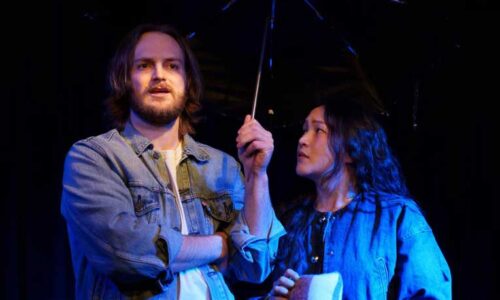
Kiss (키스), written in 1997, is a play for two characters. The Clapham production had a Korean woman (Woori Han) and a Western man (Samuel Garrett) as the two protagonists, but the scenario is universal, and the original play is non-specific about their ethnicity. The scenario for the play is very simple, stripped back. There is no plot as such: no rehearsal of past wrongs, no exorcism of past trauma as can sometimes be the case with Korean stage plays. The plot, such as it is, involves a conversation between a man and a woman – two lovers – in which the woman tries to understand why the man had just, almost subconsciously, uttered an expletive. The conversation continues as they take the tube to watch a movie and then later enjoy a picnic together. Why did the man swear? To be honest, he can’t really remember, though his silence as he wracks his brains for the reason why is misconstrued. The conversation moves on to other things, sometimes seemingly directionless but finally returning to the durability of their relationship. Does the man find the woman attractive? What would happen if they fall out of love with each other? The conversation sometimes breaks down into repetition, as if to emphasise the difficulty of organising one’s thoughts and feelings into coherent communication. Where the couple seems to be most comfortable in each other’s company is when they are silent together, as when the woman rests her head on the man’s leg while they share a picnic.
This extended, sometimes awkward, conversation constitutes the first part of the play and ends with the eponymous kiss which shows that despite the couple’s difficulty in communicating with each other verbally they still love each other: perhaps they don’t need words to communicate.
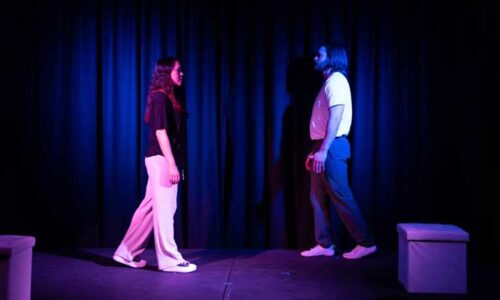
The second section of the play is even more pared back, as the two characters search for each other in what feels like a blackout, moving around the stage so that as the man walks to where the woman had been a few seconds ago, she has now moved to where she thought the man was. “I’m here and you are there” they say to each other repeatedly (나 여기 있고 너 거기 있어 in the original Korean), the phrase sometimes shattering apart into single words: I, you, here, there. But like the first half, there is a final resolution. Where the first half ends with a kiss, the second closes with the stage direction “They finally find each other”.
The play’s minimalism means that both actors and audience have to work hard, with no storyline speak of, but at the Bread and Roses Theatre in Clapham the the underlying message was clear and the performance received an enthusiastic reception. The production, appropriately, had a minimalist stage so that there were no distractions from the actors’ articulate presentation of Yoon’s ideas. Communication can happen with or without words.
- The other translated Korean play I can think of is Cha Hyun Suk’s 흑백다방 Black and White Tea Room which has been performed in both the original Korean and translated versions at the Edinburgh Fringe. [↩]