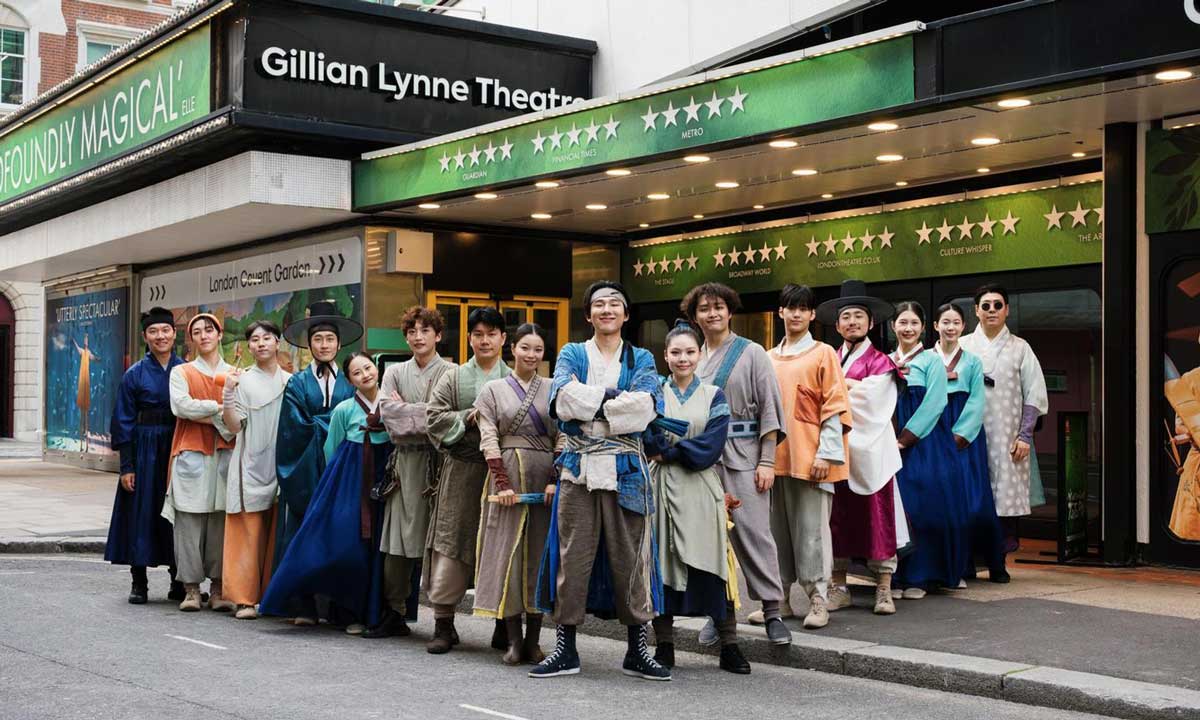
Regular followers of my reviews will know that I’m not, in general, a big fan of musicals, Korean or otherwise, having too often experienced and evening of prosaic lyrics shoehorned between the barlines of unmemorable melodies. In addition, I often find with Korean musicals that there is too much plot to fit into the allotted showtime, and the scene-setting sometimes feels a hurried. So originally I was not planning in going along to go along to see the musical Swag Age, billed as Korea’s answer to Hamilton.
However, the Korean Cultural Centre offered a sneak preview event the day before: a moderated Q&A session with some of the key creatives, along with a screening of some highlights from a staging of the musical in Korea. Disappointingly, we were only treated to fewer than ten minutes of highlights, but it was enough. Enough to reveal that the advance publicity exaggerated the work’s hip-hop credentials, so that we could also look forward to music in an accessible fusion style that blended traditional instruments such as piri and haegeum with contemporary ones. And the session also explained something else that was not clear to everyone in the audience on either day: that the “Swag” of the title was nothing to do with plunder or booty carried about by marauding bandits, but rather referred to a combination of style, confidence and attitude associated with hip-hop culture. Plus, somehow the director and composer answering questions came across as extremely likable. So in the end, the preview afternoon persuaded me to go along to the real thing the next day.
I was not disappointed. What we were seeing was not the full production, but a concert performance of a slightly edited-down version. Even though there was little in the way of props or scenery on stage, the cast were in full costume and were able to perform their dance numbers without constraint, so we got a very good idea of what the full production might look like. However, possibly because at least half an hour had been cut from the full stage production, sometimes it felt as if the initial world-building was a little rushed, and some plot points moved too fast so that key revelations might not have landed for some audience members (myself included).
The story is set in an imagined past in which Korean national spirit is built upon a shared love of sijo poetry. And in this version of the past, the love of sijo is not restricted to the austere pavilions in which the yangban contemplate the wonders of nature; instead the poems are also performed by the common people in market places, and give voice to some of the real-world experiences of the peasants. And the performance style, which (if you browse YouTube) can often sound like a cat being strangled in slow motion, is instead an appealing, toe-tapping blend of traditional and contemporary rhythms and melody styles.
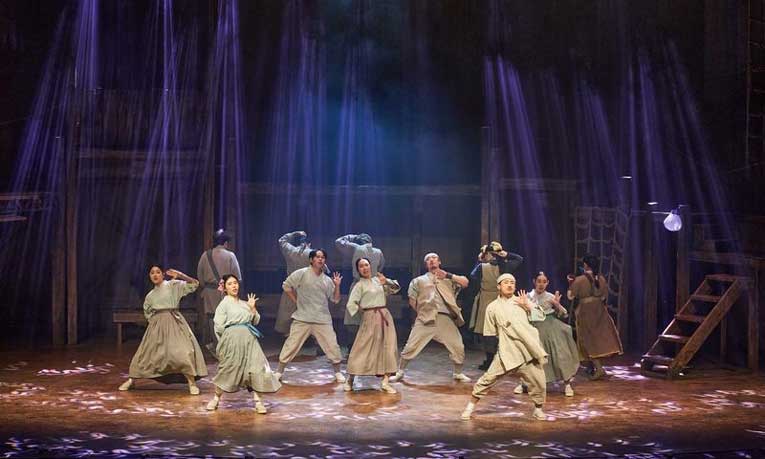
In this world, for some reason (if there was an explanation, we needed it spelled out in more detail) sijo is being suppressed, but it still survives where it can. And one group of sijo-lovers, with a passion for remedying some of the injustices in the Korean way of life, is experimenting with new performance styles. Intertwined with the struggle between the sijo-lovers and the authorities trying to hunt them out and suppress them is a plot involving a past palace coup and current political intrigue. Adding to the sense of conflict is the fact that the chief sijo-suppressor is the father of one of the main rebel sijo performers.
The climax of the plot is an official sijo contest, permitted by the authorities, in which more traditional sijo performers compete against the refreshing hip-hop music and dance style – and hard-hitting protests against injustice – of the renegades.
The production was performed in Korean with English surtitles, and consequently if there were any infelicities in the sung lyrics they would only have been noticed by fluent Korean speakers. What was missed by the locals was the playing with regional dialects that is mentioned by the Korea Times review. And we definitely missed some of the humour. But personally I would much rather hear the book performed in Korean (and miss out on some subtleties) than hear it in an English translation (and wince at any ungainly turns of phrase).
The music is not a pale imitation of something you’d find in a Cameron Mackintosh production but instead something that fits seamlessly with the world that the musical inhabits. Sometimes it’s recognisably Korean though the use of the pentatonic scale and traditional instruments in the orchestration, but it’s always accessible, and sometimes very catchy. The chorus Oh-Eh-Oh! (1) as an encore was an ideal way to send the audience home after the curtain call: (2)
The mixed Korean and non-Korean audience deservedly gave the performance a warm reception, and despite the tube strike the auditorium was full. Swag Age is definitely a musical I’d go to see again, particularly if it’s the full stage version — and preferably performed in Korean like this concert version.
Swag Age in Concert was at the Gillian Lynne Theatre on Monday 8 September.


Links:
- ‘Swag Age in Concert’ brings Joseon flair to London’s West End, Jiji Ahn, Korea Times, 9 September 2025
- As the writer Park Chan-min explains: “Though it sounds like a joyful shout, it holds deep meaning: 娛 (Oh: joy), 殪 (Eh: end), 悟 (Oh: enlightenment). Only by seeking joy even in pain can enlightenment be reached. Oh-Eh-Oh is thus both a cry of resistance and a prayer of hope. Like chants from punk bands or rhythms of hip-hop, when shouted together on stage it becomes the heartbeat of a collective.” [↩]
- Thanks to Timothy Holm for the video. [↩]