Production designer Ryu Seonghie discusses shaping meaning through space, colour, and symbolism; balancing realism and fantasy; working with directors like Park Chan-wook and Bong Joon-ho; navigating gender barriers, budget limits, and collaboration; and her concerns about commercial trends, sexuality, and diminishing narrative depth in contemporary Korean cinema. [Read More]
Category: Interviews and features (page 3)
LKFF 2014: the conversations
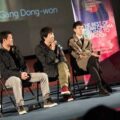
The London Korean Film Festival is not just about getting acquainted with the latest in Korean movies. It is also an opportunity to meet some of the people behind those movies – actors, directors and producers. Opportunities for engaging with these film professionals vary: for an ever-growing group of aficionados there is the offer of round-table … [Read More]
Ahn Sung-ki interview: a life in acting

Ahn Sung-ki reflects on Korean cinema’s roots in historical trauma, its role in addressing social issues, and his career choices under censorship and change. He discusses long collaborations with Im Kwon-taek, the importance of scripts and emotional depth, evolving acting freedoms, international productions, and his belief that cinema’s power lies in moving hearts rather than scale or fame. [Read More]
Park Chan-kyong interview: Manshin, Asian Gothic and artistic autonomy

Park Chan-kyong discusses financing Manshin outside the studio system, balancing artistic freedom with commercial pressures, and his recurring focus on shamanism, tradition and “Asian gothic” aesthetics. He reflects on collaboration with his brother Park Chan-wook, the creative value of short films, digital democratisation of filmmaking, and Korea’s layered relationship with its past. [Read More]
July Jung interview: loneliness, damage and connection in “A Girl at My Door”

July Jung discusses the obstacles facing female filmmakers in Korea, the precarious path to making A Girl at My Door, and her focus on loneliness, abuse, sexuality and prejudice. She explains the rural setting as a social microcosm, her collaboration with Lee Chang-dong, and her belief that intimate, local stories can achieve universal resonance. [Read More]
Kim Seong-hun interview – from relationship comedy to A Hard Day: “after ten years, the mountain changes”

Director Kim Seong-hun discusses his path from assistant director to filmmaker, the genre shift leading to A Hard Day, and how time, failure, and global cinema shaped his approach. He reflects on narrative structure, character-driven storytelling, restrained depiction of sex and violence, and challenging perceptions of Korean cinema. [Read More]
Cho Young-wuk on waltzes, playgrounds and working with Park Chan-wook

An in-depth look at film composer Cho Young-wuk, his creative process and long-standing collaboration with Park Chan-wook. From the iconic Oldboy score to live performances and audience Q&A in London, the article explores how music shapes mood, character and cinematic identity. [Read More]
Cho Young-wuk interview: motifs, process and collaboration in film music
Cho Young-wuk discusses his approach to film scoring, from early motif selection and character-focused themes to team-based composition. He reflects on collaborations with Park Chan-wook, instrument choices, gender and music, avoiding self-imitation, balancing commerce and art, and adapting styles—from classical motifs to spaghetti westerns. [Read More]
Clarice Eun-hae Ok interview: bringing a film to its completion with music

Music director Clarice Eun-hae Ok discusses her path into film scoring, close collaboration with director Oh In-chun, and the creation of Mourning Grave’s music. She explains how motifs, instrumentation, and the balance of acoustic and electronic sounds shape horror, romance, pacing, and emotional memory within a multi-genre narrative. [Read More]
Im Kwon-taek: In search of perfection

Drawing on interviews and Q&As, this piece reflects on Im Kwon-taek’s vast career, from early genre films to Seopyeonje and beyond, examining tradition, literature, Buddhism, and his lifelong pursuit of cinematic perfection. [Read More]
Seo Young-ju interview: Moebius and the power of silent performance
Actor Seo Young-ju reflects on growing from child roles into cinema-led work, favouring film over television for deeper character exploration. He discusses Juvenile Offender as a turning point, working with Kim Ki-duk on the dialogue-free Moebius, his attraction to challenging narratives, and ambitions for international acting opportunities. [Read More]
Chung Chung-hoon interview: cinematography, character and collaboration

Cinematographer Chung Chung-hoon outlines his character-driven approach to visuals, long-standing collaboration with Park Chan-wook, and balance between on-set craft and post-production. He discusses colour, contrast, technology, storyboards, working across Korea and Hollywood, and shaping imagery through drama, movement, and location. [Read More]
LBF sketch: Shin Kyung-sook on what modernity makes us forget
Shin Kyung-sook attended three London events during the this year’s London Book Fair: a conversation with Arifa Akbar on 8 April, a panel session with Han Kang on Families, Relationships and Society on 9 April, and a panel entitled Separations with Krys Lee and Quaisra Shahraz at Asia House on 10 April. The below is a digest … [Read More]
LBF sketch: Yi Mun-yol on fable and allegory in his work
Yi Mun-yol spoke at three London Book Fair events: on Korean Literature Past and Present at the British Library on 8 April; on Allegory and the Literary Imagination on 9 April; and in conversation with Claire Armitstead on 10 April. The below is a digest of those appearances. Grace Koh: Yi Mun-yol’s debut was Son … [Read More]
LBF sketch: Hwang Sok-yong and the burden of history
Like many of his fellow authors at the London Book Fair, Hwang Sok-yong was put to work in at least three events: first at the Free Word Centre on 7 April with author Adam Foulds; then on the first day of the Fair itself he appeared with Pakistani author Kamila Shamsie in a panel session … [Read More]
Exhibition visit: Chun Kwang-young’s Mulberry Mindscapes at Bernard Jacobson Gallery

Somehow, the recent acquisition at the V&A of Chun Kwang-young’s Aggregation10-SE032RED, placed as it is in a glass display case, lacks the impact of the new works by the distinguished artist currently on at Bernard Jacobson Gallery in Cork Street. Because of the glass, you can’t get right up close; and because of the compactness … [Read More]