
Synopsis
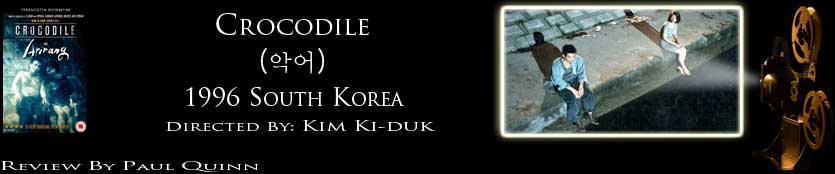
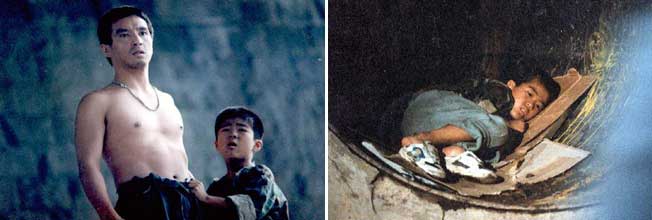
Kim Ki-duk’s debut feature Crocodile is a study of violence in South Korean society and is frankly unlike any other Korean films made before it. Crocodile depicts the life of a violent thug, the titular character played by Cho Jae-hyeon, who lives with a peddling boy, Ahn Jae-Hong, and an old man, Jeon Moo-song, by the banks of the river Han in Seoul; a popular suicide spot. Homeless Crocodile makes a living by robbing the dead bodies of those who commit suicide by jumping into the river and on saving a suicidal young woman, Woo Yoon-kyung, from drowning (another suicide victim he was planning to rob) he takes her back to his place of residence; but only to use her for sex. Keeping her there, initially against her will, he quickly develops an abusive relationship with her. However, despite his temper and violence, an inextricable bond soon begins to form between him, his lover, the boy and the old man… (text by Terracotta Distribution)
Review
Though Crocodile was director Kim Ki-duk’s debut feature, it nonetheless contains a number of elements and narrative themes that would later become almost his trademarks – certainly in the harder hitting of his films – and, as such, Crocodile is far more likely to polarize viewers than the soul-searching Arirang (2011); the other feature on this DVD boxset. While Kim Ki-duk has a plethora of ardent fans who clamour for every frame he directs and won’t hear a single bad word said against him or his work, equally he has his many detractors who have little time for either his narrative style or his depictions of characters; especially those of females.
Like the protagonists in a number of later Kim Ki-duk films, homeless thug Crocodile outwardly seems to be little more than a self-serving, vicious and nasty piece of work but as the narrative unfolds we gradually begin to see further depths to his nature; albeit controlled by the ideology of “a violent life begets a violent life”. Ultimately his, almost, disdain for life (both that of others and even his own) serves to lead him to the conclusion of his character arc – his destiny, if you will; inherently thought-provoking as it is.
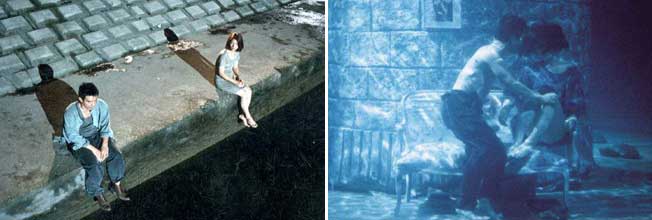
Over the years, one of the many criticisms levelled at Kim Ki-duk is the claim that his film narratives often positively scream of misogyny in their depictions of women and in the suffering he puts female characters through, but while Crocodile‘s sub-plot of a young woman saved from suicide only to become a victim of rape and abuse at the hands of a man she later falls in love with could be said to be guilty of the same (certainly to those who listen to Kim Ki-duk’s critics), it actually suits the overall story and underlying themes to the extent that it feels not only natural to proceedings – difficult and uncomfortable though it may be – but also entirely necessary to this story of a man whose (implied) violent past combined with the difficulties (again implied) that have been put in his path by society have not only caused him to end up homeless but also left him largely unable to separate violence from his other emotions; regardless of the fallout and consequences those around, and closest to, him must face as a result.
One issue I personally have with some of Kim Ki-duk’s work (though as I write this I can almost hear the gasps of incredulity at me having the utter audacity to say what I’m about to) is his tendency to make narratives jump through hoops to a degree to specifically put characters – again often females – in peril or into situations of extreme suffering; even if that means the narrative flow jars somewhat to achieve the director’s ends. However, thankfully the plot of Crocodile is free of any such contrivances and is, as such, all the more believable and dare I say gripping.
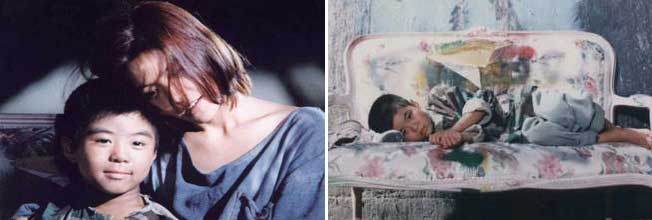
Finally, special note should be made of the deftness with which Kim Ki-duk references family and familial bonds in Crocodile. The perceived importance of stability within family has long been a staple of Korean cinema with an utter plethora of films (right from the Golden Age of the 50s and 60s to the present day) referencing the idea that should the family unit begin to disintegrate so too will the lives of the members of that family and even the implication that an individual who destroys family is inherently of a dubious nature; often even evil. By creating inextricable bonds between the main characters of Crocodile – a man, a woman, a child and an old man – Kim Ki-duk shows our band of homeless individuals to be as much a family as any family unit you could mention and allows him to point to the implication that, dysfunctional though it may be, this unit is no less valid than other more archetypal depictions of family in films and culture throughout the years. In fact, it could even be said that Kim Ki-duk is telling us that no family unit is as pure, stable and “normal” as society would have us believe.
Cast: Cho Jae-hyeon, Ahn Jae-Hong, Woo Yoon-kyung, Jeon Moo-song
Summary
Though Crocodile was Kim Ki-duk’s debut feature, it positively screams of themes, narrative elements and directorial style that would almost become his trademarks over the years. A gripping story, both because of and in spite of its violence, Crocodile is a must for those who wish to see the early, burgeoning talent of one of Korea’s most controversial directors.
DVD
The DVD used for this review is the Terracotta Distribution ‘Kim Ki-duk Collection’ boxset (Region 2) DVD release, consisting of this his first feature from 1996, along with his soul-searching and cathartic 2011 film Arirang. The DVD was generously provided by Terracotta Distribution. It has the following special features:
- Arirang Trailer
- Terracotta Far East Film Festival 2012 Montage
- About Terracotta
- Photo Gallery
- Breathless Trailer
- Return to Burma Trailer
- Petty Romance Trailer
- God Man Dog Trailer
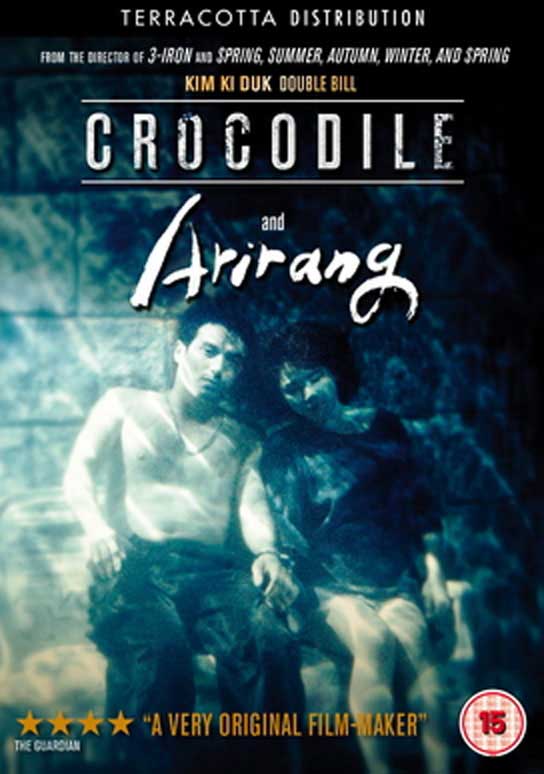
All images © Terracotta Distribution
Review © Paul Quinn