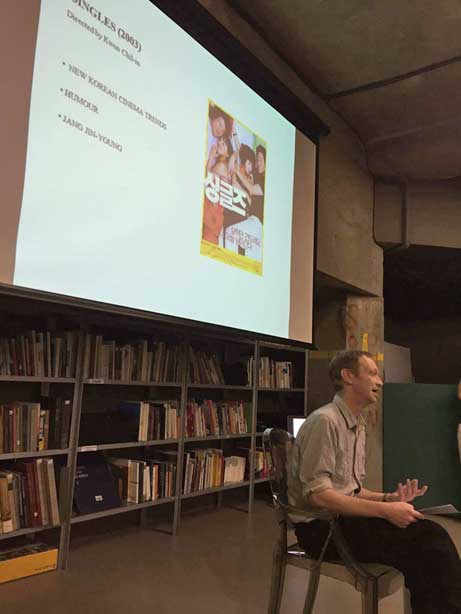
In June 2016, I was asked by the Korean Cultural Centre UK to give an introductory film talk prior to the KCCUK ‘Korean Film Nights’ screening of ‘Singles’ (2003). The talk was given in a slightly expanded version to the Korean Society of the University of Westminster as part of an International Women’s Day event on 4 March 2019. The following is a transcription of that talk:

Trends
I’m sure most of you have checked out the synopsis of Singles on the KCC’s site or wherever. Singles tells the story of the friendship between two women and their various relationships – Nan is nearing her 30s and is pretty sure her life will take the traditional route of decent job and relationship leading to marriage, that is until she’s dumped by her boyfriend and demoted at work, while Dong-mi is currently on her 48th boyfriend, is happy to tell anyone and everyone about her rather liberal attitude to life, relationships and sex and has no intention whatsoever of settling down.
The film was released 13 years ago in 2003, but even in 2016 it feels contemporary, wholly modern, to the extent that it could almost stand alongside Korean relationship comedies of the present day. But that fact in itself makes it all too easy see Singles as just another relationship comedy, one in a very long list, and overlook the part it played in huge changes that took place in Korean cinema in the late 90s / early 2000s, a period that’s become known as the New Korean Cinema wave.
While the vast majority of discussions about the New Korean Cinema wave can almost be guaranteed to cite Park Chan-wook, Bong Joon-ho etc. as directors whose films fuelled the entire expansion of Korean cinema – using modern filmmaking techniques, merging genres to create highly original films that had an impact both internationally and domestically – far fewer mention the many other New Korean Cinema directors who chose to focus on familiar genres and narrative ideas, bringing a progressiveness to already popular subjects and often imbuing their films with noticeably modern attitudes.
With many of these directors having been schooled abroad, they began to step away somewhat from traditional Korean depictions of relationships, love and romance – such as pre-marital chastity, relationships serving largely as a means to marriage, lasting happiness only coming within the standard ideal of ‘married family’ – and move more towards depictions of relationships as an end in their own right for young adults not yet ready for marital commitment, this more modern attitude coming at a time when young single Korean women were beginning to assert their individuality and become far more sexually aware and worldly wise than previous generations.
In Singles, the character of Nan being dumped by her boyfriend (thereby, in the early stages of the narrative, no longer having a relationship that could lead to marriage), having to learn to be single again, as well as the change in her attitude towards life and relationships as the film progresses can be seen as a mirroring of the gradual move from traditional to modern that that was taking place throughout New Korean Cinema at the time, and indeed in Korean society as a whole.
Of course, stories of sexually aware women pursuing their own needs and desires outside of marriage were certainly nothing new back in 2003, but for decades Korean films had dealt with such subjects as cautionary tales, with such women with wholly modern attitudes to life and sex shown as a threat to traditionalism, family and Korean society as a whole and ultimately punished for their ‘wantonness’. Discussions of these sorts of depictions can almost be guaranteed to cite director Kim Ki-young as a driving force, and indeed he was absolutely obsessed with what he himself described as these ‘Despicable Women’ throughout the Korean cinema Golden Age of the 60s and 70s, whether you look at Io Island (1977), Insect Woman (1972), Woman of Fire (1971) or indeed his absolute classic The Housemaid from 1960, and on and on.
However, while Kim Ki-young was pretty much the most famous director of such narratives, he certainly wasn’t alone or indeed anywhere near the first to point to a supposed societal threat posed by modern female attitudes, autonomy and sexuality. Indeed, if you look further back to the 50s to films such as Madame Freedom or even way back to the 30s with Sweet Dream from 1936 you’ll find an absolute myriad of such cautionary tales relating to female modernity. As well as themes, what all of these films across the decades had in common was the ultimate punishment of the wayward female in question. Whether she committed adultery, became obsessed with consumerism – her love of Westernised trinkets and clothing leading to her neglecting her family – or pursued sexual freedom, in the process turning her back on traditional female ideals, the outcome was the same – she would be made to pay dearly for her self-serving actions. In fact, the first ever Korean film where such a sexually voracious woman wasn’t ultimately punished in some form or other for her sexual actions and choices outside marriage was The Adventures of Mrs Park which wasn’t released until 1996, just seven years before Singles.
Admittedly, those earlier depictions of independent, modern, sexually aware females looking out for themselves rather than focusing on marriage, husbands and family were much harder and forceful. These women were far more conniving, far more self-serving than the fun-loving independent women in films like Singles, but that’s kind of the point. New Korean Cinema directors were essentially saying that modern women following their own needs, desires and pleasures was no big deal, it was just life and even something to be celebrated… and that struck a massive chord with female cinema audiences, making films like Singles hugely successful at the Korean box office.
Singles also utilises other popular New Korean Cinema trends, those of depictions of noticeable feisty females and a somewhat reversal of traditional male / female roles – i.e. strong women paired with far meeker, or even hapless, males. There was an absolute explosion in the appearances of these sassy female characters around the time of Singles and slightly before, the most obvious example being Kwak Jae-young’s My Sassy Girl in 2001 with its story of a mild-mannered man’s relationship with a hilariously violent, virtually psychotic girl. This switch in gender roles combined with strong female characters was so popular with audiences (especially young women) that a slew of similar examples really had to follow, from the My Wife is a Gangster series of gangster comedy movies to romance Windstruck, to Saving My Hubby – the story of a woman’s fevered journey through Seoul to rescue her husband who has been taken hostage by a bar owner over an unpaid drinks bill, all while carrying her baby on her back. As time passed, the physicality of these sassy depictions mellowed somewhat turning largely to dialogue-based feistiness, resulting in much more realistic and natural narrative humour.
While many of the NKC comedies were aimed directly at those in their pre-marital late teens and early 20s, just as many targeted a slightly older demographic, allowing discussions of modern attitudes to marriage and sex to be included within the humour and speak directly to age groups for whom such issues really mattered. Such is the case in Singles, as well as, for example, The Art of Seduction (telling of a competition between a man and a feisty female to see who is better at seducing members of the opposite sex for a one night stand), A Bizarre Love Triangle (the title really speaks for itself) and, later, My Wife Got Married, in which a strong sassy woman married to a meek man decides she wants to marry a second husband while keeping her current marriage going.
Singles’ use of all of the above ensures that though the film is based on the Japanese novel Christmas at Twenty-nine, it is Korean through and through to the extent that it could almost be considered a poster film for New Korean Cinema comedies.
Ultimately, Singles was at the very forefront of changing decades-long depictions of women in Korean cinema to show modern female attitudes and sexuality in a far more positive and natural light than ever before, celebrating their modernity rather than punishing them for it, and the film’s success ensured that such depictions snowballed in its wake. As such, in hindsight, Singles’ importance to Korean cinema as a whole cannot be overstated in any respect.
Humour
It almost goes without saying that this reversal of traditional gender roles, either overtly or subtly, and the idea of noticeably feisty females easily lend themselves to humorous depictions and director Kwon Chil-in uses them to great comic effect in Singles combining them with genuinely witty dialogue throughout… whether it’s Dong-mi (Uhm Jung-hwa) dragging her trouserless boss across a office by his tie to loudly berate him in front of her work colleagues, or more traditionally feminine Nan (Jang Jin-young) undertaking a sexual liaison dressed as a bunny girl brandishing a whip, while her conquest is on all fours on the floor. This carries through to Nan’s thoughts being shown and voiced on screen – on the outside she’s shy, polite and respectful – as society would want her to be as a lady – while inside she’s the archetypal feisty female, swearing like a trooper and happy to imagine herself beating up a woman in the street on hearing her talk happily about love.
While Singles is wholly modern, Kwon Chil-in nonetheless references a number of cinematic romance and drama clichés throughout, gently parodying them in the process… rain to represent a character’s sadness, a 360 degree camera pivoting around two lovers etc etc and in each case Kwon Chil-in has one of the characters point out that it is a movie cliché, almost poking fun at himself in the process.
As a final note on the humour in Singles, there was somewhat of a trend during the New Korean Cinema wave for comedies to use overtly and overly ‘loud’ humour. Take for example Crazy First Love in which actor Cha Tae-hyun’s character spends the entire first half hour of the film yelling almost every line of dialogue at the top of his lungs, getting, as far as I’m concerned, more annoying and less funny with each passing second. Kwon Chil-in wisely avoids such overly contrived attempts at noisy humour in Singles and, by keeping things fairly bright and peppy as well as creating genuinely likeable characters that are easy to warm to, what boisterousness there is comes across as far more legitimate and indeed welcome, succeeding to a much funnier degree.
Jang Jin-young
I’d love to give you an overview of all of the main Singles cast members but time is rather of the essence. So, instead, I’m going to briefly focus on one cast member specifically. That is, actress Jang Jin-young who in her nine film career was nominated for 21 acting awards, winning 14, quickly becoming one of Korea’s best loved actresses, in the process.
Jang Jin-young began her career in front of the camera as a model, and even represented her home province in the 1993 Miss Korea beauty pageant. She briefly moved from modelling to television acting in 1997 and in 1998 she landed her first film role in fantasy drama Ghost in Love. While her tough girl supporting role in Kim Jee-woon’s classic The Foul King in 2000 brought her to the attention of audiences and film critics far more than Ghost in Love, it was her first major starring role in 2001’s Sorum that truly set her on the path to stardom. Telling the story of a chain-smoking victim of domestic abuse who gradually begins to lose her grip on reality, Jang Jin-young’s jaw-dropping performance will at once break your heart and send a chill up your spine… and that performance quite rightly earned her six best new actress awards in Korea and abroad.
In 2003, Jang Jin-young starred, of course, in Singles for which she won another load of awards and Scent of Love – a film about a woman diagnosed with stomach cancer which tapped into New Korean Cinema’s penchant for films dealing with terminal illness. However, following a further two film roles which included the superlative Blue Swallow, a historical biopic about the life of one of Korea’s first women pilots, Jang Jin-young began to suffer from debilitating abdominal pain, and on seeking medical attention was herself diagnosed with stomach cancer, sadly mirroring the narrative of Scent of Love. Life cruelly imitating art, if you will.
She immediately retired from acting and began treatment combining Eastern and Western medicine but though she bravely battled against her disease for almost exactly a year, on September 1st 2009 Jang Jin-young passed away. She was just 35 years old.
During an interview at the time of Singles’ cinema release in 2003, Jang Jin-young said her character in the film had a personality closer to her own than any other role she’d ever played. As such, Singles is a beautifully, genuinely funny comedy that not only stands as a tribute to the talent of one of Korea’s best-loved actresses but also serves as an uplifting reminder of how warm, witty and full of life Jang Jin-young really was.
Enjoy the film.