
I was asked by the Korean Cultural Centre UK to give an introductory film talk prior to the KCCUK ‘Korean Film Nights’ screening of ‘Saving My Hubby’ (2002) on 15 September 2016. The following is a transcription of that talk:
Introduction
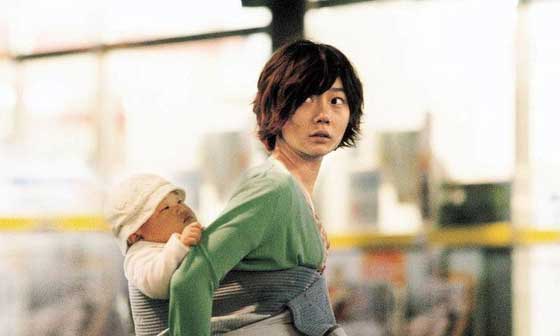
Tonight’s screening of Saving My Hubby takes us back once again to 2002, almost slap bang in the middle of the New Korean Cinema wave of late 90s and early 2000s. The film tells the story of Geum-sun and her husband Ju-tae, a young married couple with a six month old baby. As Geum-sun desperately tries to juggle looking after her husband, raising her child and trying not to disappoint her mother-in-law, she receives a phone call telling her that Ju-tae is being held hostage by a bar owner over an unpaid drinks bill and won’t be released until it is paid. Realising it’s up to her to save the day and having no-one to look after her baby, Geum-sun straps the kid on her back and heads out on a frantic journey through the night streets of Seoul to rescue her hubby.
New Korean Cinema
Take a look back at Korean cinema over the years – from way before the Golden Age right through to the first Korean Wave of the 80s – and you’ll find a steady and almost constant stream of films stressing the importance of the family unit and mirroring the traditional idea that a young woman’s focus should first and foremost be finding a husband, getting married, setting aside whatever her pre-marital life was to take care of her bread-winning husband’s needs and building a home to raise a happy family. In fact, if you were to choose a Korean film at random from the Golden Age of the 60s and 70s, there’s a fair chance you’d find a tale involving the importance of the family unit to Korean stability as a whole and a detailing of any number of perceived threats to the traditional ‘norm’ of family, either as narrative focus or, at the very least, a significant underlying reference.
However, by the time of the New Korean Cinema wave, young Korean adults had begun to embrace a far more modern attitude to life and love than previous generations, with young women especially increasingly asserting their individuality, demanding equality in relationships and seeing success and fulfilment in their own lives as important to their overall happiness with or without marriage. Just as classic Korean cinema reflected traditionalism and the gradual shift to modernity of Korea as a whole (often showing the latter as a danger), New Korean Cinema repeatedly mirrored the ongoing modernising change in attitude, and in the case of Saving My Hubby those references are many in spite of it outwardly appearing to be simply a light-hearted comedy.
From almost the outset, Saving My Hubby positively screams that Geum-sun and Ju-tae got married far too young, with neither having the emotional maturity to cope with the pressures and frustrations of married life and parenthood. While Geum-sun did indeed take the wholly traditional route to marriage (sacrificing her own needs, desires and pursuits completely in favour of marriage and motherhood), she is far from finding the happiness and contentment the traditional ideal implied she would. She almost constantly yearns for the excitement and fulfilment of her pre-marital life as a professional level volleyball player instead of the mundane, housebound existence she currently has and it could even be said that a part of her wishes she’d taken the more modern approach to relationships, either devoting a longer time to her career or not giving it up entirely on being wed.
Certainly, part of Geum-sun’s night-time battle to save Ju-tae is a result of her having little other option as a Korean wife but to try and (traditionally) care for her helpless, hapless hubby but at the same time her efforts are also based on her (more modern female) desire to take control and bring her family unit back to normality.
Ultimately, while classic Korean cinema repeatedly wrapped depictions of family within cautionary tales, detailing actions and events that could or would tear a family unit apart, New Korean Cinema brought an influx of far more upbeat movies such as Saving My Hubby that showed what it takes to hold a family together, and that shift strikes a hugely positive note on the increasing feeling of stability being felt by young adults in Korean society at the time, certainly compared to previous generations.
There was also a trend in New Korean Cinema for the reversal of traditional male/female relationship roles, feisty females paired with weaker, sometimes hapless males that can be seen in a myriad of films from My Sassy Girl to the My Wife is a Gangster series, to My Wife Got Married and beyond… and while at the outset of Saving My Hubby Geum-sun is more manically hysterical than feisty, more neurotic than strong, her overcoming of numerous obstacles on her journey to rescue her hubby and the way in which addresses each of her weaknesses in turn underlines that trend towards depictions of female strength beautifully and says something deeply positive about the changing place of women in Korean society from before and during the time of the New Korean Cinema wave.
Humour
The humour in Saving My Hubby comes largely as a two pronged attack from trends that have been and are consistently popular in Korean cinema. The first of these could be described as Fish Out of Water comedies, stories of characters taken from their comfort zone and placed in situations utterly alien to them, the often madcap humour coming from their desperate efforts to bring order to chaos while being completely out of their depth. Seen in numerous films from gangsters in a monastery comedy Hi Dharma, to Geum-sun’s Saving My Hubby night-time battle through Korea’s underworld, to Kiss Me, Kill Me’s emotionless hitman falling in love with his target etc etc, these fish out of water scenarios became so prevalent that they sat alongside the equally popular Love Across Time romances, Terminal Illness melodramas, High School horrors and Gangster comedies to almost form sub-genres in their own right.
Of course, Geum-sun is a fish out of water two times over, with both her (initial) inability to cope with married life and motherhood and her seemingly endless, often violent, encounters with a myriad of freaks and reprobates on the streets of Seoul – all with her baby strapped firmly on her back – speaking of (ultimately) female fortitude and resilience at the same time as repeatedly underlining the genuine, often laugh-out-loud, humour that can be so easily derived from fish out of water scenarios.
The other trend that screams from Saving My Hubby is the idea that what can go wrong will go wrong, again seen in a myriad of films from classics such as insurance fraud farce Just Do It, to The Quiet Family’s death upon death at a boarding house, to the far more recent A Hard Day in which a detective desperately attempts to hide a body and cover up the fact that he is responsible for accidentally killing the man. In Saving My Hubby, every step Geum-sun takes pushes her life even closer to collapse and the more she tries to move forward, the more madcap and even hilariously surreal her difficulties become – a classic example of the comic “catalogue of errors” idea that Korean filmmakers have become so adept at detailing. Anyone who has had a day where absolutely everything goes wrong can hardly fail to secretly smile and think to themselves “Thank heavens that’s not me”, even in between the laugh-out-loud moments of Saving My Hubby.
Add to that, the appearance of archetypal characters from multiple genres and references to everything from thriller to Chaser-like action movies ensures Saving My Hubby not only succeeds as a genuinely funny, light-hearted comedy but also shows itself to be as much a reflection of film trends appearing throughout New Korean Cinema.
Bae Doo-na
I’m sure you’re all aching for the film to start and for me to stop so as a quick final note:
Saving My Hubby stars Bae Doo-na, one of the most internationally recognisable Korean actresses, both as a result of her roles in Park Chan-wook’s masterful Sympathy for Mr Vengeance and the hugely popular and internationally successful Bong Joon-ho film The Host, as well as her appearance in Western films Cloud Atlas, Jupiter Ascending and Netflix sci-fi drama Sense8.
While Bae Doo-na’s Western film performances have tended to be in big budget, blockbuster affairs, her Korean films have often been smaller productions, her choices being based on what the films had to say about the place of women in Korean society, female strength or even societal issues surrounding alternative lifestyles.
I interviewed Bae Doo-na towards the end of last year, and when we talked about those choices she said that while the societal statements made by the films was the most important thing to her, she was aware that as they were often smaller productions they’d likely be seen by fewer people, especially internationally. At that point, I mentioned how much I love Saving My Hubby and Bae Doo-na physically squealed with delight, almost jumping up and down with excitement at the fact that I’d seen one of her much lesser known films (of which she is clearly, deeply proud) and that I’d seen it in the UK. She had pretty much assumed that virtually no-one internationally had watched or been aware of Saving My Hubby and that even in Korea few had seen it.
If Bae Doo-na knew you’re all here tonight to watch this little gem of a movie, I’d virtually guarantee she’d be jumping up and down with excitement all over again.
Enjoy the film.