
I was asked to give an introductory film talk prior to the KCCUK Korean Film Nights’ ‘Chills & Thrills’ screening of ‘The Red Shoes’ (2005) on 23 February 2017. The following is a transcription of that talk:
Introduction
Tonight’s screening of The Red Shoes takes us back to 2005 and the period that’s become known as the New Korean Cinema wave, a time in the late 90s and early 2000s that saw an influx of new, younger Korean directors – many of whom had studied abroad – using the latest film-making techniques within the easing of film censorship to take Korean cinema in wholly new and highly original directions, allowing Korean film to explode onto the international stage, in the process.
Prior to this period, the horror genre was pretty much a hard sell in Korea and while some of Korea’s horror output over those years is now deemed to have been both classic and hugely influential for Korean cinema as a whole – for example, Kim Ki-young’s use of horror ideas and elements in the 60s and 70s within his depictions of what he described as “despicable women”; Shin Sang-ok’s groundbreaking 1969 cinematic take on the legend of the gumiho or nine-tailed fox, ‘Thousand Years Old Fox’; or Go Yeong-nam’s surreal and almost experimental 1981 film ‘Suddenly in the Dark’ – the Korean horror genre was nonetheless far from the powerhouse it would later become as a result of the New Korean Cinema wave.
That change largely began with the release of Park Ki-hyung’s ‘Whispering Corridors’ in 1998, continuing with ‘Memento Mori’ in 1999 and ‘Wishing Stairs’ in 2003. This series of girls’ school horror films spoke directly to a far younger audience than those who films had been aimed at prior to New Korean Cinema and with similar shifts in audience demographics taking place in other genres, young adults began to flock to cinemas. In short, these films were a huge success not just for the horror genre but for Korean cinema as a whole. They not only awakened a desire in viewers to see more horror films featuring characters they could directly relate to in either age or situation (the horrors of school, the pressure of studies, the difficulties of relationships) but also shone a light for the film industry to finally see that horror could be a driving force in the expansion of Korean cinema as a whole.
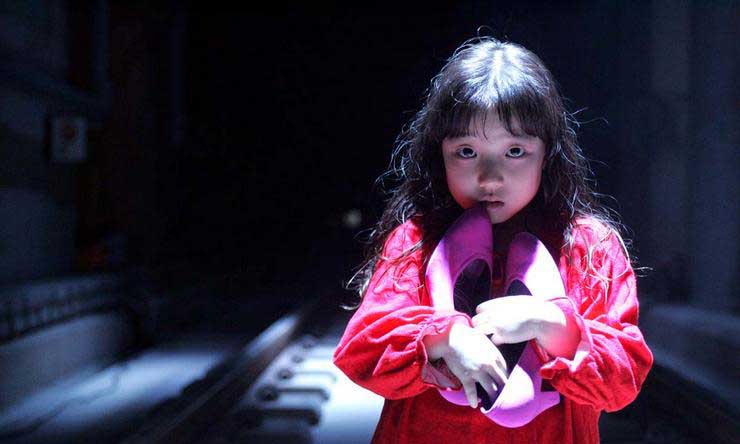
Based loosely on Hans Christian Andersen’s fairytale of the same name, The Red Shoes tells the story of a young woman called Sun-jae who finds a pair of beautiful shoes mysteriously abandoned on a subway train. Immediately drawn to them, she is wholly unaware that her inability to resist taking the shoes home is the result of a sinister curse that exerts its power over all who come into contact them. Soon Sun-jae and her young daughter, Tae-soo, become bitter rivals for possession of the shoes as the curse takes bloody revenge on anyone trying to steal them.
In the years directly preceding, and indeed following The Red Shoes, there were numerous Asian horror films focused on, or strongly featuring, similarly deadly or malevolently possessed objects, and Korea was no exception: Phone (2002), in which a journalist who has broken a paedophile story begins receiving anonymous calls on her new phone that seem to change her daughter’s personality; Unborn but Forgotten (2002) which tells the story of people dying after visiting a website; the prominent featuring of a Ouija board at the start of Dead Friend’s (2004) tale of ghosts and possession; The Doll Master (2004) featuring a doll quite a bit more animated than most; The Wig (2005) with its focus on a possessed wig, funnily enough; and even recent examples such as Don’t Click, about a video that seems to kill anyone who watches it; and Killer Toon (2013) – also directed by Kim Yong-gyun, director of The Red Shoes – in which a female horror webtoon artist discovers that everything she draws is taking place in real life… and the list really does go on. So much so, in fact, that these types of tales almost form a sub-genre in their own right.
With its horrific story of seemingly possessed shoes – the specific colour of which we will discuss shortly – The Red Shoes fits neatly alongside these so called haunted object movies but director Kim Yong-gyun goes to decent lengths to raise proceedings above the norm, mainly in the case of Sun-jae’s fragile mental state. From the very outset of The Red Shoes, Sun-jae’s life is falling apart, even before she comes across the titular footwear. Her relationship with her husband is rocky to say the least, she’s trying to set up an eye care clinic with next to no money, and as she desperately tries to hold everything together she catches her husband having sex with another woman in her marital bed. As Sun-jae takes little Tae-soo and moves out of her home, Kim Yong-gyun repeatedly visually underlines her crumbling mental state by featuring dilapidated and rubble strewn buildings, namely the run down, claustrophobic apartment she moves into and the eye clinic which is at the very start of its renovation. Present day lighting and colours (or lack thereof) at the same time highlight the drabness of Sun-jae’s life without the shoes and contrast it with the always sumptuous, sometimes almost luminous colour and beauty of the shoes themselves. Not only that, but flashback scenes to the time of Japan’s occupation of Korea on more than one occasion appear almost sepia with the bright, shimmering high colour of the shoes or of a traditional dress being virtually the only colours present.
The horror set pieces work fairly well. Certainly, Asian horror fans will certainly seen some similar things before – I mean, who hasn’t seen an Asian film featuring a long-haired, white-faced ghost; or a female character peril in an ominous corridor with lights flickering on and off plunging the entire area into darkness for seconds at a time? – but even so, some of the other horrific moments in The Red Shoes – such as falling snow turning to blood – are frankly utterly inspired and deeply memorable.
You’re lucky tonight to have an opportunity to see the uncut version of The Red Shoes. On being submitted for certification, The Red Shoes was given an 18 rating and as film companies in general were determined to entice young adults to cinemas (as already stated), Showbox demanded cuts to allow the film a 15 certificate. Though only a matter of minutes were cut for the theatrical release, the removal of that content changed the feel of the climax of the film significantly. In the cut version, in the latter stages as the main story thread appears to have reached its conclusion, The Red Shoes does seem to change tone quite dramatically to thriller, rather than classic or psychological horror, and though the final reveal explains that move, it does, at least temporarily, feel somewhat of an odd shift when it first takes place, jarring to a degree once more with the ultimate conclusion shifting back to pretty standard horror fare. The few minutes of extra narrative in the uncut version both eases that transition and allows the film to focus more on the far more important psychological aspects of Sun-jae’s fractured mind and the darker tone that creates.In short, the uncut version of The Red Shoes is a much superior film.
And so to talk of colour: In the first five minutes of The Red Shoes – in the very first scene, in fact – one thing will massively, instantly stand out. That is that the red shoes aren’t red, they’re pink. The reason for that is very simple: In Korea, The Red Shoes has long been known as The Pink Shoes. In 1948, a British cinema version of Hans Christian Andersen’s fairytale was released. That film was shown in Korea in 1954 and the Korean distributors changed its title from The Red Shoes in English to The Pink Shoes in Korean. There has been debate for years as to the reason for that change: Some claim with the film being shown so soon after all the horrors of the Korean War that the distributors wanted to stay away from a colour associated with blood (a claim I tend to pretty much dismiss), while others believe the change was to make a subtle step away from the red associated with communism. However, there is another possibility: Over the years, the most inconsistencies in translations from English to Korean – in books, films and theatrical pieces – have been in terms of colours. For example, for a long time in Korea, Nathaniel Hawthorn’s novel The Scarlet Letter was incorrectly known as The Orange Letter, and if you’re aware of its story of betrayal and adultery it’ll be pretty obvious to you that orange is entirely the wrong colour to reference, scarlet being the only colour that really fits. Whatever the ultimate reason for the change in title all those years ago from The Red Shoes to The Pink Shoes, the outcome is the same. Ever since, there has been a duality to Hans Christian Andersen’s fairytale in Korea, with those who know of it being aware that its true title is The Red Shoes but still being just as likely to refer to it as The Pink Shoes because that’s the title they grew up with.
As far as I’m concerned, the use of (if you will) innocent pink for the stilettos in Kim Youn-gyun’s classic horror rather than erotic red works all the better to beautifully contrast the gentle look and beauty of these otherworldy shoes with the absolute horrors they cause.
As a final point, in 2001 Tartan Video launched the Tartan Asia Extreme label, releasing various horror films and thrillers from a number of Asian countries in the UK and US, the more intense the content the better. Asia Extreme was the entry point to Korean cinema for many international viewers, some of whom had hardly been aware Korea even had a film industry. Tartan’s release of The Red Shoes in 2007 not only played a significant role in the film becoming, internationally, one of the most famous Korean horrors of the New Korean Cinema wave but also in it gradually becoming thought of as a classic of the genre. It does also have to be said that the Asia Extreme label was partly to blame for the misconception among many that all Korean films were inherently violent, but as far as I’m concerned the pros of what Tartan did for Korean cinema internationally far outweigh the cons.
I have talked your ears off for long enough and I’m sure you’re all itching to see The Red Shoes.
So, thank you and enjoy the film.