
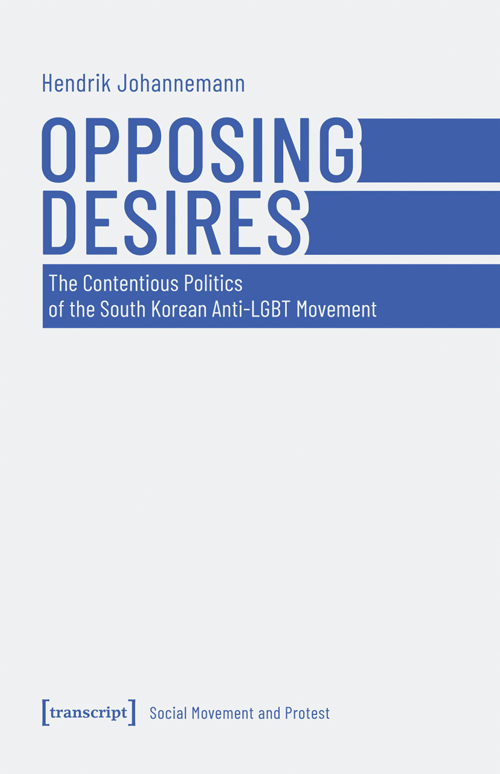
Author: Hendrik Johannemann
Publisher: Transcript, 2025
Link to online store *
In times of right-wing populists gaining traction worldwide, conservative Christians engage in both continuous and dynamic action forms to gain societal and political hegemony. Hendrik Johannemann delves deeply into the contentious practices of the South Korean anti-LGBT movement, investigating its roots, framing strategies, transnational ties, and political endeavors. Sociologists, political scientists and practitioners alike will discover how this dynamic continuity runs like a thread through anti-LGBT politics in Korea, displaying not just another far-right success story, but unveiling also contradictions and internal conflicts.
Contents
- Introduction
- A strategic ‘war of position’ for hegemony: ‘Dynamic continuity’ and right-wing Gramscianism in Korea
- The analytical framework: mechanisms and contentious politics through a Gramscian lens
- Methods and methodology
- Development of the Korean anti-LGBT movement and media coverage critical of LGBT issues
- How to create contention: topics, targets, and action forms of anti-LGBT protest
- Framing strategies of the anti-LGBT movement
- The Opposing desires within Korean anti-LGBT activism
- Discussion: does the anti-LGBT movement mobilize effectively in its ‘cultural war’?
- Anti-LGBT norm brokers within the Protestant Right: social movement organizations, movement leaders, and their political endeavors
- Communicating anti-LGBT content: the roles of education and media
- Opposing desires revisited: opportunities and threats in pro and anti-LGBT activism within South Korean Protestantism
- Conclusion: bringing dynamics back into the analysis of conservative movements
- Bibliography
Source: publisher’s website