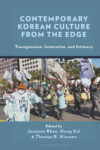
This book is for any reader seeking to understand and engage with contemporary South Korean culture. Inspired by the term “edge”, which in Korean refers to attitudes and ideas that are new, gripping and transgressive, each chapter provides a new perspective on today’s Korea. Drawing from a range perspectives, Contemporary Korean Culture from the Edge: Transgression, Innovation, … [Read More]

Booklist: Literature
Death Without End: Korea and the Thanatographics of War

The Korean War was never formally declared, and no peace treaty ending the war was ever signed. The 1953 armistice did not stop the war but marked its extension and expansion into a warlike state of emergency. How did the new reality of life under armistice shape visions of the possible in North and South … [Read More]
Lyrical Translation: The Creation of Modern Poetry in Colonial Korea

Lyrical Translation is a literary history of modern Korean poetry’s origins and its development through translation. As the use of Korean became increasingly restricted during the Japanese occupation, translation was not a choice but a necessity for higher education and intellectual labor. Yet it also had an expansive, creative function: Korean poets wielded it as an … [Read More]
The History of Korean Popular Culture

This book is a seminal example of historical writing on Korean popular culture, based on solid data that integrates historical facts and cultural symbols within a broader analytical framework, offering insightful critical interpretation. It explores the history of Korean popular culture that has grown and developed on the foundation of modern history. The history of … [Read More]
Every Day I Read: 53 Ways to Get Closer to Books

From the internationally bestselling author of Welcome to the Hyunam-dong Bookshop comes a warm and reflective collection of essays about reading, language and life. Why do we read? What is it that we hope to take away from the intimate, personal experience of reading for pleasure? Rarely do we ask these profound, expansive questions of ourselves and … [Read More]
Yun Dong-ju: A Critical Biography

Historian and novelist Song WooHye chronicles the life of Yun Dong-ju (1917-1945), one of the most beloved and important poets in the modern Korean literary canon, widely considered Korea’s “National Poet”. Beginning with the history of the North Gando region (now Yanbian, China), where Yun was born, and ending with facts behind the publication of … [Read More]
Triangle Republics: Cross-Border Literary Transits Between the Cold War Koreas and Japan

In Korea, the end of the Second World War in 1945 brought both liberation from Japanese colonial rule and the division of the nation by the triumphant Allies. The peninsula was not only decoupled from its former colonial metropole but also carved up into two halves that were subsequently incorporated into the rival blocs of … [Read More]
Against the Chains of Utility: Sacrifice and Literature in 1970s and 1980s South Korea
The 1970s and 1980s were pivotal decades in South Korea, marked by rapid industrialization and urbanization. The language of sacrifice was constantly employed by the developmental state to justify its exploitation of workers and violation of countless civil rights as necessary for the nation’s economic growth and security. As a counter to this prevailing rhetoric, … [Read More]
The Sensational Proletarian: Leftist Cultures in Colonial Korea
Starving ghosts, anguished farmers, and grieving mothers. Floating heads, gaunt bodies, and masses of bodily fluids. Such are the visceral sensations, exaggerated affects, and suffering subjects that characterized leftist Korean cultural production in the 1920s and 1930s. In popular fiction, print cartoons, reportage, and other emergent forms of mass culture, scenes detailing the spectacular bodily … [Read More]
Korean Culture in the Global Age: K-Pop, K-Drama, K-Film, and K-Literature
Since the late 1990s, South Korean cultural products such as pop music, TV drama, and film have shaped the country’s image around the world. This book explores these three internationally best-known media of the Korean Wave global phenomenon, along with a less commonly featured aspect, K-literature. Iconic images of South Korea today include stylish music … [Read More]
Comics Art in Korea

In Comics Art in Korea, comics scholar John A. Lent embarks on a comprehensive exploration of the vibrant world of Korean comics, cartoons, comic strips, graphic novels, webcomics, and animation. This meticulously researched work delves deep into the intricate history, cultural significance, and artistic innovations that have shaped the comics landscape in both North and South … [Read More]
Worm-Time: Memories of Division in South Korean Aesthetics
Worm-Time challenges conventional narratives of the Cold War and its end, presenting an alternative cultural history based on evolving South Korean aesthetics about enduring national division. From novels of dissent during the authoritarian era to films and webtoons in the new millennium, We Jung Yi’s transmedia analyses unearth people’s experiences of “wormification”—traumatic survival, deferred justice, and warped … [Read More]
The Korean War Novel: Rewriting History from the Civil War to the Post-Cold War

Uncovers how historical novels rewrite the history of the Korean War Revisits the Korean War and the Korean War novels from a post-Cold War perspective of decolonisation Examines the dual role of East Asians as both victims and agents of the Cold War Recovers previously hidden dimensions of the conflict, including its framing as a … [Read More]
Mediating Gender in Post-Authoritarian South Korea
Mediating Gender in Post-Authoritarian South Korea focuses on the relationship between media representation and gender politics in South Korea. Its chapters feature notable voices of South Korea’s burgeoning sphere of gender critique enabled by social media, doing what no other academic volume has yet accomplished in the sphere of Anglophone studies on this topic. Seeking … [Read More]
The Dynamic Essence of Transmedia Storytelling: A Graphical Approach to the Journey to the West in Korea

The Dynamic Essence of Transmedia Storytelling challenges many established truths about popular literary classics by presenting an analysis of sixty Korean variations of The Journey to the West, a set which includes novels and poems, as well as films, comics, paintings, and dance performances dating from the 14th century until today. In contrast to the typical assumption … [Read More]
Impossible Speech: The Politics of Representation in Contemporary Korean Literature and Film

In what ways can or should art engage with its social context? Authors, readers, and critics have been preoccupied with this question since the dawn of modern literature in Korea. Advocates of social engagement have typically focused on realist texts, seeing such works as best suited to represent injustices and inequalities by describing them as … [Read More]