
For the past 3 years LKL has concocted a quiz of the year as a way of gathering together some of the news stories which have most caught our eye. This year, as I came to draw up the list in mid December I found it hard to think of anything amusing or diverting: most … [Read More]
Heritage Category: Cultural Tourism (page 6)
Before Babylon There Was…Pyongyang
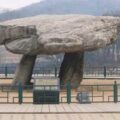
Two thirds of the world’s dolmens are contained in the Korean peninsula. The Gochang, Hwaun, and Ganghwa dolmen sites can be found on the UNESCO World Heritage list. This probably begs the question, from me at least – what are dolmens exactly? They are stone monuments, generally consisting of two supporting stones and a cover stone … [Read More]
Meeting more Mr Kims: CoolstuffKorea on Cheju Island

Jennifer Barclay, LKL contributor and author of Meeting Mr Kim, has landed herself a dream assignment for the Korean Tourism Organisation: tweet about Korea, travel round Korea, write about Korea on Facebook, generally do things we’d all like to be doing, and maybe earn a little bit of pocket money as well. Nice one, Jen. … [Read More]
Jongmyo skyscraper may irk UNESCO

Seoul’s skyscraper may irk UNESCO, according to the Korea Times. A new 36-storey building could mean Jongmyo Shrine loses world heritage status: http://bit.ly/oiEuJ # [Read More]
Korean heritage at UNESCO

Korea is rightly proud of some of its heritage, much of which has been given official recognition by UNESCO. For those of you who like lists, here are the various items of Korea’s tangible and intangible heritage which have been so listed. Also included below are links to any LKL articles on these treasures. (1) … [Read More]
The Shining Fortress part 2: its remarkable story.

by Matthew Jackson The story which surrounds the building of the Hwaseong fortress is an extraordinary one. The fortress was originally built as part of the new Suwon city, a project initiated by King Chongjo. King Chongjo (or King Jeongjo, depending on your preferred romanization) had been greatly devoted to his father, Sado Seja, who … [Read More]
The LKL Korea Trip 2009 pt 6: Haeinsa

Monday 20 July 2009 The trip to Haeinsa is via Daegu. A quick tube journey to the inappropriately named Busan Central Bus Terminal – at the northernmost extremity of the Busan public transport system (Nopodong), and then the express bus to East Daegu station takes nearly two hours. Another tube to the Seobu bus terminal … [Read More]
The Shining Fortress part 1: its construction

by Matthew Jackson The official report by the advisors to UNESCO’s World Heritage Committee concluded that the Suwon Hwaseong Fortress “represents the pinnacle of 18th century military architecture, incorporating the best of that from Europe and from the Far East. As such it has a unique historical importance”. What makes Hwaseong special? Following the editor’s … [Read More]
The LKL Korea Trip 2009 pt 5: Bulguksa and Seokkuram

Sunday 19 July 2009 More World Heritage points today. The Samgyeopsal from last night is still sitting heavily on my stomach and I don’t feel like breakfast. The 9 am KTX from Seoul Station, and the connecting train from East Daegu, went without a hitch, and bang on time. Just before I arrive in Gyeongju … [Read More]
The LKL Korea Trip 2009 pt 2: Suwon and Prince Sado’s tomb

Thursday 16 July Today the plan is to get a few UNESCO world heritage points: the Hwaseong Fortress at Suwon, followed maybe by the nearby folk village. From my base in Insadong, a one-hour tube journey direct from Jonggak station on Line 1 takes me to Suwon, armed with my guide books. A moment of … [Read More]
Living Heritage at the KCC

An Exhibition of Intangible Heritage Properties produced by twenty-five of Korea’s finest Master Craftsmen and Women. 29 June ~ 21 July 2009 The Korean Cultural Centre proudly announces the upcoming exhibition of Living Heritage at the Korean Cultural Centre UK. The title Living Heritage is one given by UNESCO that refers to the most fragile … [Read More]
Making History Part 3 – Uigwe

By Matthew Jackson It occasioned the UNESCO inspectors no little surprise when they came to inspect the restoration of the Hwaseong fortress, in order to verify its resemblance to the original complex. They were shown an exhaustive eight volume report documenting its original construction, prepared at the time it was built around two hundred years … [Read More]
Making History Part 2 – Diaries of the Royal Secretariat

By Matthew Jackson After the invasion of Kanghwa Island in 1886, a French navy officer remarked that he was surprised to find that even the poorest Koreans he met lived in companionship with books. There was a strong culture of writing as well as reading in Korea, particularly following the adoption of Hangul. It was … [Read More]
Making History: Part 1 – The Sillok
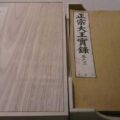
In the first of three articles, Matthew Jackson looks at the ways that the official history of the Joseon dynasty was written. At most Korean events I have been to, there has generally been a Korean studiously taking photographs throughout, for reasons that were not immediately obvious to me. I once asked, and was told … [Read More]
An introduction to Hangeul – part 2

By Matthew Jackson. Despite the technical merits of Hangeul, it is hard to get beyond the fact that it is, after all, just a phonetic alphabet, albeit a unique one. As with other treasures of Korea, the real value of Hangeul lies in the story behind it. Its creator, King Sejong the Great, worked very … [Read More]
The World’s Oldest Woodblock Print
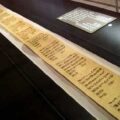
Matthew Jackson explores another of Korea’s contributions to world culture The first printing presses were made out of wood. The process of woodblock printing emerged in the East during the 8th century. For some time, the earliest woodblock print was believed to be a copy of the Diamond Sutra, discovered at Dunhuang in China by … [Read More]