
Sancheong, Gyeongsangnam-do, Thursday 29 March 2012. Today is the day we start the ascent of Jirisan, but first there’s a couple of local sites of interest that I need to visit. First, the two Unified Silla dynasty stone pagodas, which are now the only remnants of Dansoksa, a temple built in the middle of the eighth … [Read More]
Heritage Category: Cultural Tourism (page 4)
Kkokdu – a cortege’s colourful attendants
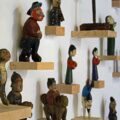
Accompanying the KCC’s exhibition of Korean funerary figures, Charlotte Horlyck gave a helpful lecture providing some historical background and context to these colourful wooden characters. The talk was particularly valuable as the introduction provided by the director of the Kkokdu Museum a few weeks previously had lacked much content. While generally admitting that not much … [Read More]
2012 Travel Diary #14: Mugwort pancakes and bronze age dolmen
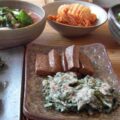
Tongyeong and Sancheong, Gyeongsangnam-do, Wednesday 28 March 2012. It’s time to leave Tongyeong, and head off to Sancheong, where I have happily spent much of my time in Korea in recent years. We set off along the main Tongyeong to Seoul expressway, which passes alongside the Gyeonghogang river and thus cuts through the heart of Sancheong … [Read More]
2012 Travel Diary 7: Yi Sun-shin — military genius, hero, poet

Tongyeong, Gyeongsangnam-do, Monday 26 March 2012. The brief ferry ride from Tongyeong to Hansando traverses the sheltered sound where Admiral Yi Sun-shin won a famous victory over the Japanese navy on 14 August 1592. On the day I crossed, it was difficult to imagine the tumult of a battle in which 47 Japanese ships were … [Read More]
Taekkyeon gets UNESCO listing
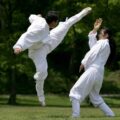
Taekkyeon beats Chinese Shaolin Kung Fu to UNESCO intangible cultural heritage listing. http://t.co/KkyDZ6tC. Tightrope walking (jultagi) and ramie weaving (mosi) also listed. [Read More]
What is the Donguibogam and what is in it?

Koreans usually have two choices when they have to visit a clinic: one is a medical clinic, employing western medicine for treatment; and the other is a traditional clinic, employing traditional medicine. There are many obvious differences between the two types, mainly concerning methods of diagnosis and treatment. Most importantly, the traditional medical clinic has … [Read More]
Buddha’s Voice – The Bell of King Seongdeok
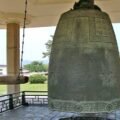
People sometimes take a jaundiced view of Korea’s estimation of the importance of its cultural heritage. In the case of the Sacred Bell of King Seongdeok, however, it was foreigner, Dr. Otto Kummel, a director at the National Museum of Germany, who suggested that the museum’s description of the bell as ‘the best in Korea’, … [Read More]
Donguibogam: Prevention before Treatment

The Donguibogam is a medical encyclopedia written by Heo Jun (1539-1615), a royal physician and renowned doctor, in the 16th to 17th century. People often say there has been no traditional Korean medicine (TKM) doctor greater than him since. The encyclopedia was registered at UNESCO as part of the ‘Memory of the World’ register in … [Read More]
Haeinsa celebrates 1,000 years of the Tripitaka Koreana

Haeinsa Temple is hosting its first contemporary art exhibition, involving 34 artists from 10 countries, to commemorate the millennial anniversary of the Tripitaka Koreana, which UNESCO has designated one of the “most important and most complete corpus of Buddhist doctrinal texts in the world.” The exhibition’s title — 通 | 통 | Tong — uses … [Read More]
Historical Korean portraiture on show at two Seoul museums

Interesting feature on two exhibitions of Korean portraiture, including a 1617 portrait of “the first Korean in Europe” http://t.co/lVN629Bx, also http://bit.ly/r9fy9g [Read More]
The many attractions of Sancheong County at the Thames Festival and beyond

This year, as for the past four years, Korea will be heavily represented at the Thames Festival. But this year, for the first time, the Korean village will host some stalls from parts of the country outside of Seoul. The regions all have particular unique characteristics to attract people to visit. Jeju-do, still in the … [Read More]
Is there a doctor in the peninsula? – Heo Jun and the Donguibogam medical textbook

Known as one of the greatest books in the history of Eastern medicine, the Donguibogam was composed by Heo Jun, a court physician in the early 17th century, and is today included as part of UNESCO’s World Heritage list. Despite the huge advances in medicine since that time, it is still referred to by doctors … [Read More]
The Changdeokgung’s Secret Garden – A Part of Nature

There was a series by Monty Don a while ago called Around the World in 80 Gardens. The East Asian segment was naturally devoted to Chinese and Japanese gardens. It is pity Korea was missed out, as the gardens of Korea have a distinct and unusual ethos. Koreans feel that nature has been good to them. … [Read More]
Rediscovering the Lost Kingdom of Baekje

History, according to the saying, is written by the victors. The unification of the three kingdoms of Korea under Silla in 668 AD solved the problem of constant war in the peninsula, but created a significant problem for modern day historians, in that very little of the culture and heritage of Baekje (BC 18~AD 660) … [Read More]
The Changdeokgung’s Injeong Hall – Welcome to the Rock Show!

When I visited Changdeok Palace in Seoul, my attention was naturally focussed mainly on the buildings themselves. One of these buildings is the Injeong Hall (Injeongjeon), which was used for important celebrations and ceremonies. The unassuming forecourt one walks through to enter the hall was been designed with great care, but for the unsuspecting observer … [Read More]
China claims Arirang as its own

Why 'Arirang' isn't listed among Korea's cultural assets – and why it soon will be thanks to the Chinese. Interesting article in the Chosun Ilbo http://bit.ly/jFz2MM with a counterblast by Roboseyo (Nobody owns Arirang) # [Read More]