
Sancheong County, Gyeongsangnam-do, Sunday 1 April 2012. Mun Ik jeom (문익점, 文益漸) was a rare individual who was honoured by the kings of two royal dynasties, first by King U of Goryeo and second by the great Joseon King Sejong. The honour received from Sejong was posthumous, and was in recognition of what started, in … [Read More]
Heritage Category: Cultural Tourism (page 3)
Mt Chilbo is the fourth DPRK biosphere reserve
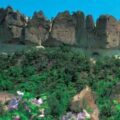
At the 26th meeting of the UNESCO International Coordinating Council of the Man and Biosphere Program on 10-13 June, thirteen new sites were added to the World Network of Biosphere Reserves. Among them was Mt Chilbo (칠보산), in Myongchon County, North Hamgyong Province. This 340 hectare site in the north-east of the country is a … [Read More]
Namhansanseong joins Suwon fortress on UNESCO World Heritage list
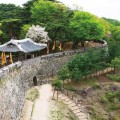
South Korea’s eleventh listing on the UNESCO World Heritage list is Namhansanseong. It was added to the list at the end of a 10 day meeting of UNESCO’s World Heritage Committee at Doha on 25 June. According to the summary on the UNESCO website: Namhansanseong was designed as an emergency capital for the Joson dynasty … [Read More]
2014 Travel Diary day 7: the concubine, the eunuchs and the gisaeng
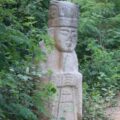
Another literary lunch and a visit to the tombs of the trusted palace servants. Eulji-ro, Seoul, Thursday 12 June, 9am. I decide to take it easy today, and have a bit of a lie in. I pop outside to the subway station to pick up a coffee and pastry, and then pay a quick visit to … [Read More]
Looking back at 2013: Culture, tourism and branding stories

In the second of five articles looking back over 2013, we recall some of the tourism and heritage stories that made the news. And we also take a look at some of the stories about Korean food, given the increasing popularity of Korean cuisine of Korea. Arts and Heritage Sungnyemun, the great Namdaemun gate, reopened … [Read More]
Kimjang gets a UNESCO listing

Kimjang, the making and sharing of kimchi in the Republic of Korea, was admitted to the UNESCO register of intangible cultural heritage on 5 December 2013. Note that, like the listing of Arirang, this pan-Korean cultural item has been registered by South Korea. Links: Kimjang page at UNESCO Update 13 December: The South China Morning … [Read More]
2013 Travel Diary #34: The Gods of Land and Grain

Deoksugung, Jung-gu, Seoul, Sunday 15 September, 10:45am. By the time I reach the Deoksu Palace at 10:45am I’m already perspiring. I was wearing sunblock, but should have been wearing a sunhat and some shorts. It was going to be a hot day. This morning’s activity is a guided walk following the Sajik Daeje procession from … [Read More]
2013 Travel Diary #20: The temple of a thousand pagodas

Unjusa, Hwasun-gun, Wednesday 11 September, 3:45am. My phone wakes me up at 3:45 am, and I struggle into my trousers, splash some water onto my face, and make my way to the main shrine. I’m the first one there, and soon Kyung-sook arrives, then Wonsan himself. Later, a couple of the temple women join us. … [Read More]
2013 Travel Diary #19: Mosquitoes at Unjusa

Suncheon-si, Tuesday 10 September, 12:30pm We head back to the hotel for a quick shower and change of clothes, before lunch at a nearby eatery – a deliciously delicate clam noodle soup. The soup is brought in a large bowl full of a light broth. At the bottom of the bowl is a mound of … [Read More]
2013 Travel Diary #10: Breakfast at Beopgyesa

Beopgyesa Temple, Jirisan, Sancheong-gun, Sunday 8 September, 8:30am. Breakfast is again in the kitchen, and as usual (because I’m a foreigner unused to sitting on the floor) I’m allowed to sit with my back to the wall. I’m encouraged to stretch my legs out straight, and pummel my thighs and massage my knees, which are already … [Read More]
Photos of King Taejo’s tomb in Kaesong
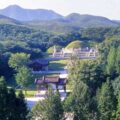
The Rodong Sinmun has some nice pictures and a brief article on the tomb of Wang Kon, founder of the Koryo dynasty as King Taejo. The tomb is one of the Historic Monuments and Sites of Kaesong recently entered into the UNESCO list of world heritage. Update: links to the full set of Rodong Sinmun’s … [Read More]
Looking back at 2012: Culture, tourism and branding stories

The first of four articles in which we look back at some of the stories which caught our attention during the course of 2012. In this first article we look at cultural promotion, heritage, tourism and related topics. Heritage and Cultural Promotion Korea’s national folk song, Arirang, was listed as world Intangible Cultural Heritage by … [Read More]
2012 Travel Diary #22: The Burial Grounds of the Royal Joseon Placentas, and why underfloor heating is not always good for you

Sancheong Town, Gyeongsangnam-do, Sunday 1 April 2012. Yes, it’s 1 April, and no, this article is not an April Fool’s joke. Sunday in Sancheong town, and the National Assembly election campaign is in full swing. All along the main street, the ppongtchak trucks are parked nose to tail, probably about eight of them. All of … [Read More]
2012 Travel Diary #21: Seong Cheol’s birthday, Park Chan-soo’s museum and Gaya period tombs

Sancheong County, Gyeongsangnam-do, Saturday 31 March 2012. The impact of the love shots is still fogging my brain when Mr Yoon arrives at 9:30 in the morning. Today, he is accompanied by his wife, who is to join us for the morning. It is, after all, a Saturday, so Mr Yoon is working overtime on … [Read More]
“Arirang” looks to be safeguarded at UNESCO for (South) Korea

After last year’s scare that China was laying claim to Arirang, Korea’s most famous folk-song, it looks like UNESCO will soon be listing it as part of Korea’s intangible heritage (source: Korea Times / Cultural Heritage Administration). But the song, which is loved throughout the peninsula and in Korean communities elsewhere, is to be registered … [Read More]
2012 Travel Diary #19: Beopgyesa Temple and those Japanese feng-shui stakes

Beopgyesa Temple (법게사) is the highest in Sancheong County and at least the third-highest in Korea. The good people of Sancheong believe that Beopgyesa is the highest temple in South Korea, a claim which is supported by Beopgyesa’s entry on the Cultural Heritage Administration website, where the following text is to be found: “It is … [Read More]