
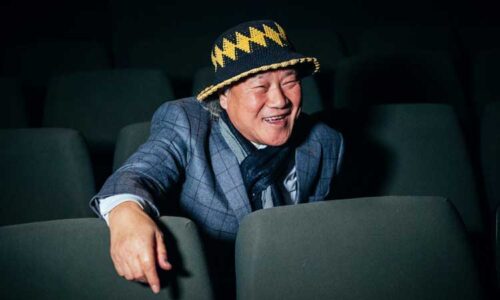
Lee Jang-ho discusses state censorship from the colonial era through the 1990s, the enforced transformation of Declaration of Idiot, and his turn to sexuality as a tool of anti-establishment expression in the 1980s. He reflects on Shin Sang-ok’s abduction, North Korean filmmaking, and argues that contemporary Korea still harshly penalises social critique. [Read More]
Post Series: HC interviews
July Jung interview: loneliness, damage and connection in “A Girl at My Door”

July Jung discusses the obstacles facing female filmmakers in Korea, the precarious path to making A Girl at My Door, and her focus on loneliness, abuse, sexuality and prejudice. She explains the rural setting as a social microcosm, her collaboration with Lee Chang-dong, and her belief that intimate, local stories can achieve universal resonance. [Read More]
Kim Seong-hun interview – from relationship comedy to A Hard Day: “after ten years, the mountain changes”

Director Kim Seong-hun discusses his path from assistant director to filmmaker, the genre shift leading to A Hard Day, and how time, failure, and global cinema shaped his approach. He reflects on narrative structure, character-driven storytelling, restrained depiction of sex and violence, and challenging perceptions of Korean cinema. [Read More]
Clarice Eun-hae Ok interview: bringing a film to its completion with music

Music director Clarice Eun-hae Ok discusses her path into film scoring, close collaboration with director Oh In-chun, and the creation of Mourning Grave’s music. She explains how motifs, instrumentation, and the balance of acoustic and electronic sounds shape horror, romance, pacing, and emotional memory within a multi-genre narrative. [Read More]
Seo Young-ju interview: Moebius and the power of silent performance
Actor Seo Young-ju reflects on growing from child roles into cinema-led work, favouring film over television for deeper character exploration. He discusses Juvenile Offender as a turning point, working with Kim Ki-duk on the dialogue-free Moebius, his attraction to challenging narratives, and ambitions for international acting opportunities. [Read More]
Choi Seung-ho interview: Norigae – where justice fails

Director Choi Seung-ho discusses Norigae’s origins in real-world abuse scandals, its critique of sexual coercion and lenient sentencing, and the choice to portray injustice through a sombre tone. He addresses funding constraints, casting challenges, and how lighting, music, and explicit scenes serve the film’s social and moral intent. [Read More]
Lee Joon-ik interview: Hope, humanity and the weight of filmmaking

Director Lee Joon-ik explains why Hope/소원 drew him back to filmmaking, outlining its aims to address crimes against children, strengthen legal punishment, and highlight victim support. He discusses reshaping the script, working sensitively with child actor Lee Re, and portraying trauma through shared family and community perspectives. [Read More]
Kang Woo-suk interview: showing the reality of Korean cinema

Director Kang Woo-suk reflects on Korean cinema’s growing freedom to address once-taboo subjects, his recurring focus on social “enemies,” and the primacy of story over character. He discusses adapting webtoons, balancing action and drama in Fists of Legend, and producing films he believes need to exist. [Read More]
Kim Sung-su interview: “Flu” – when disaster feels real

Director Kim Sung-su explains why Flu uses a disease outbreak as a realistic disaster scenario, grounded in recent epidemics and historical trauma. He discusses national self-interest during crises, depictions of Korean and US responses, the symbolic role of leadership, and prioritising entertainment while embedding social themes. [Read More]
Kim Jee-woon interview: “perhaps I’m a workaholic”

Kim Jee-woon explains his continued return to short films as a space for experimentation, genre exploration, and constant creative work. He discusses making a romantic comedy short, the challenges of screening shorts in Korea, and contrasts between Korean and Hollywood production systems shaped by his experience on The Last Stand. [Read More]


Jules Suo interview: “some real heartfelt questions”

Director Jules Suo discusses developing Dosi from her short 528 New York, drawing on immigrant experience, multicultural New York life, and humanist cinema influences, while navigating independent production, casting across Korea and the US, and funding a first feature through Kickstarter. [Read More]
Min Byung-woo interview: cinema on a smartphone

Director Min Byung-woo discusses creating Cats and Dogs, Korea’s first feature-length smartphone film, blending romance with animal metaphors, using animation and webtoons, and the possibilities iPhone filmmaking offers independent cinema amid industry and budget constraints. [Read More]
Kim Joo-il interview: a defector reflects on life in the North and on cinematic realities

Kim Joo-il reflects on his defection from North Korea and critiques South Korean cinema’s “distorted” portrayals of the North. He details the absence of concepts like “human rights” under state brainwashing, advocates for refugee status for defectors in China, and describes North Korean film as a tool for regime-led propaganda and psychological indoctrination. [Read More]
Kim In-geun interview: creative life abroad — art, film, and living in London

London-based Korean artist Kim In-geun discusses his move from sculpture to filmmaking, the creation of his debut short One Fine Day, influences from Hong Sang-soo, collaboration across art forms, and themes of creativity, self-consciousness and everyday absurdity within contemporary artistic life. [Read More]