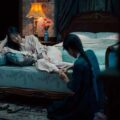
Park Chan-wook’s ‘The Handmaiden’ is a masterful film contrasting dark with light and (male) lecherous ugliness with (female) emotional beauty in a multilayered tale of immaculate depth and indeed meaning. Ultimately, ‘The Handmaiden’ sits atop the very best of Korean cinema, both in terms of narrative content and visual sumptuousness. [Read More]
LKL articles by Hangul Celluloid (page 6)
Amor (그리울 련, 2015) review: a heartfelt revival of the terminal illness drama

There was a time in Korean cinema when terminal illness was a regular and recurring theme. With its gentle depth and understated, yet wholly realistic, heart-wrenching characterisations, ‘Amor’ reminds us of why the best of such films became thought of as classics at the same time maintaining an originality to its ultimately thought provoking narrative. [Read More]
Train to Busan (부산행, 2016) review: zombies, corporate self-interest and a relentless ride

A father and daughter’s train journey becomes a fight for survival when a zombie outbreak erupts onboard. Combining ferocious, fast-moving undead with humour, emotional stakes and critiques of corporate selfishness, Train to Busan delivers white-knuckle intensity, crowd-pleasing thrills and a rare balance of spectacle and human drama. Miss it at your peril. [Read More]
Missing You (널 기다리며, 2016) review: reimagining the female revenge thriller

While many of the narrative elements of ‘Missing You’ will be very familiar to fans of Korean cinema, its story of one young woman’s need for revenge is engaging enough to make the film worth watching, its strongest point being its decisive and unexpected resolution [Read More]
Mulberry (뽕, 1986) review: erotic commerce and female agency in Lee Doo-yong’s classic

A simple story concept that uses understated humour to draw audiences into a sumptuously erotic tale that not so long before would have been virtually taboo, ‘Mulberry’ also gives Korean cinema fans the opportunity to watch Lee Mi-sook as a young actress and realise that she was every bit as talented all those years ago [Read More]
Hyeon Nam-seop’s Saving My Hubby: female strength, comedy and the New Korean Cinema Wave

Saving My Hubby (2002) follows Geum-sun as she navigates parenthood, marriage, and a frantic night rescuing her husband. Blending madcap comedy with New Korean Cinema trends, the film highlights modern female strength, role reversals, and the rise of light-hearted, relatable stories reflecting young adults’ evolving attitudes toward family and relationships. [Read More]
The World of Us (우리들, 2016) review: cruelty and quiet empathy in childhood

A gently moving story of the tumultuous relationship of two young girls, Yoon Ga-eun’s debut feature – ‘The World of Us’ – is exemplary in every respect. Highlighting both Yoon Ga-eun’s talent as a writer and director, and introducing the superlative natural acting skill of young newcomer Choi Soo-in. [Read More]
The Truth Beneath (비밀은 없다, 2016) review: politics, betrayal and a mother’s descent into reckoning

Initially appearing to be a tale of politics and family, ‘The Truth Beneath’ ultimately shows itself to be a far more personal and poignant story of one woman’s efforts to uncover the truth of what happened to her daughter, and her discovery in the process of the lies and betrayal that permeate her entire life. [Read More]
The Priests (검은사제들, 2015) review: demons, doubt and ritual

While many would consider one exorcism horror movie to be much like another, ‘The Priests’ manages to combine ideas of modern Catholicism with far more traditional Buddhist rituals to bring a noticeable originality to proceedings. An engaging horror drama with utterly exemplary cast performances. [Read More]
Kwon Chil-in’s Singles: modern womanhood and the rise of New Korean Cinema comedy

Paul Quinn introduces Kwon Chil-in’s Singles, positioning it as a defining New Korean Cinema comedy, reflecting shifting attitudes to love, sex and independence. Through its modern female characters, role reversals and humour, the film marks a break from decades of punitive depictions of women and celebrates changing social values in early-2000s Korea. [Read More]
Spirits’ Homecoming (귀향, 2016) review: trauma, memory and the search for closure

Spirits’ Homecoming splits its timeline between the 40s and modern day to shine a light on the ordeal faced by young girls forced into military sexual slavery and the trauma they have suffered. An ultimately uplifting story that speaks of the closure and peace so desperately needed by these blameless women [Read More]
Dirty Romance (더티 로맨스, 2015) review: a multi-layered narrative of poverty, disability and desire

This hard-hitting independent drama focusing on poverty, disability and desire is wholly in keeping with director Lee Sang-woo’s previous work. But ‘Dirty Romance’ also has moments of warmth, of understated humour and even of beauty to add layers and further levels to this already accomplished, thought provoking and important film. [Read More]
Alice in Earnestland (성실한나라의 앨리스, 2015) review: a fractured mind and a failing system

Director Ahn Gook-jin’s debut feature, ‘Alice in Earnestland’, has polarised audiences since its release – you’ll either love it or absolutely hate it – but those who can indulge themselves in Soo-nam’s surreally comic horror story will be rewarded with inventive set pieces bringing thoughts of numerous classic Korean films to mind. [Read More]
Speed (스피드, 2015) review: rebellious youth, broken dreams and first love

While Speed is equally as hard-hitting and Korean specific as director Lee Sang-woo’s earlier work, its story of the difficulties faced in life during the move from youth to adulthood makes it perhaps his most universally accessible film so far. [Read More]
Ryoo Seung-wan interview: Veteran, action cinema and imagined justice

Director Ryoo Seung-wan discusses Veteran as a fantasy of justice where power can be defeated, his shift toward humour, casting Hwang Jung-min and Yoo Ah-in, and plans for sequels. He reflects on audience appeal, realistic action choreography, and his view of action as the core language of cinema. [Read More]
Korea Joa Project – farewells and an interview with KOFICE

The final Korea Joa travelogue reflects on departure day, emotional farewells, and lasting memories. It includes an interview with KOFICE’s Minju Kwon, highlighting the project’s success in promoting Korean culture globally, documenting media coverage, and fostering international collaboration, with hopes for future editions and reunions of Korea Joa participants. [Read More]