
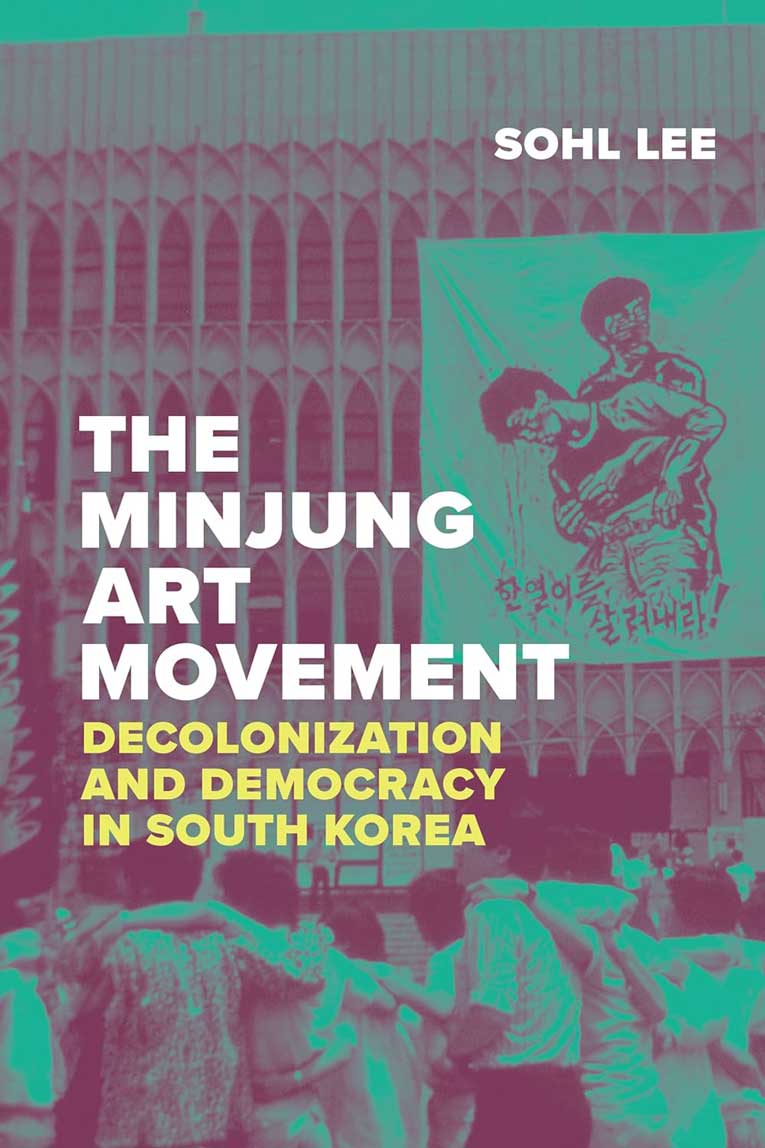
Author: Sohl Lee
Publisher: Duke University Press, 2026
Link to online store *
Emerging as multifaceted cultural activism, the minjung (people’s) art movement defined the aesthetics of the pro-democracy movements in the 1970s and 1980s in South Korea. Tracing minjung art’s history and legacy, Sohl Lee explores how artists associated with the movement mobilized images, print, and performance to build movement publics and reimagine sovereignty. Hundreds of artists questioned the underlying assumptions of liberal democracies and the art-making practices of the global Cold War. Their decolonial critiques of international modernism were inseparable from reimagining democracy and refiguring the relationship between art and democracy. Recuperating overlooked performance-oriented practices and the protest aesthetics that helped usher in parliamentary democracy in 1987, Lee shows that South Korea’s globalization in the 1990s and its rise as cultural soft power in the new millennium cannot be understood apart from a pro-democracy culture that was both political and popular.
Sohl Lee is Associate Professor of Art History at Stony Brook University. She specializes in modern and contemporary art and visual culture of East Asia, and her interdisciplinary research interests include aesthetics of politics, activist art, vernacular modernism, postcolonial theory, historiography, and curatorial practice. She joined Stony Brook as assistant professor of art history, after receiving her PhD in Visual and Cultural Studies from University of Rochester in 2014. Her dissertation, entitled “Images of Reality/Ideals of Democracy: Contemporary Korean Art, 1980s-2000s,” was supported by fellowships from the Social Sciences Research Council, the Korea Foundation, the Susan B. Anthony Institute of Gender and Women Studies at University of Rochester. She teaches undergraduate courses on contemporary East Asian art, including topics such as “Art and the City,” “Modern and Contemporary Korean Art,” and “Social Engagement and Publicness in East Asia.” Her English publications have appeared in Yishu: Journal for Contemporary Chinese Art, Art Journal, and InVisible Culture, and she has curated exhibitions in both the U.S. and South Korea.
Sourced: publisher’s website
Contents
- Decolonizing Modernism during the Cold War: Origins of the Minjung Art Movement
- The Visual Cultural Turn for Decolonial Democracy: Forms and Methods of Reality and Utterance (1979–1984)
- The Decolonial Place of Vernacular Folk Culture in Democracy: Turŏng, Collective Painting, and Sited Knowledge Production (1982–1985)
- To Bring Back to Life: On the Metonym of Democracy (1987)
- Exhibiting Minjung Art Abroad: Tokyo, New York, and Pyongyang in the Twilight of the Cold War (1986–1989)
Conclusion. Revolutionary Presents: Making Histories of Decolonial Democracy
Source: publisher’s website