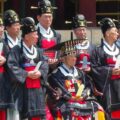
Sunday 2 May 2010. As we file out from the shrine after the first ceremony of the day, we mingle with the butlers who are off to have a quick breather and cigarette before the next ceremony. Already the queues are forming to get into the main shrine for the headline event at 1pm. No … [Read More]
Heritage Category: National Heritage (Cultural Heritage Administration) (page 5)
| Web and contact link(s): |  |
2010 Travel Diary #7: The Jongmyo Rituals, part 1
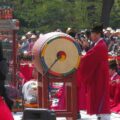
Sunday 2 May 2010. I found it really quite hard to find accessible information online in respect of the Jongmyo rituals. Often, on the UNESCO site, there is documentation which sets out why the submitting country thinks that this particular intangible cultural property is worthy of inscription on the international list. But no such information … [Read More]
The Shining Fortress part 2: its remarkable story.

by Matthew Jackson The story which surrounds the building of the Hwaseong fortress is an extraordinary one. The fortress was originally built as part of the new Suwon city, a project initiated by King Chongjo. King Chongjo (or King Jeongjo, depending on your preferred romanization) had been greatly devoted to his father, Sado Seja, who … [Read More]
The LKL Korea Trip 2009 pt 6: Haeinsa

Monday 20 July 2009 The trip to Haeinsa is via Daegu. A quick tube journey to the inappropriately named Busan Central Bus Terminal – at the northernmost extremity of the Busan public transport system (Nopodong), and then the express bus to East Daegu station takes nearly two hours. Another tube to the Seobu bus terminal … [Read More]
The Shining Fortress part 1: its construction

by Matthew Jackson The official report by the advisors to UNESCO’s World Heritage Committee concluded that the Suwon Hwaseong Fortress “represents the pinnacle of 18th century military architecture, incorporating the best of that from Europe and from the Far East. As such it has a unique historical importance”. What makes Hwaseong special? Following the editor’s … [Read More]
The LKL Korea Trip 2009 pt 5: Bulguksa and Seokkuram

Sunday 19 July 2009 More World Heritage points today. The Samgyeopsal from last night is still sitting heavily on my stomach and I don’t feel like breakfast. The 9 am KTX from Seoul Station, and the connecting train from East Daegu, went without a hitch, and bang on time. Just before I arrive in Gyeongju … [Read More]
The LKL Korea Trip 2009 pt 2: Suwon and Prince Sado’s tomb

Thursday 16 July Today the plan is to get a few UNESCO world heritage points: the Hwaseong Fortress at Suwon, followed maybe by the nearby folk village. From my base in Insadong, a one-hour tube journey direct from Jonggak station on Line 1 takes me to Suwon, armed with my guide books. A moment of … [Read More]
Making History Part 2 – Diaries of the Royal Secretariat

By Matthew Jackson After the invasion of Kanghwa Island in 1886, a French navy officer remarked that he was surprised to find that even the poorest Koreans he met lived in companionship with books. There was a strong culture of writing as well as reading in Korea, particularly following the adoption of Hangul. It was … [Read More]
Making History: Part 1 – The Sillok
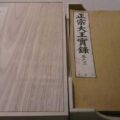
In the first of three articles, Matthew Jackson looks at the ways that the official history of the Joseon dynasty was written. At most Korean events I have been to, there has generally been a Korean studiously taking photographs throughout, for reasons that were not immediately obvious to me. I once asked, and was told … [Read More]
An introduction to Hangeul – part 2

By Matthew Jackson. Despite the technical merits of Hangeul, it is hard to get beyond the fact that it is, after all, just a phonetic alphabet, albeit a unique one. As with other treasures of Korea, the real value of Hangeul lies in the story behind it. Its creator, King Sejong the Great, worked very … [Read More]
The World’s Oldest Woodblock Print
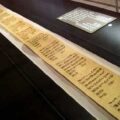
Matthew Jackson explores another of Korea’s contributions to world culture The first printing presses were made out of wood. The process of woodblock printing emerged in the East during the 8th century. For some time, the earliest woodblock print was believed to be a copy of the Diamond Sutra, discovered at Dunhuang in China by … [Read More]
Exhibition visit: Smile of Buddha, the big Korean show in Brussels
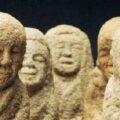
The Smile of Buddha exhibition is the centrepiece of the Made in Korea festival currently showing in Brussels, which also includes photography, ceramics, architecture and video art. As the Korean ambassador to the EU says in his introduction to the exhibition catalogue, not many people in the West know much about Korea, and this exhibition … [Read More]
The Tripitaka Koreana part 2 – the Depository Buildings

Matthew Jackson continues his series of articles on the important treasures from Korea’s past The depository buildings which house the Tripitaka Koreana library are unique in almost every sense. Officially the largest wooden storage complex in the world, they are registered together with the Tripitaka itself as part of the UNESCO World Heritage (http://whc.unesco.org/). The … [Read More]
The Tripitaka Koreana – part 1

Matthew Jackson continues his series of articles on the important treasures from Korea’s past One crowning achievement of Korea’s Buddhist heritage that is not included in the Bozar ‘Smile of Buddha’ exhibition is the Tripitaka Koreana. There is a practical reason for this, as it consists of 81,258 woodblocks, weighs 280 tons in total, and … [Read More]
Crowning glory at the Smile of Buddha

Matthew Jackson reports from the “Smile of Buddha” exhibition in Brussels I had never been to the Bozar Centre (French: “Palais des Beaux-Arts”) in Belgium prior to the current “Smile of Buddha” exhibition of Korean Buddhist art. It is an impressive place (right) and I highly recommend it if you are ever in Brussels. The … [Read More]
The Pensive Bodhisattva comes to Brussels
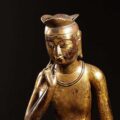
By Matthew Jackson The centrepiece of the Bozar exhibition of Korean Buddhist Art, beginning in Brussels on the 10th of October, will be the Pensive Bodhisattva statue, Korea’s National Treasure No. 83. It is difficult to describe in words why the statue is regarded so highly as a work of Buddhist art, because its qualities … [Read More]