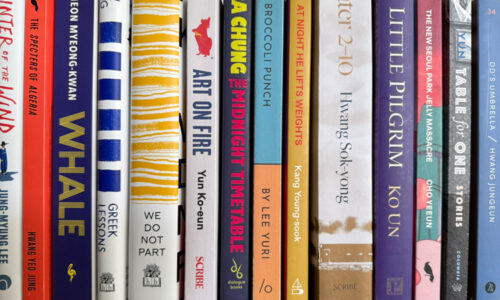
A few months ago I asked for your help with preparing for a talk at a conference organised by the Literature Translation Institute of Korea to celebrate their 30th birthday. The brief for my talk was, to quote from the email I received commissioning it, “how Korean literature is received by English-speaking readers — what aspects they are particularly drawn to, what elements they find compelling, and how they perceive Korean literature overall”.
I had little time to prepare – less than two months – and needed as much input as possible from knowledgeable stakeholders in the translated Korean literature sphere. So I planned some interviews with some experts, and designed a survey to recruit further input from active readers. If I’d had more time, I would have maybe honed the survey’s questions a bit more, and put more effort into pushing the survey out there to attract more responses (for example by asking my contacts to forward it on to interested parties). I deliberately made the majority of questions open-ended: shamelessly, I wanted to harvest the survey for quotes I could use in my talk. What was brilliant about the exercise was the quality of responses. To be honest, if I’d had many more responses I would have been buried in data and wouldn’t have been able to process it all in the time. So, thanks to the 16 people who took the time to respond. Everything you said was of value.
Let’s get down to looking at the results. First some demographic information about those who participated: age, gender, country. Plus an indication of how avid a reader they are, how much Korean literature they read, and whether they follow Korean literature as part of a broader interest in Asian / Korean culture. Here are some charts.
I was pleased that I got responses ranging from those in their twenties to 60+ and from a reasonably wide geographical spread – including a reader in Sri Lanka. One slight disappointment, though entirely understandable when you think about who was likely to have come across the survey and feel motivated to complete it – is that there were no “casual” readers of Korean literature, by which I mean people who read broadly across books from many countries, or just English-speaking countries, and just happen to pick up a Korean title every now and then. To identify and get the views of such a generalist reader, able to compare and contrast across literatures, would have been particularly valuable in addressing LTI Korea’s brief. But to achieve that would probably have required active solicitation of readers and there was no time for that.
Here are some of the things that interested me in the answers.
- Despite my survey clearly being about Korean literature in translation, a couple of respondents talked about Korea-related fiction by authors of Korean heritage written in English. Titles such as Min Jin Lee’s Pachinko and White Chrysanthemum by Mary Lynn Bracht. That, to me, was a valuable insight, indicating that people sometimes don’t register whether a novel is translated or not. What matters is the quality and subject matter of the novel, not what language it was originally written in. And this reflects how Korean novels are displayed in bookshops: Min Jin Lee, Susan Choi and Han Kang are sometimes displayed on a table together, rather than hiving off the translated literature into a separate section of the bookshop. This I believe is a positive and natural development.
- Yes, there are a lot of Han Kang fans out there. Unsurprisingly, she is the author who brought many people to Korean literature. But readers who responded to my survey named Chung Bora, Hwang Sok-yong, Shin Kyung-sook, Hwang Jungeun, Bae Suah and many others among their favourite authors. One person highlighted Cho Se-hui’s The Dwarf as the book that drew them into Korean literature. I loved the variety of people’s enthusiasms, in part because it reinforced my own little preconception that the exercise I had been asked to accomplish was an impossible one: that there are almost as many attitudes to Korean literature as there are readers.
- Continuing with the theme of diversity in people’s views, many readers said they enjoyed healing fiction, while one found it boring – and gave me some fun quotes that I would go on to use liberally in my talk. Similarly, while Shin Kyung-sook’s Please Look After Mother was praised by many, one respondent found it “whiny and dull”. Again, there is no one single view as to “what aspects [readers] are particularly drawn to”.
Reading some of the answers, I wanted nothing more than to get together with the respondent over a cup of coffee (or something stronger) and have a lively discussion to explore their views further. You can delve into the detail of the answers in the excel spreadsheet attached below – all of the responses are there apart from one respondent who didn’t want their answers published. The text of my talk will be posted here soon.
Links
- LKL Korean Literature in Translation survey responses (50Kb Excel download)