From the publisher’s website: “Passionate, cantankerous, and fascinating. Rather like Korea itself.” –Nicholas D. Kristof, New York Times Book Review Korea has endured a “fractured, shattered twentieth century,” and this updated edition brings Bruce Cumings’s leading history of the modern era into the present. The small country, overshadowed in the imperial era, crammed against great powers … [Read More]

Archives: Books (page 90)
Dictée
From the publisher’s website: Dictée is the best-known work of the versatile and important Korean American artist Theresa Hak Kyung Cha. A classic work of autobiography that transcends the self, Dictée is the story of several women: the Korean revolutionary Yu Guan Soon, Joan of Arc, Demeter and Persephone, Cha’s mother Hyung Soon Huo (a … [Read More]
Korea – a religious history

This is an historical survey of all the religious traditions of Korea in relation to the socio-cultural trends of seven different periods of Korean history. The book includes a discussion of the history of the study of religion in Korea, a chronological description of Korean folk religion including shamanism, Buddhism, Confucianism, Roman Catholicism and Protestantism, … [Read More]
Religions of Korea in Practice

From the publisher’s website: Korea has one of the most diverse religious cultures in the world today, with a range and breadth of religious practice virtually unrivaled by any other country. This volume in the Princeton Readings in Religions series is the first anthology in any language, including Korean, to bring together a comprehensive set … [Read More]
Broken Voices: Postcolonial Entanglements and the Preservation of Korea’s Central Folksong Traditions

From the publisher’s website: Broken Voices is the first English-language book on Korea’s rich folksong heritage, and the first major study of the effects of Japanese colonialism on the intangible heritage of its former colony. Folksongs and other music traditions continue to be prominent in South Korea, which today is better known for its technological … [Read More]
Creating Korean Music: Tradition, Innovation and the Discourse of Identity

From the publisher’s website: With the rise of nationalism in the Republic of Korea, music has come to play a central role in the discourse of identity. This volume asks what Koreans consider makes music Korean, and how meaning is ascribed to musical creation. Keith Howard explores specific aspects of creativity that are designed to … [Read More]
Preserving Korean Music: Intangible Cultural Properties as Icons of Identity

As Korea has developed and modernized, music has come to play a central role as a symbol of national identity. Nationalism has been stage managed by scholars, journalists and, from the beginning of the 1960s, by the state, as music genres have been documented, preserved and promoted as ‘Intangible Cultural Properties’. Practitioners have been appointed … [Read More]
Healing Rhythms: The World of South Korea’s East Coast Hereditary Shamans

Still today, in South Korea, many people pay for the services of mudang – the intermediaries of Korea’s syncretic folk religion. The majority of mudang are called to the profession by gods; their clients are individuals or small groups and they focus on the use of spirit-power (‘possession’) for diagnosis and problem-solving. There is, however, … [Read More]
SamulNori: Korean Percussion for a Contemporary World

From the publisher’s website: SamulNori is a percussion quartet which has given rise to a genre, of the same name, that is arguably Korea’s most successful ’traditional’ music of recent times. Today, there are dozens of amateur and professional samulnori groups. There is a canon of samulnori pieces, closely associated with the first founding quartet … [Read More]
P’ungmul: South Korean Drumming and Dance
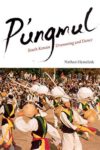
From the publisher’s website: Composed of a core set of two drums and two gongs, p’ungmul is a South Korean tradition of rural folk percussion. Steeped in music, dance, theater, and pageantry, but centrally focused on rhythm, such ensembles have been an integral part of village life in South Korea for centuries, serving as a musical accompaniment … [Read More]
Aesthetic Constructions of Korean Nationalism: Spectacle, Politics and History

While most studies on Korean nationalism centre on textual analysis, Aesthetic Constructions of Korean Nationalism offers a different approach. It looks at expositions, museums and the urban built environment at particular moments in both colonial and postcolonial eras and analyses their discursive relations in the construction of Korean nationalism. By linking concepts of visual spectacle, urban space … [Read More]
Consuming Korean Tradition in Early and Late Modernity: Commodification, Tourism, and Performance
From the publisher’s website: Contributors to this volume explore the irony of modern things made in the image of a traditional “us.” They describe the multifaceted ways “tradition” is produced and consumed within the frame of contemporary Korean life and how these processes are enabled by different apparatuses of modernity that Koreans first encountered in … [Read More]
Songs of Seoul: An Ethnography of Voice and Voicing in Christian South Korea
From the publisher’s website: Songs of Seoul is an ethnographic study of voice in South Korea, where the performance of Western opera, art songs, and choral music is an overwhelmingly Evangelical Christian enterprise. Drawing on fieldwork in churches, concert halls, and schools of music, Harkness argues that the European-style classical voice has become a specifically … [Read More]
Currents and Countercurrents: Korean Influences on the East Asian Buddhist Traditions
From the publisher’s website: Soon after the inception of Buddhism in the sixth or fifth century B.C.E., the Buddha ordered his small band of monks to wander forth for the welfare and weal of the many, a command that initiated one of the greatest missionary movements in world religious history. But this account of a … [Read More]
Power of the Buddhas: The Politics of Buddhism During the Koryo Dynasty

From the publisher’s website: Buddhism in medieval Korea is characterized as “State Protection Buddhism,” a religion whose primary purpose was to rally support (supernatural and popular) for and legitimate the state. In this view, the state used Buddhism to engender compliance with its goals. A closer look, however, reveals that Buddhism was a canvas on … [Read More]
Shamans, Housewives and Other Restless Spirits: Women in Korean Ritual Life

“I describe in these pages the system of belief and practice I found among women and shamans in and around Enduring Pine Village, Republic of Korea” (author) “This exceptionally well-written book is good reading, not only for specialists but also for beginning students interested in women, Korean culture, and shamanism.” –Journal of Asian Studies “Kendall … [Read More]