Seeing that I invested a bit of time in pulling together some discussion material for the culture panel at the Korea Symposium on 29 September I thought I’d share some of the slides together with the gist of what I was trying to say.
I was trying to trace, as objectively as possible, what one might describe as the rise of elements of Hallyu in the UK over the last 20 to 25 years – the period over which I have been observing (and consuming) such things. In preparation for the panel I pulled together data from LKL’s event archives and LKL’s Korea Book DataBase to try to identify trends, and supplemented the data with subjective observations, in four broad cultural areas:
- K-pop and other live music performance
- Korean fiction in translation
- Visual arts
- Film and TV dramas
Outside of these areas LKL has no data, though it is possible to observe that in the last few years Korean popular culture has been spreading in other respects:
- K-beauty stores can be found popping up in shopping centres in major cities
- Korean restaurants and grocery stores are also gradually spreading to new cities
- In London and maybe elsewhere, the food offering is diversifying from the traditional mainstream Korean restaurant to street food and market stalls on the one hand and higher end cuisine on the other.
- Kimchi can be found in some mainstream supermarkets, and artisan kimchi-makers can be found selling their wares online and in farmers markets
- Makgeolli is now brewed in the UK, and at least one specialist sool (traditional Korean alcohol) supplier can be found in London
- The number of K-pop-related fan meetups that can be found on Eventbrite is getting too large to track, and there are no doubt many such events that are advertised on other sites and social networks.
Sometimes it’s difficult to see the wood for the trees, but if I were to try to summarise the trends over the past 20-25 years, it is that in respect of the middle to highbrow space not much has changed; but in the aspects of culture that are more commercial and which appeal to a younger demographic, that is where the growth has been seen. Put simply, the entertainment companies and other content providers are moving to where money can be made.
Live music
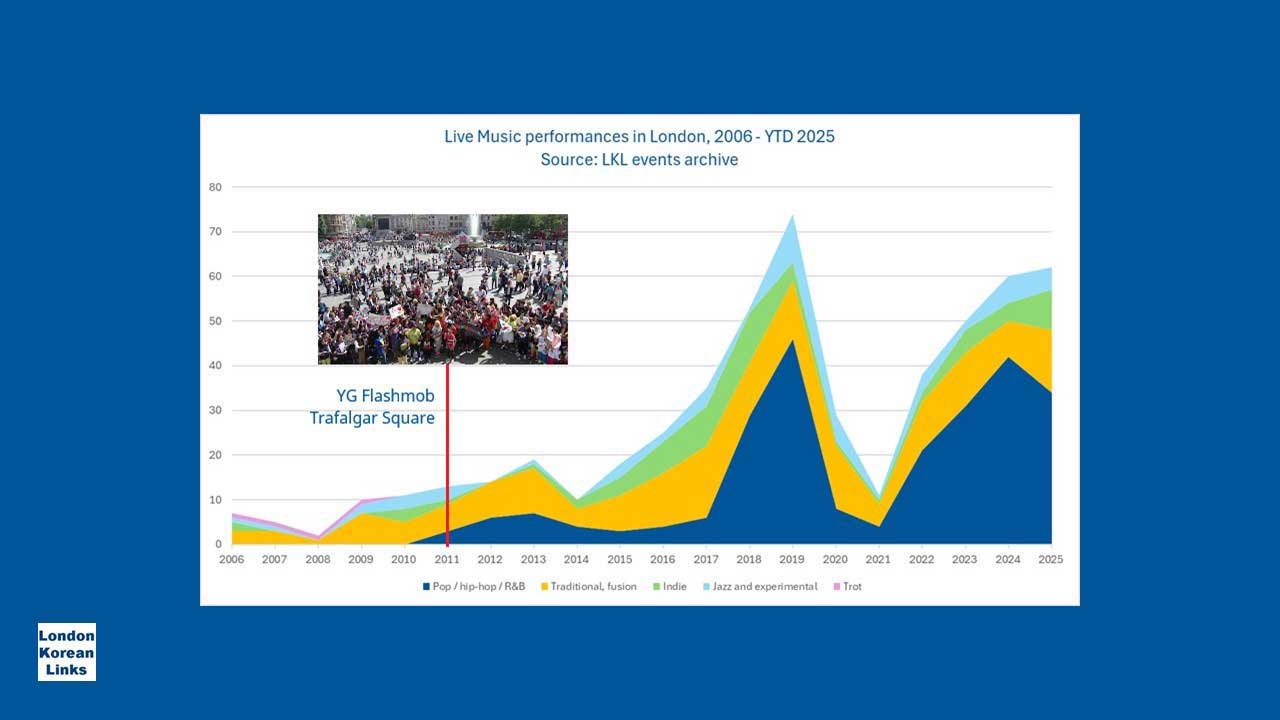
The graph shows the number of live music performances in the LKL event archive by genre over the last 20 years. The dark blue area represents genres such as pop, hip-hop and R&B, while the other colours represent traditional Korean music and contemporary groups that use traditional instruments (yellow); indie bands (green) and jazz and experimental music (particularly electronic) (light blue). What is noticeable is that while the latter genres have seen a modest growth since the start of our records in 2006 – some of that growth being attributable to the K-music Festival which had its origins in 2012 – the more popular genres of pop / hip-hop / R&B have grown from nothing in 2010 to be the dominant genre in terms of number of gigs.
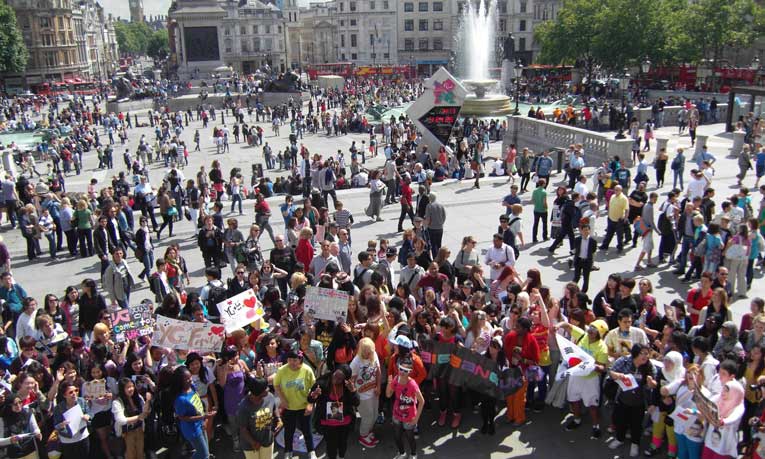
In the early years of this website’s existence, I recall there being an unmet demand for K-pop in London. I remember that one of the students in the first Korean language classes at the KCCUK (in summer 2008) wanted to learn Korean in order to go to Korea and meet K-pop idols; early 2010 was the first late night K-pop party in a Vauxhall club that I tracked; and as we moved into 2011 I remember looking enviously across the channel to Paris where they had their first big SM Town K-pop event. Early in the year, the KCC dipped its toes into the waters with its first (and very well attended) K-pop night, and flashmobs demanding idol concerts began emerging, most notably in Trafalgar Square. This site even provided the space for an open letter to the KCC from a K-pop fan to demand live K-pop in London.
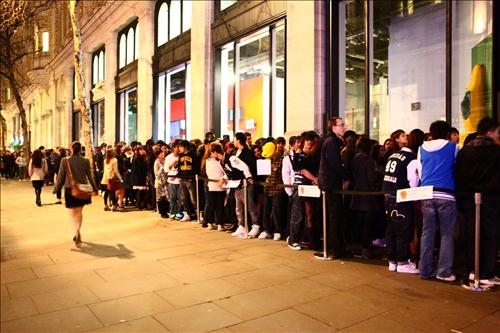
Then in July 2011 we had what was billed as the UK’s first K-pop concert – organised by the same team that brought you the club nights in Vauxhall – which featured hip-hop artist Dok2. Genre purists may quibble about whether that claim was justified, but the year closed with an undisputed K-pop event when Cube Entertainment brought B2ST, G.NA and 4minute to the Brixton Academy. Since then, K-pop concerts have grown in number and scale, to a point where BTS (2019) and Blackpink (2025) can fill Wembley Stadium for two nights, Stray Kidz can play BST Hyde Park (2024), and Seventeen can play the main stage at Glastonbury (2024). Clearly, the big entertainment companies see there is money to be made by touring their idols to Europe, and there is a readymade fanbase eager to snap up the tickets. Further, as highlighted at at the V&A Hallyu seminar in 2023 and demonstrated by the BBC’s Made in Korea reality show (2024) where the British K-pop boyband Dear Alice was born, there is an increasing number of non-Koreans involved in the K-pop machine. If further evidence were required the organisers reported that no fewer than 500 people queued up to audition with PLEDIS (a subsidiary of the agency that manages BTS) at the Hallyu Festival in New Malden on 28 September.
Korean literature in English translation
This is a slightly modified version of the slide I showed on the day, stripping out Korean poetry in translation (where there has been little growth over the past couple of decades) and instead focusing on fiction, and looking at the types of publisher involved in bringing us our literature. The graph shows physical books published in the past 25 years (and excludes short stories published in magazines and online).
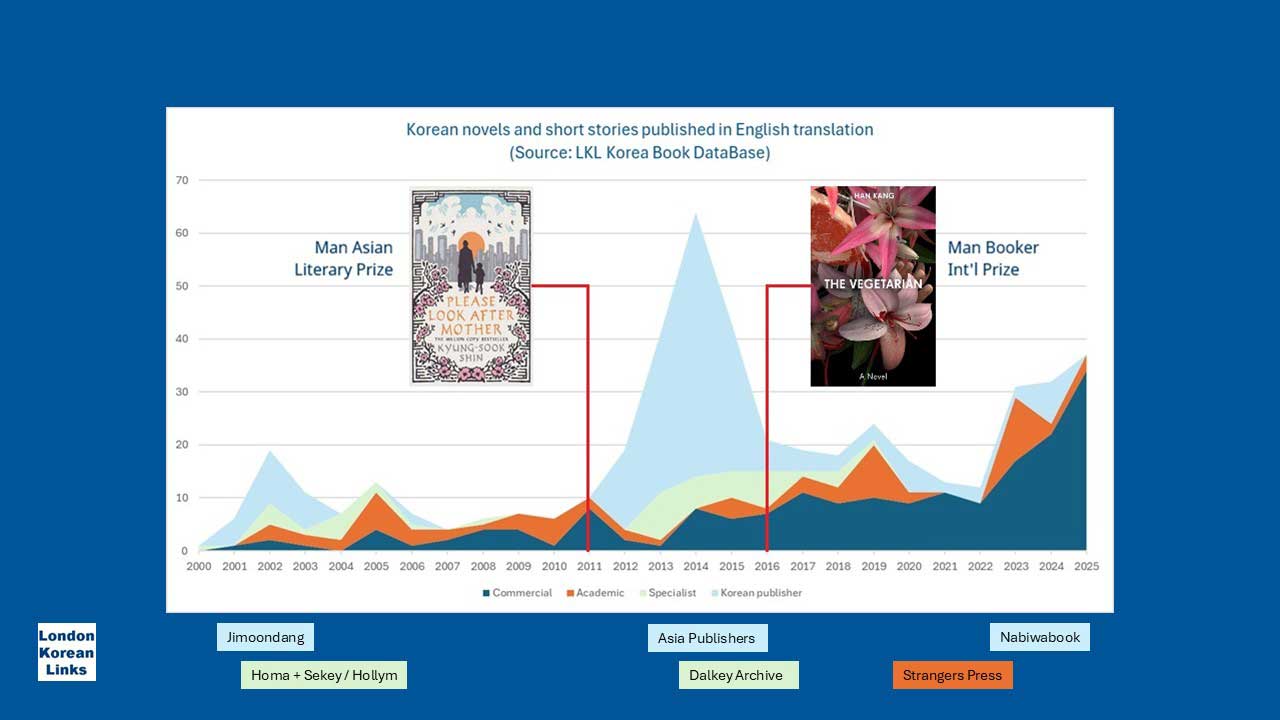
The split of publishers between “Academic” and “Commercial” is a little bit judgmental, but within the former category I have included all the University presses (Hawai’i, Cornell, Columbia etc) plus Eastbridge, Merwin Asia (now part of Bertelsmann), and Strangers Press (who are associated with all the good translation work that happens in Norwich, and who with their 8 chapbooks in each of 2019 and 2023 are responsible for the orange peaks in those years). The light blue area represents Korean publishers whose products you’re likely only to find in Seoul Selection or a specialist bookstore in US metropolitan Koreatowns (Asia Publishers, Jimoondang and the more recent Nabiwabook), and the light green area represents Western publishers who are similarly hard to find (though Dalkey titles can sometimes be seen in specialist UK bookshops). Pretty much everything else is included in the dark blue “commercial” sector.
As you can see, that sector has seen significant growth in the past few years.
It would be tempting to speculate that the academic presses have been focusing on those genres of Korean literature which have historically been prized in Korea: short stories and novels dealing with the colonial period, or with the traumas associated with the Korean War, national division, the post-war dictatorship years and rapid industrialisation (let’s call these the “traditional genres”); while the commercial publishers have been cherry-picking the more popular genres such as crime novels, thrillers, and more recently sci-fi and speculative and healing fiction (the “popular genres”).
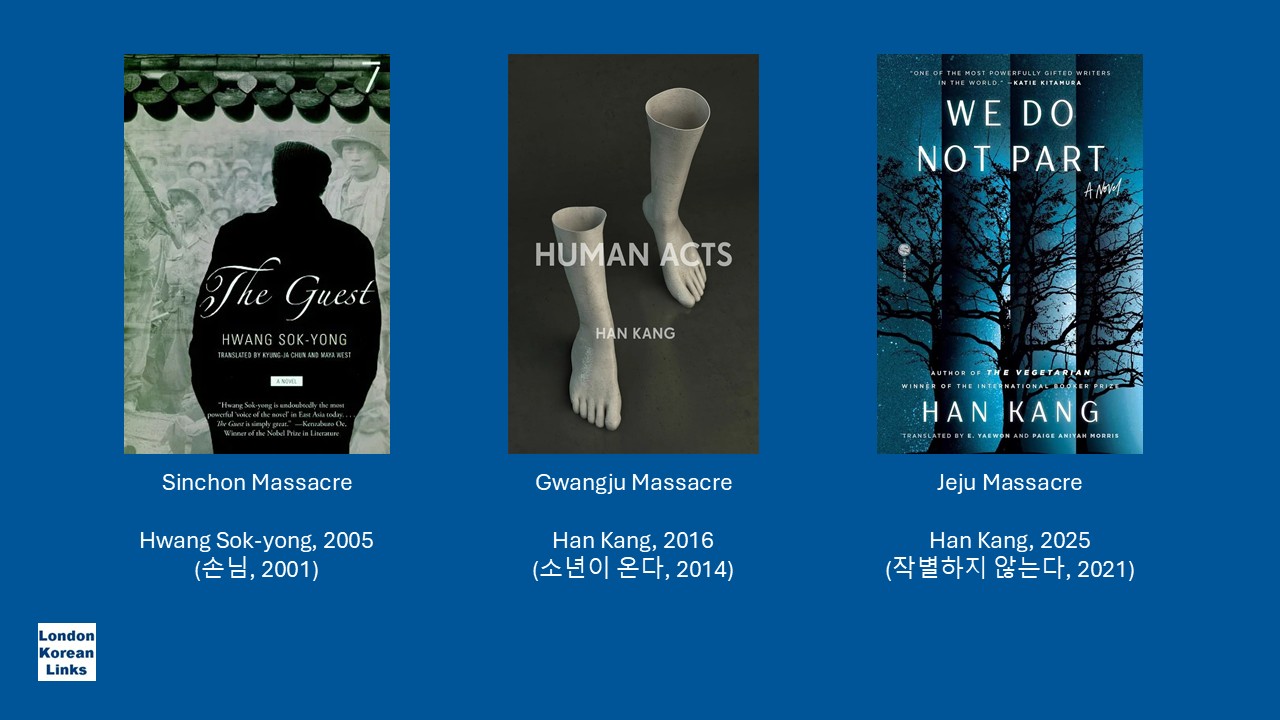
That, however is not a true picture. Let’s take as an example three of the most prominent “traditional” titles published this century: a trio of novels dealing with Korean-on-Korean civilian massacres: Hwang Sok-yong’s The Guest, Han Kang’s Human Acts and We Do Not Part. Published respectively by Seven Stories, Portobello Books, and Penguin, not by any university press. Similarly – and commendably – Penguin have recently published their anthology of Korean Short Stories, and collections of short stories from the 1970s and 80s by Lee Chang-dong and Oh Jung-hee, all three of which would typically be thought of as the preserve of academic presses.
But of course, the typical fayre that you can normally see displayed on the table of Waterstones will look more like this:
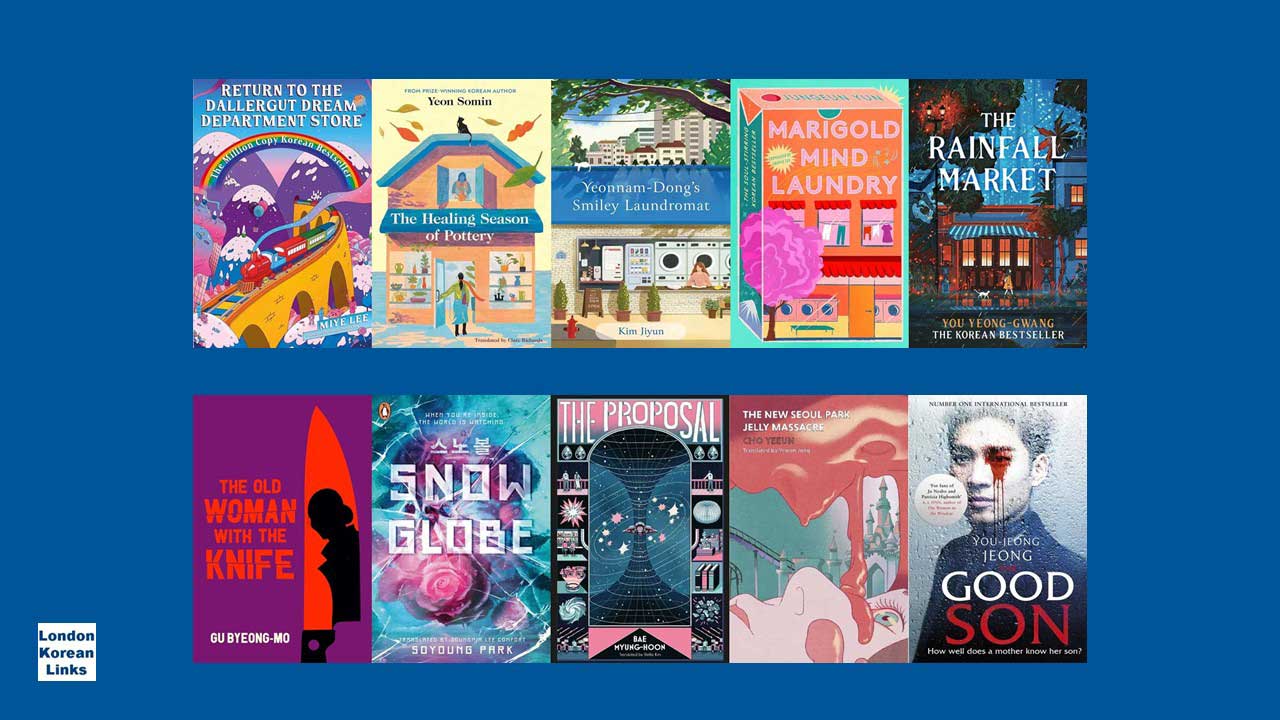
Science fiction, Young Adult fiction, thrillers and healing fiction, and not a university press in sight. This is a marked turnaround from the situation that many observers noted at the 2014 London Book Fair, at which Korea was the “Focus Country”. People wondered at the time why genres such as crime and sci-fi were not seen in English translation (of course, no-one had heard of healing fiction all those years ago, that genre being more a product of the 2020s perhaps reflecting the stresses of Hell Joseon and Covid).
Despite pessimism about the future of book publishing, there seems to be no shortage of recent publications which have received an enthusiastic reception in Korea and which are ripe for a global audience. And some of the boost to sales can perhaps be attributed to celebrity endorsements. For example, Sohn Won-pyun’s Almond (2017) and Cho Nam-ju’s Kim Ji-young Born 1982 (2016) (and, in non-fiction, I Want to Die but I Want to Eat Tteokbokki (2018) by Baek Sehee) got recommended by members of BTS, while Lee Miye’s DallerGut Dream Department Store (2020) got the thumbs-up from members of Got7 and Seventeen.
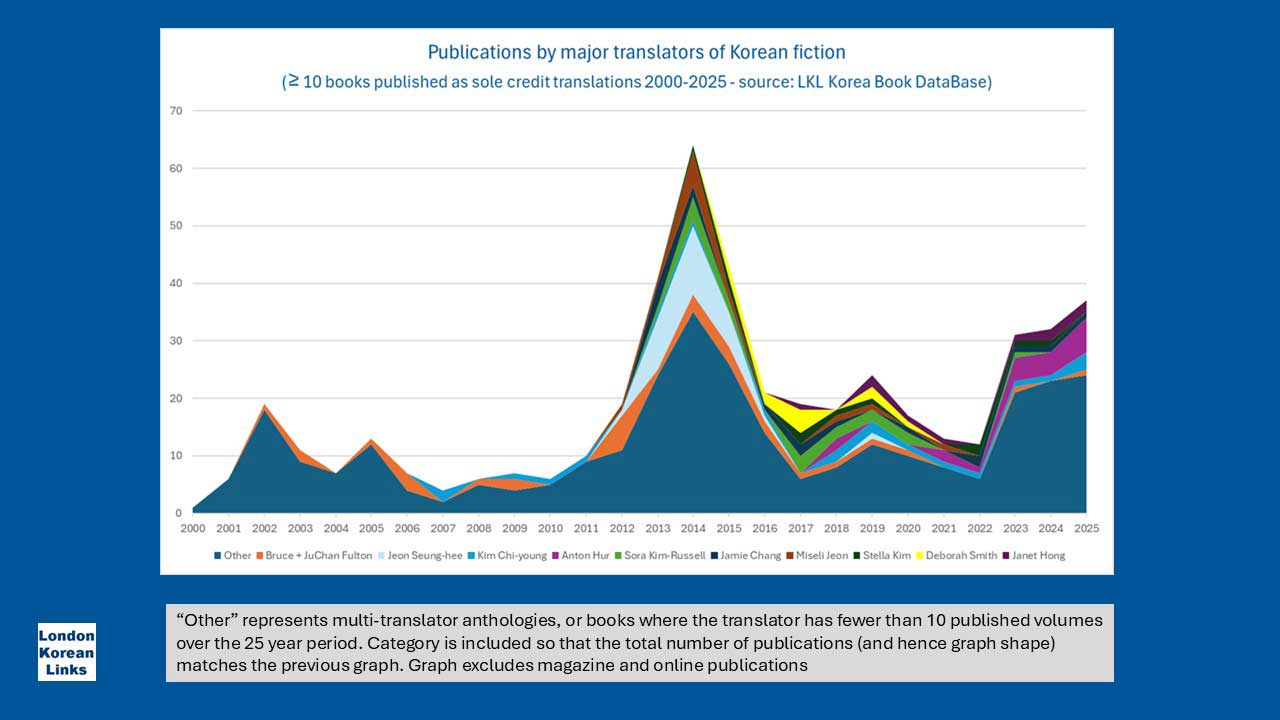
Of course, the increase in titles being published – and the decreasing time period between publication in Korean and publication in English translation – would not be possible without the deepening of the pool of talented translators. The 488 books included in the above graphs were brought to us by more than 220 different translators and it’s difficult to pull together meaningful graphics with so many names. But if we focus on the top 10 prose translators (in terms of physical books published as sole translator) over the past 25 years, with Bruce & Ju-Chan Fulton topping the list with 31, down to Janet Hong with 10, we can see that the number of active translators has seen a marked increase over the last dozen years. Thus, in the first 10 years of this century, the Fultons and Kim Chi-young are the names that register, while in the most recent 10-15 years new translators have emerged such as Anton Hur, Sora Kim-Russell and Jamie Chang.
Not included in the statistics above are volumes of poetry in translation. And to help bring this section to a conclusion here’s a simplified graph of books published in the last quarter-century split between fiction and poetry in translation:
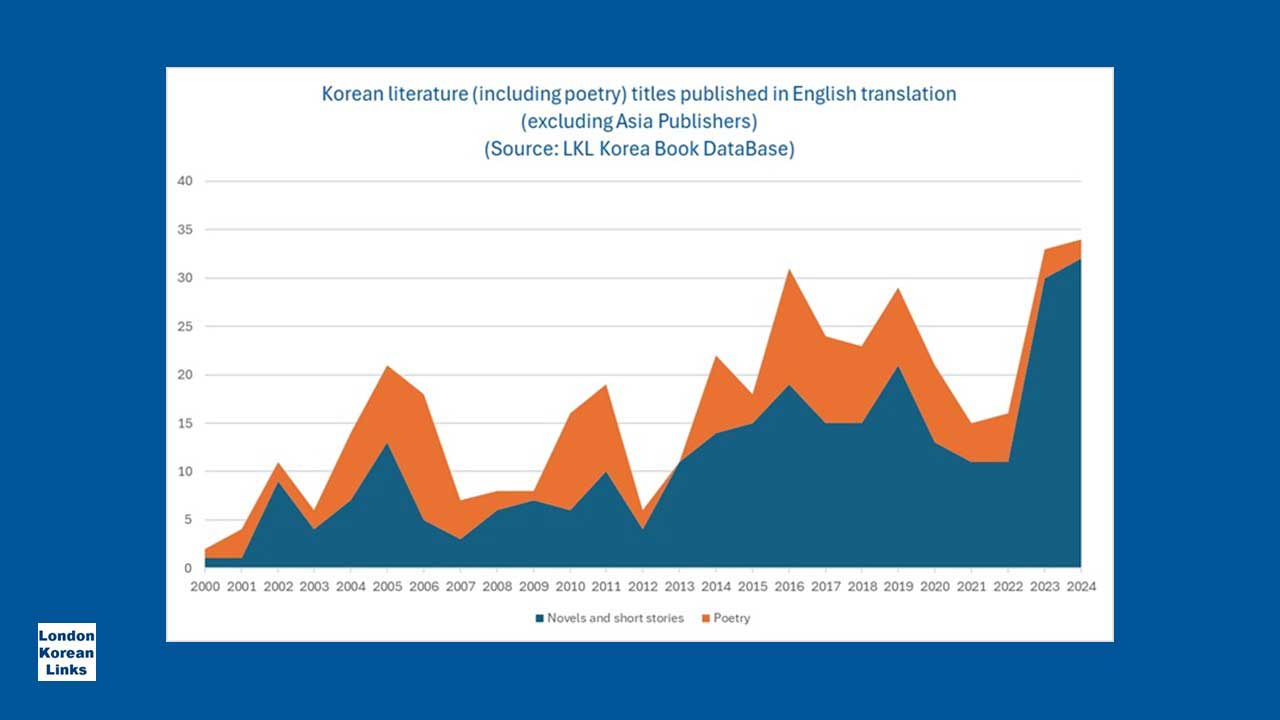
And here perhaps we can make a similar observation to the one that we made in relation to music performances over the past quarter-century: if on the one hand we were to think of poetry as the middlebrow / high brow / non-commercial end of the literature in translation spectrum (similar, in the music world, to traditional music, jazz and indie) and on the other to think of prose as including the titles which are more popular and commercial in nature, then we can see that it is the commercial end of the market that has seen the growth in the more recent period. And within the prose fiction world, the recent growth has been attributable to a diversification in genres making their way to the Anglophone audience and in particular genres focusing on the YA market, healing fiction, thrillers and speculative fiction. Anecdotally the success of some of these titles has led to an increase in the expectations from authors in terms of payment for the rights for overseas publication, but we have not done any research on this, and suspect that the hardworking translators are not reaping significant benefits.
Visual Arts
In the area of visual arts, we can observe a pattern which is similar in some respects, but not others: a relatively stable picture in terms of not-for-profit exhibitions in public galleries, with commercial exhibitions showing more variability (ie, not a consistently upwards trajectory).
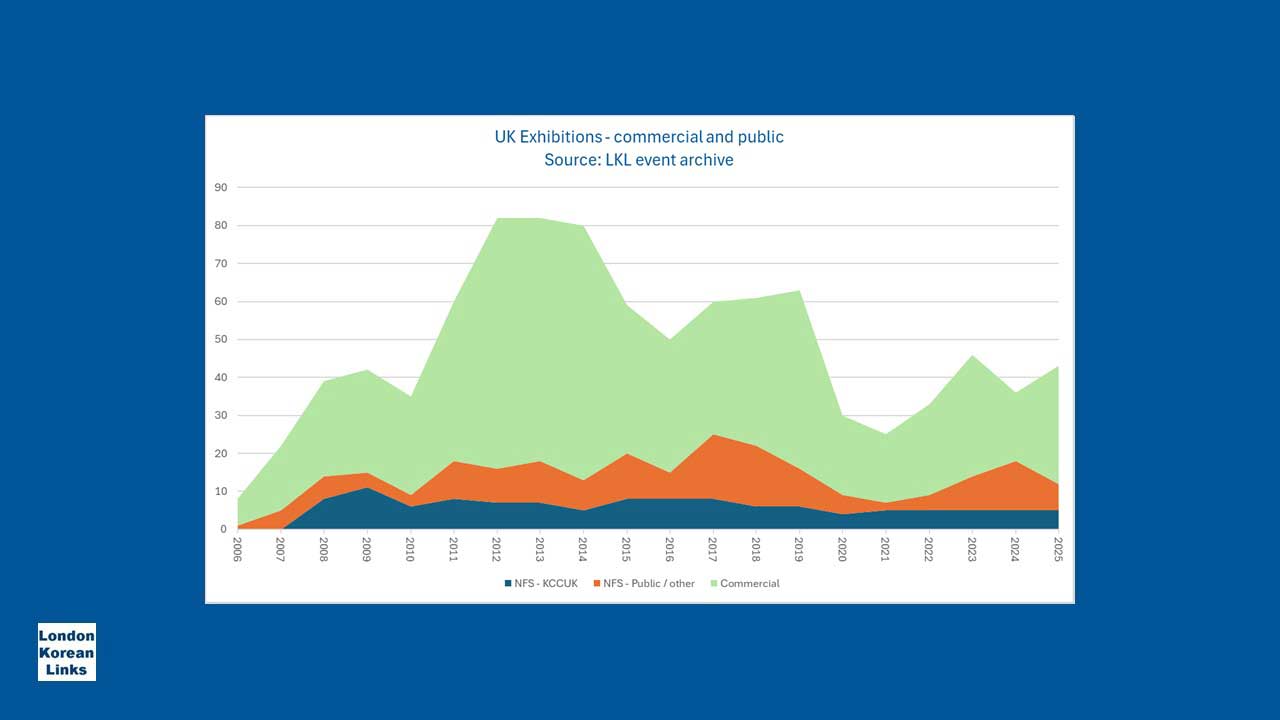
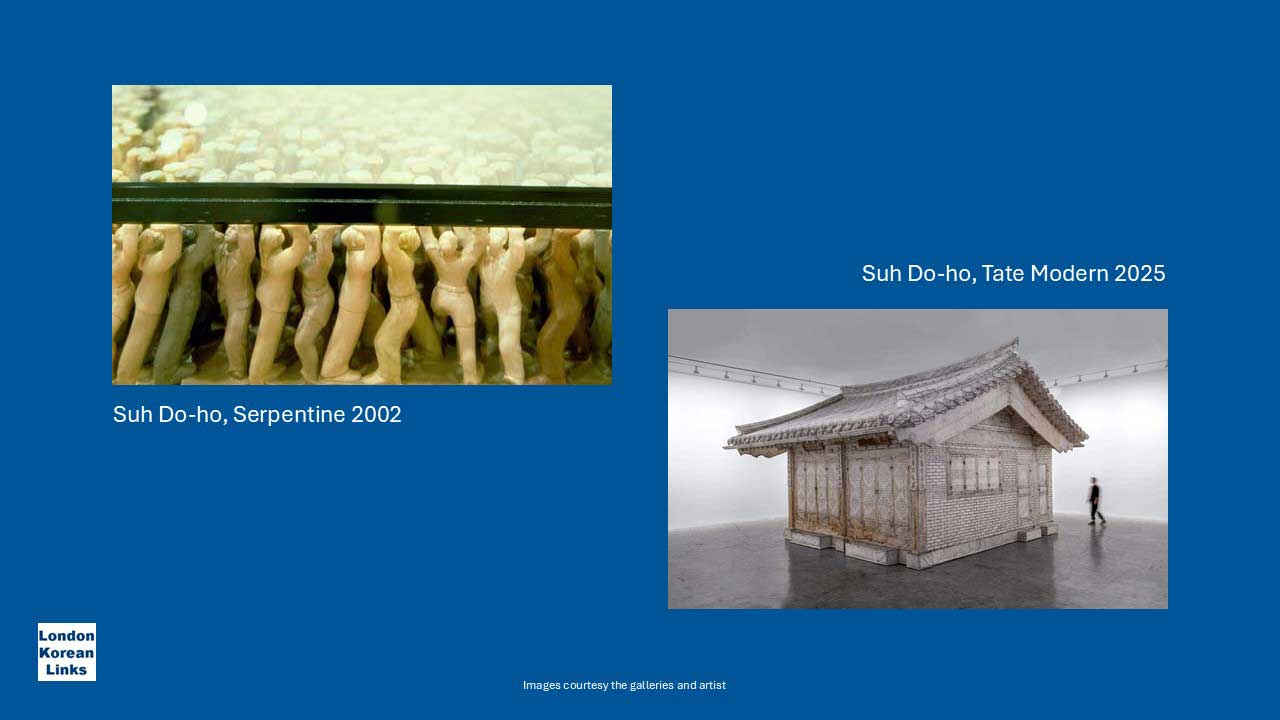
The above graph shows exhibitions logged in LKL’s events archives, split between those held in (a) the Korean Cultural Centre and (b) other public galleries where the artworks are not for sale, and those where (c) the works are available for sale or where the organisers aim to make a profit from an entry fee. The data includes contemporary visual arts, crafts (such as ceramics, jewellery etc) and art-historical exhibitions. Are any trends visible? Well, in the not-for-profit space what struck me is that one of the first London exhibitions that I logged, and the most recent, feature the same artist:
Within the commercial space galleries have come and, sadly, gone, as the hopes and realities of Korean art being the next big thing have varied. I’ve noticed in some of the more recent commercial shows the use of hallyu as a marketing tool, and exhibitions which include works by or depicting K-pop idols certainly boost visitor numbers in the younger demographic, but this is a feature in only a handful of exhibitions. Exhibition numbers have yet to return to pre-Covid levels, for which we do not have an explanation, though anecdotally we understand that overseas buyers do not frequent London as much as they used to. I have tried to make a comparison between the number of commercial exhibitions and the number of young artists active in London…
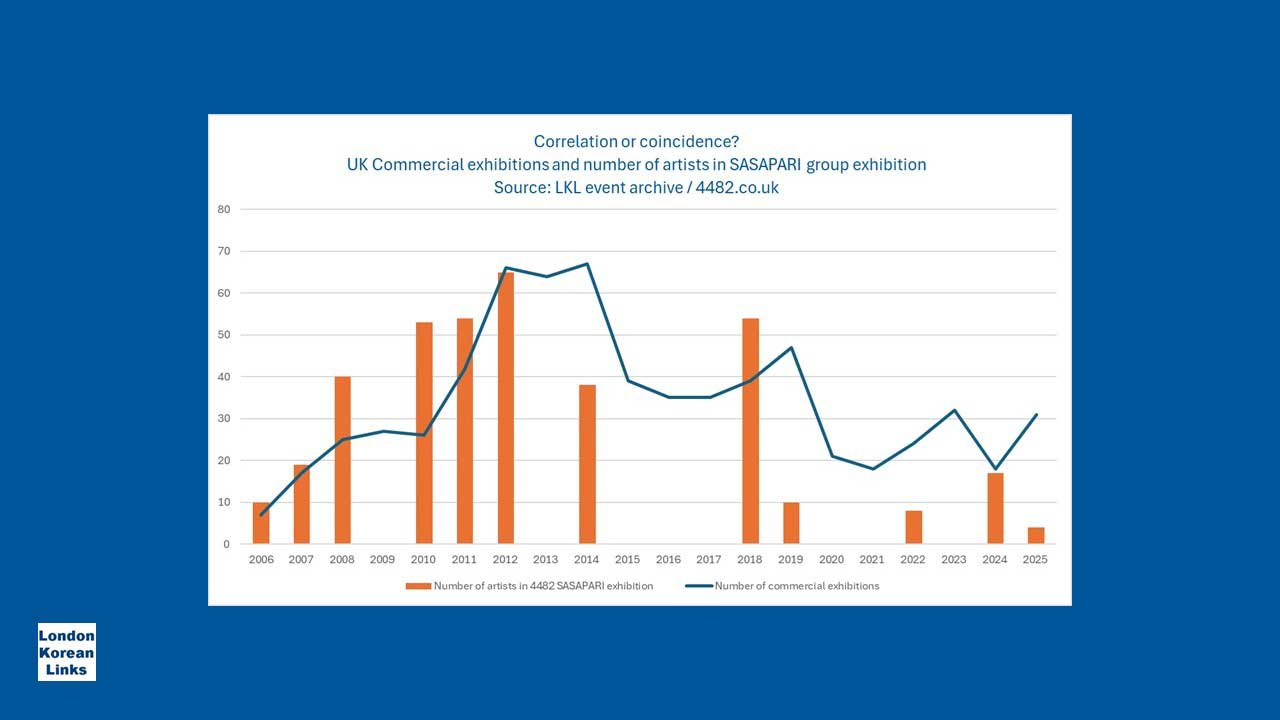
…but I suspect any correlation is mainly coincidental. I’ve noticed fewer Korean student artists in London over the past 10 years than previously. That might simply be because the number of exhibitions per year peaked in 2012-2014, so I haven’t had the chance to meet them; or it might be because, genuinely, there are fewer artists coming to study in London – perhaps because of the stricter visa rules which came into force around then.
Film and TV
What is surprising to me is that in many ways things have changed little in the past 25 years. Park Chan-wook and Bong Joon-ho are still the big names in the film world (and among the similarities between Park’s 2003 hit and his most recent is some extreme dentistry); and popular TV dramas still involve cuisine in the royal palace, among other genres.


I’m not confident that I have sufficiently complete data about UK releases of Korean movies over the period under review, but it is only relatively recently that I have noticed that selected commercial movies (typically in the crime / action genres) have had a limited UK release within a week or so of their Korean releases, suggesting a possible market for Korean movies outside of the arthouse and festival circuits. Separately, it would be interesting to have access to attendance figures at the major film festivals that feature Korean movies: there has been a London Korean Film Festival running annually since 2003 (albeit with different organisers) and maybe earlier. I suspect that audiences have grown over the years and certainly the conversations I overhear at screenings are more informed than they were 20 years ago.
There is no doubt that Netflix has improved the accessibility of Korean content, and some titles have proved remarkably popular. But Netflix does not have a magic formula: I suspect Bong Joon-ho’s Okja did not turn a profit, and I for one regard it as the least satisfying of all his movies. And other East-West collaborations (such as Stoker, Mickey 17 and The Last Stand) have not had a consistent critical and commercial record. Nevertheless, where the formula succeeds, the experience with Squid Game and Demon Hunters shows that there is money to be made. I wonder if fellow panelist Bizhan Tong has observations to make on what makes for a successful collaboration in the movie and TV drama industry.
The K-Culture Panel at the Korea Symposium on 29 September was chaired by Dr Eugene Kim of Kingston University. The Panel consisted of Bizhan Tong, CEO of Phoenix Waters Productions a producer-director focused on bridging East and West through genre-driven, commercially viable stories; Bob Holland, Executive Producer, at The London Coliseum (which hosted a successful run of the Korean-produced musical The Great Gatsby this summer); Prof Dale Harrow, Chair, Intelligent Mobility Design Centre at the Royal College of Art (who presented about their collaboration with Hyundai on motor vehicle design); and myself who gave a much shorter version of the above material to kick off the discussion.
Very informative and in depth, thank you!
I remember studying in a London University back in the early 2000s and the Korean Society there regularly organised Korean disco nights! You can imagine how new of an idea it was back then but oh so fun! The energetic music was so great and yet different from Brit Pop back then. I do remember hearing many songs that you could find from the arcade machine Pump It Up (think Park Ji Yoon, etc).
Interesting – K-disco nights in the early noughties! And you’ve got me listening to Park Ji Yoon again!