The following is the text of the talk I submitted to the LTI Korea conference held in Seoul on 1 – 3 July 2026 celebrating their 30th birthday. I am grateful to LTI Korea for the invitation to present, and to those who helped and encouraged me in the preparation. Special thanks go to literary agent Barbara Zitwer and Foyles bookshop‘s translated literature expert Carmelo Puglisi for being so generous with their time.
On the day of course I had to trim down the material significantly as I had written too much. Five thousand words does not fit into a 30 minute speaking slot. A video of the talk including the slide deck I used is linked at the bottom of this page.
— — — —
Introduction
When LTI Korea invited me to give this talk, I was very honoured, but found the prospect rather daunting. The brief was how Korean literature is received by English-speaking readers: what aspects they are particularly drawn to, what elements they find compelling, and how they perceive Korean literature overall. My difficulty with the brief was the huge breadth of the topic. To try to encompass opinion from across the whole Anglophone audience from Australia to Alaska would be an impossible task in the time available. But just to talk from the perspective of my own personal preferences would be wholly unrepresentative. Everyone is different. Everyone has their own likes and dislikes, and it is dangerous to make sweeping generalisations.
For example, I love Han Kang’s Human Acts, and was gripped by The Vegetarian. So you might expect me to devour with enthusiasm everything that she has written. But I am almost ashamed to say that I have tried twice to get more than half way through The White Book, and failed both times. It just doesn’t speak to me.
But let me show you this photo:
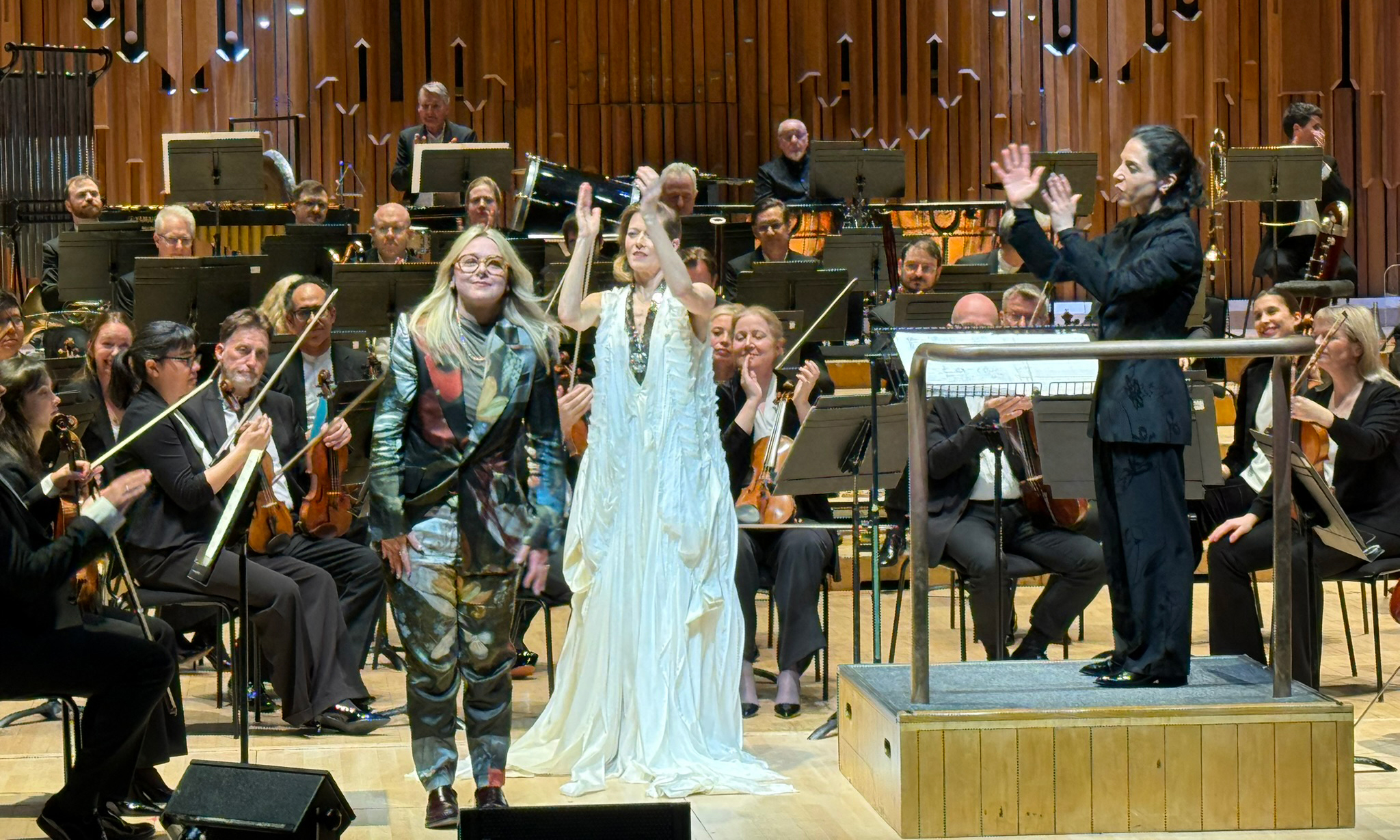
What’s going on here? It’s the London premiere of The White Book on 4 March 2026, with the London Symphony Orchestra. Here’s some explanatory text from the programme notes of that concert:
In 2019 [composer] Laura Bowler came across Han Kang’s The White Book and was reading it while her mother was in hospital being treated for acute myeloid leukemia. “The book reflected a lot of what I was feeling at the time” says Bowler, “and it was a great comfort in some ways. I didn’t feel as lonely when I was reading it.”
Laura Bowler had discovered Han Kang’s earlier books including The Vegetarian and happened to be reading The White Book at the right time, for her. Out of that reading came a desire to set it to music, and thus was born a unique piece for soprano and orchestra lasting around half an hour which incorporates five short chapters from the English translation of that book, verbatim. Barbara Hannigan, the soprano who performed it, described singing it as “Like turning your soul inside out”.
To help me gather material for this talk, I launched a survey out into the internet. And in response, by coincidence, I received another reference to The White Book:
About five years ago, I picked up a copy of The White Book in a Daunt bookshop, and thought, ‘What is this?’. Han Kang became the key to Korean literature for me. The other titles followed, now We Do Not Part as well. I read some other Korean novels. When I went to Korea two years ago, I spent several days in Gwangju to try to find the background to Human Acts. I was engaged to the point that a passing reference in the novel to Unjusa took me into the countryside to a site where many early Buddhist statues were carved.
So, one book which I can’t even finish has inspired two very different and very significant cultural journeys for other people.
So, as far as possible in this talk I’m going to try to focus on what other people think, rather than on my own views: because I don’t think I’m a representative reader. I have drawn upon conversations that I organised with people for the purposes of this talk, on the survey that I launched, on articles in the press, and on observations I have made over the 25 years that I have been following Korean literature as part of my broader explorations of Korean history and culture.
Some London bookshop displays
I’d like to start with some more photos: a snapshot of what a visitor will find on display in two London bookshops in March 2026.
First, possibly London’s most famous bookshop, in the heart of the theatre district of London’s West End: Foyles.
Like any bookshop, it displays piles of books that it thinks are appealing, topical, recent – books that it hopes will sell in decent volumes. It has nice window displays showing the most attractive of the topical books, and each month features a book of the month.
Here’s what I saw when I entered the shop at the end of March this year:
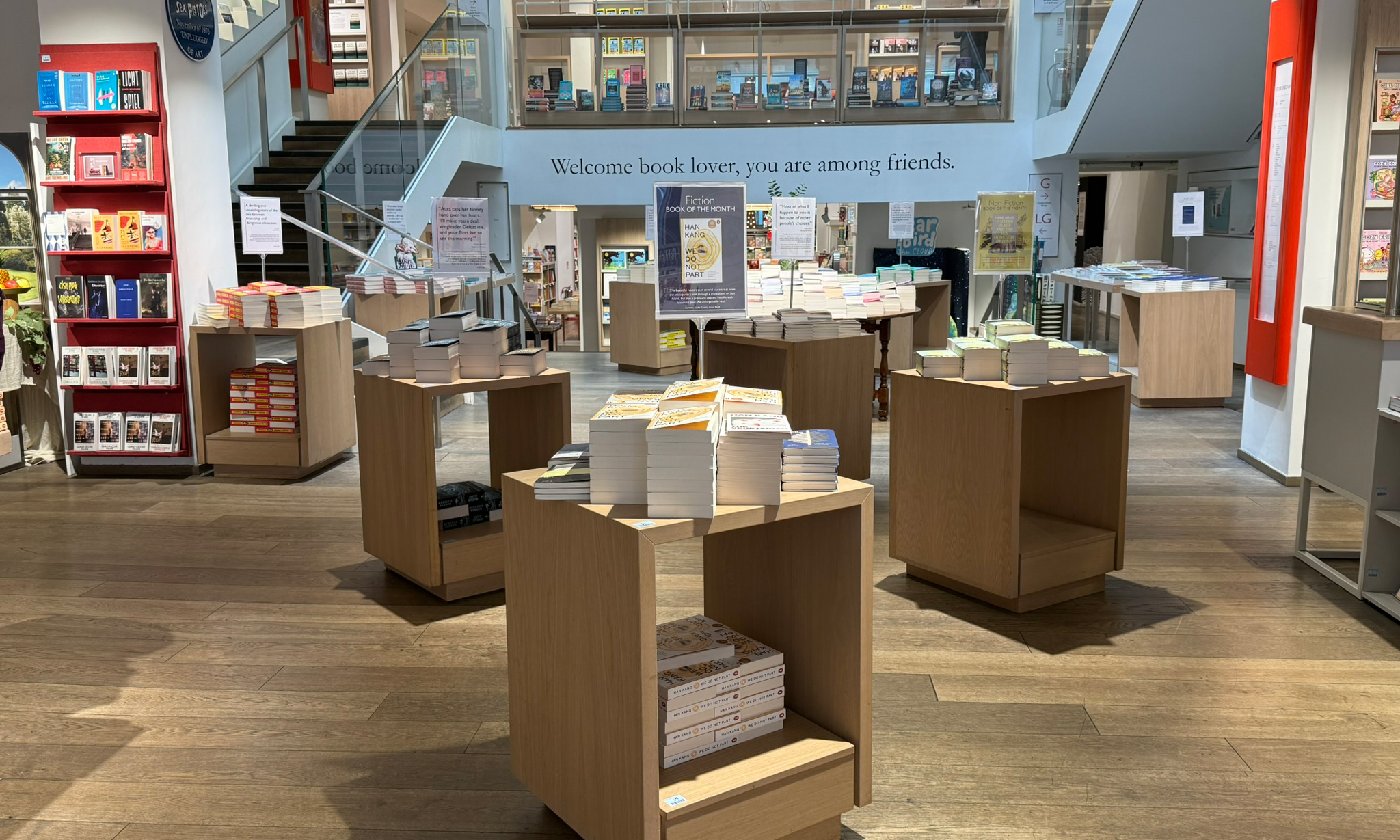
A nice open bit of floor space to welcome you into the shop. And the first pile of books you come to? It’s the book of the month:
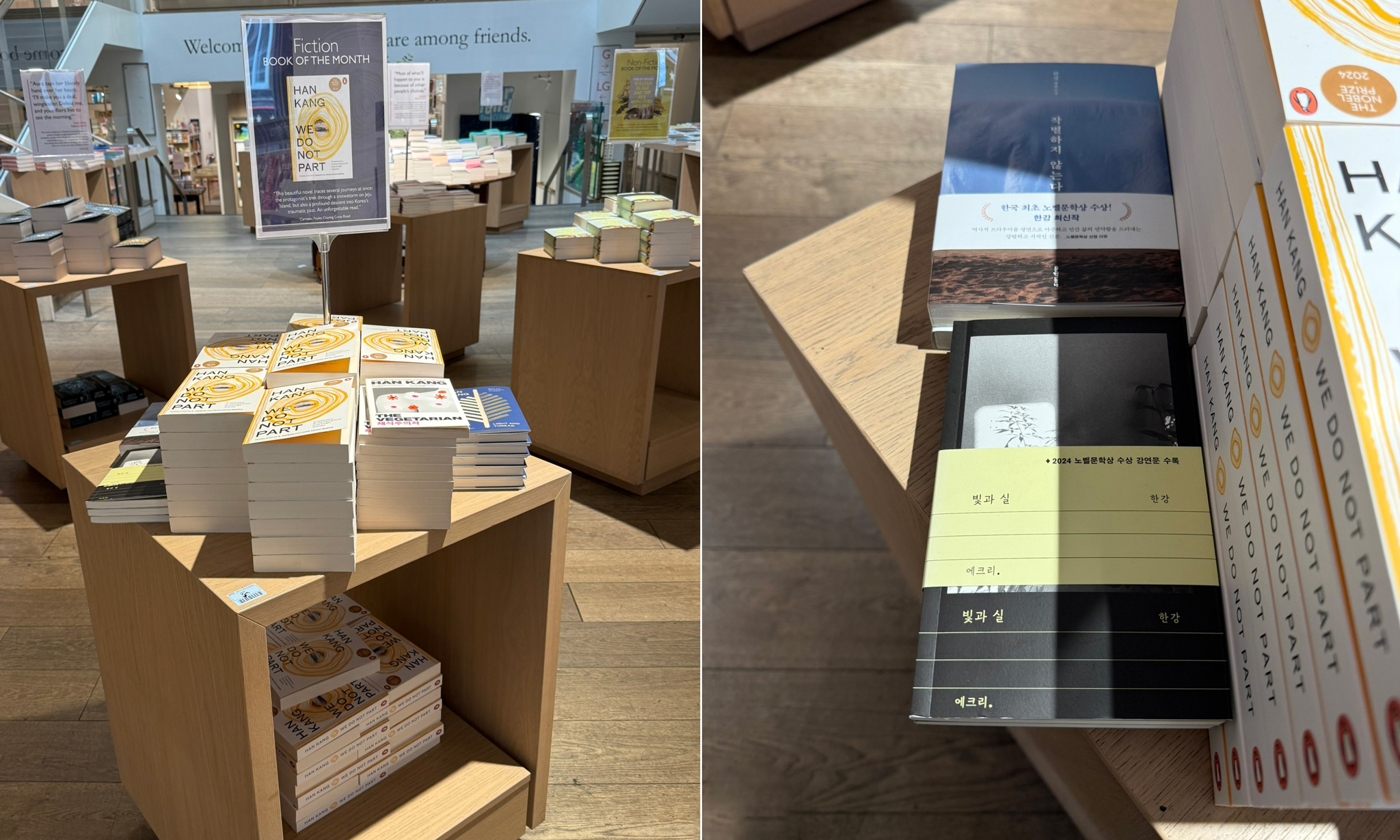
It is the month that We Do Not Part came out in paperback, and also the month in which her latest collection of writings, Light and Thread, was published in English. And (if you zoom in) you can see that the shop has taken the opportunity to display copies of The Vegetarian, too. You might also be interested that alongside the English translations, they have the Korean originals of both We Do Not Part and Light and Thread. Foyles is unusual in probably having the best selection of Korean-language books in London. Meanwhile, here’s what they are displaying in their window that faces out onto London’s busy Charing Cross Road:
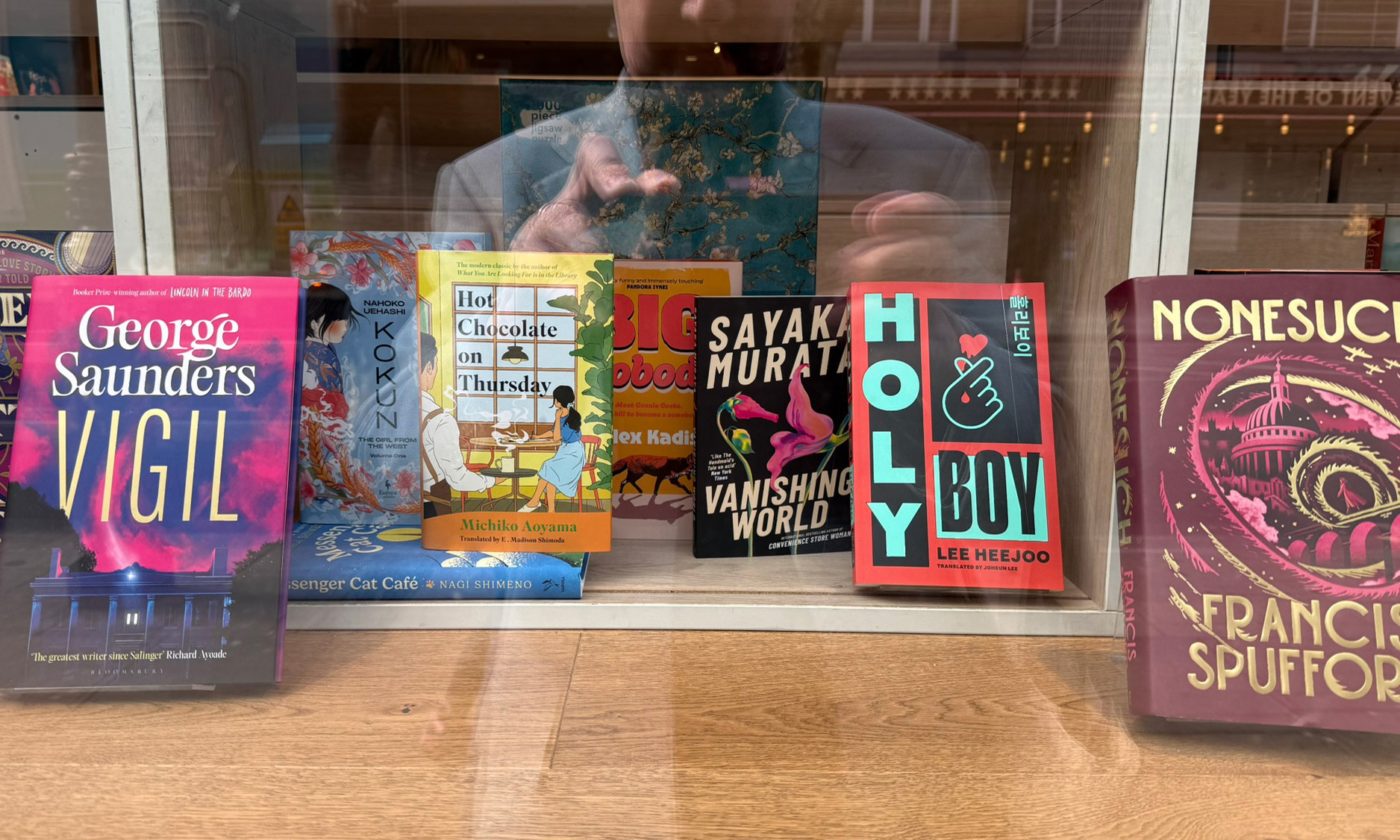
Another translated Korean title, this one on a K-pop theme (Lee Heejoo’s Holy Boy). But also, note that alongside it are four Japanese titles (and two by Anglophone writers).
Next, take my own local independent bookshop as another example – a bookshop which I imagine is roughly the same size as Hwang Bo-reum’s fictional one in Hyunam-dong, and has a similar vibe, though it does not have room for a coffee bar inside. It’s run by a passionate lady who also runs an annual literature festival in my neighbourhood.
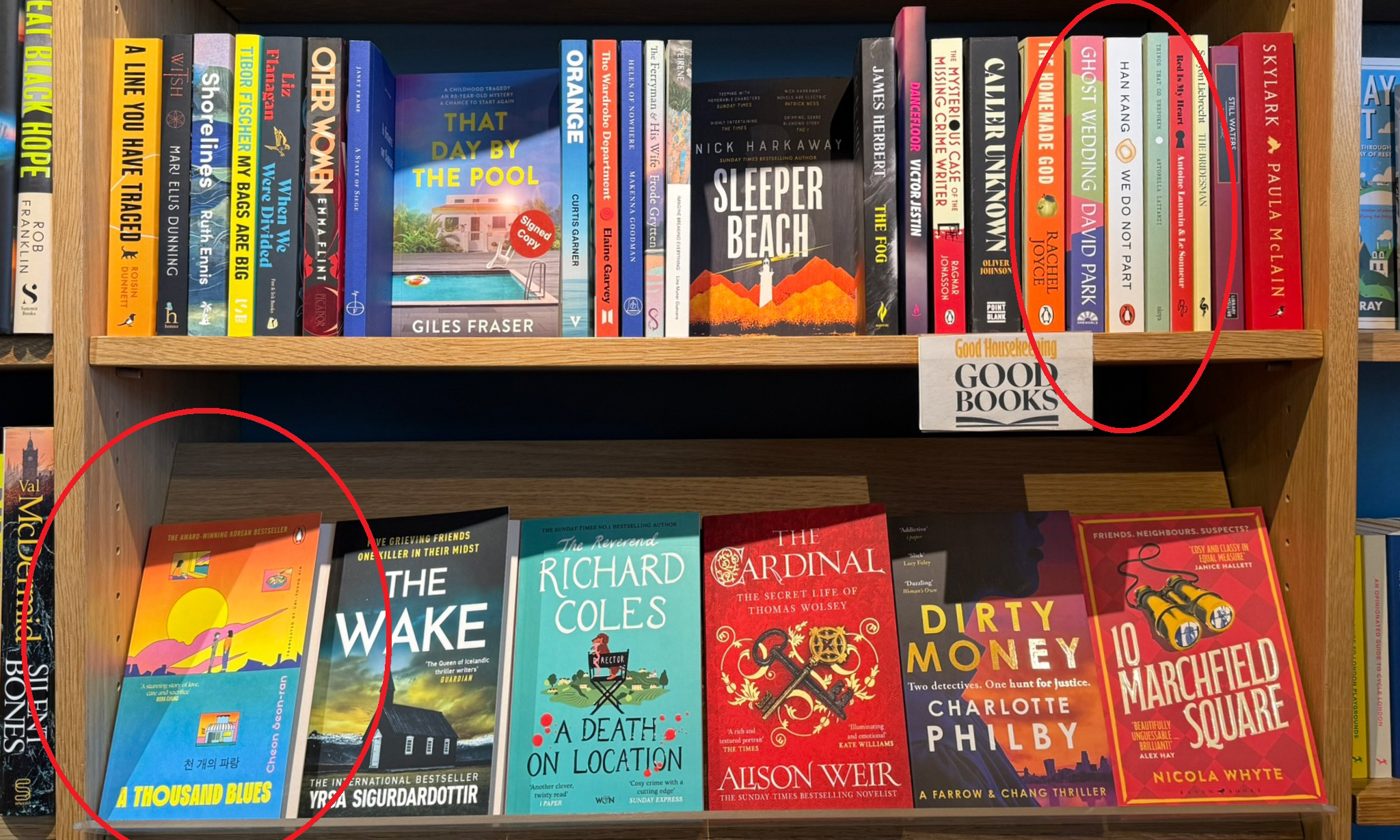
Here are two of the shelves showcasing “new fiction”. And as you can see there are two Korean titles there: Han Kang’s We Do Not Part and Cheon Song-ran’s A Thousand Blues. Note, to state something that I have to remind myself quite often: this is not a section of niche literature in translation. It’s general, mainstream fiction. For example, two books away from A Thousand Blues is a cosy murder mystery by a TV and radio celebrity. Unfortunately, while Foyles has plenty of other Korean titles on its shelves, my local bookshop currently just has those two. There is simply no room for any more in such a small shop.
One last photo. Both Foyles and my local bookshop cater to a broad audience including serious readers, and, having spoken with people who run both shops, I can confirm that much thought goes into what books to display to their discerning customer base. By contrast, what sort of books do you expect to find in an airport bookshop? Certainly not Korean literature in translation. But here’s the WH Smith in Heathrow Terminal 4 on 22 April:
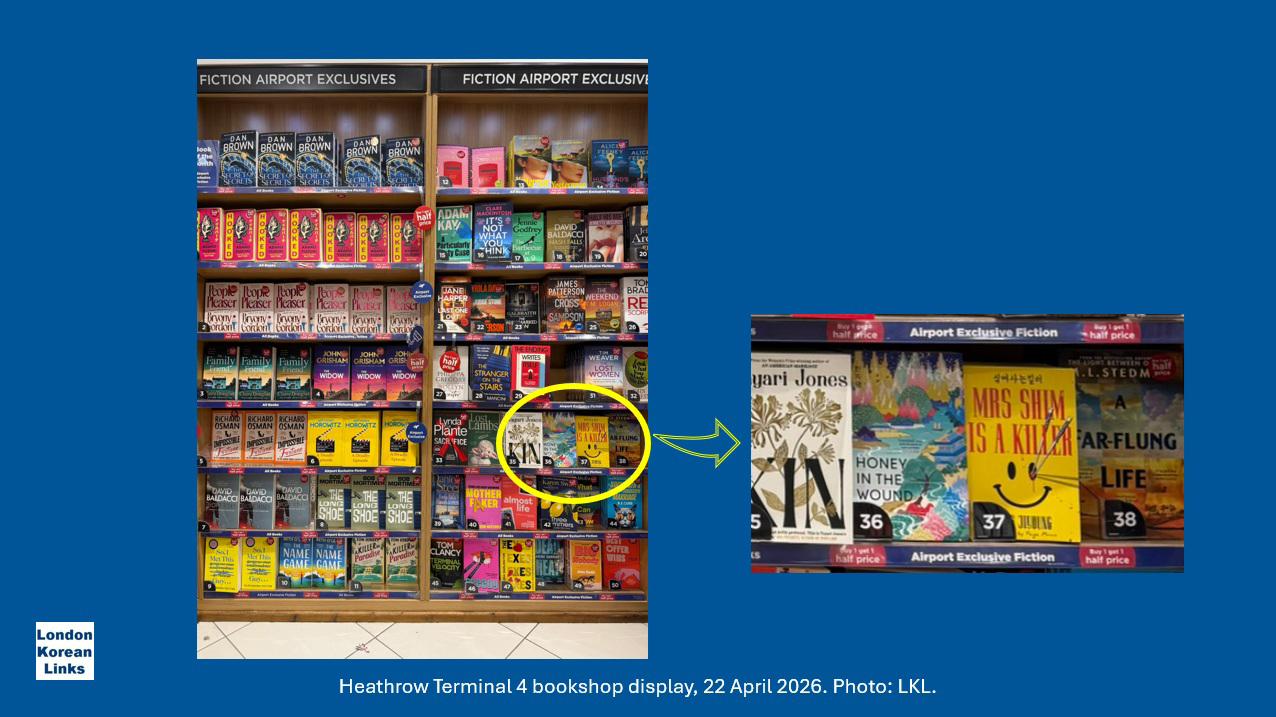
Next to each other are Han Jiyoung’s Honey in the Wound and Kang Jiyoung’s Mrs Shim is a Killer (tr Paige Aniyah Morris), both recently published (in fact, in April there were two London book launch events for Honey in the Wound).
The growth over the last 10-15 years
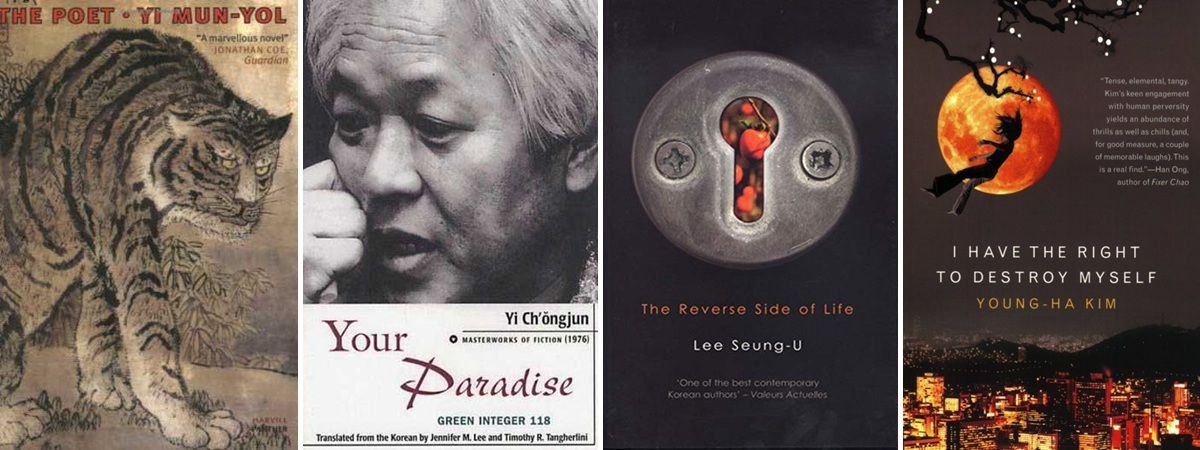
Twenty-five years ago when I started exploring Korean literature, I could not have dreamed of a world in which a mainstream bookshop would have stocked any Korean titles at all. I think the first translated Korean fiction I managed to find in a London bookshop was Yi Mun-yol’s The Poet (Harvill Press, 1995) Yi Chong-jun’s Your Paradise, (Green Integer, 2004), Chae Man-sik’s Peace Under Heaven (M.E. Sharpe, 1993) and Yeom Sang-seop’s Three Generations (Archipelago, 2005). I managed to find them in Daunt Books – the same shop mentioned by my first survey respondent above – a bookshop which uniquely displays its books by country, rather than by genre, which meant I could easily feed my Korean fascination in one place. Daunt is still my favourite bookshop anywhere in London. Back in those days, the shop had in total around two or three feet of Korea-related books – but that included history, travel, language, along with English fiction and translated fiction. And quite a lot of the non-fiction was North Korea-related: a feature of Western interest in Korea which has persisted over the years. I’m afraid I don’t have a photo of the Daunt stock from 20 years ago. But today, that same London bookshop has nearly four shelves containing Korea-related fiction – both translated literature and fiction by English language authors including those of Korean heritage – a huge increase.
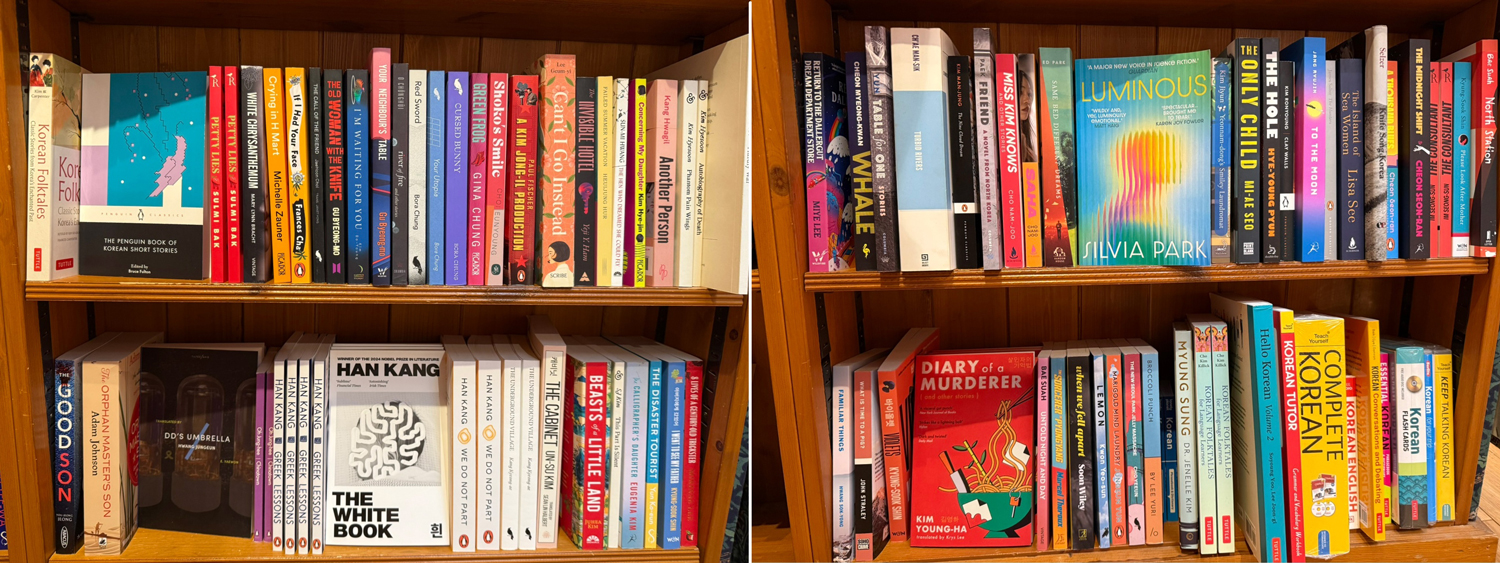
And of course that increase in availability of translated Korean literature is in no small part attributable to the efforts of LTI Korea, whose 30th anniversary we are here to celebrate.
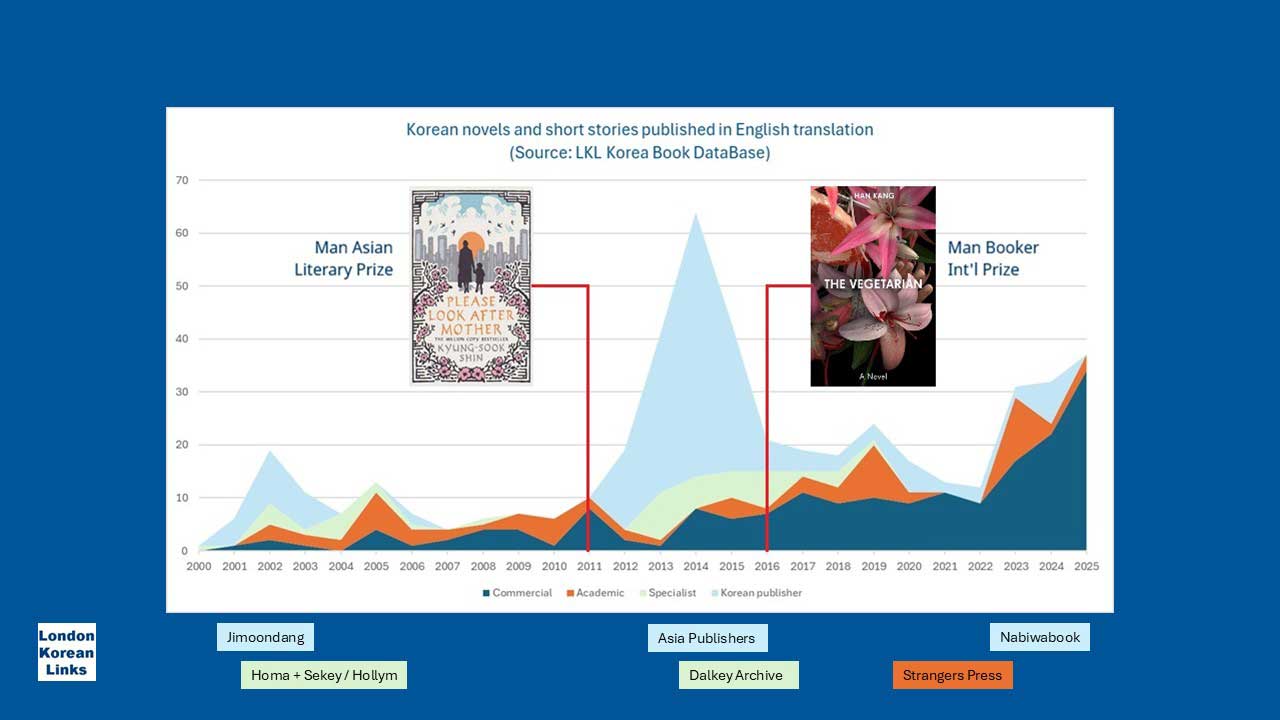
Over this period, we’ve seen a big increase in both the number of translations published and the number of translators active in the field (1), and we’re now in a world in which the resulting books in general feel as if they were written in English – an improvement on what we had a while ago where the language could sometimes feel a little awkward. (2)
The broader context
My personal challenges in finding Korean literature in translation 20-25 years ago was part of a bigger problem. Whereas countries in continental Europe have historically been more open to literature in translation, that has not been the case in English-speaking countries. As the University of Rochester noted in 2007,
“Only about 3% of all books published in the United States are works in translation … And that 3% figure includes all books in translation—in terms of literary fiction and poetry, the number is actually closer to 0.7%.”
Since then, several developments have led to a growing interest in international literature. Readers today are more internationally minded. Streaming platforms, global news, and social media expose people to stories from places they might never visit. That curiosity naturally extends to literature—people want to read voices from beyond the conventional. Translated fiction offers different narrative structures, cultural perspectives, and storytelling traditions.
“There’s an element of people wanting to read things that are pushing the boundaries” is a statement from a prominent influencer on BookTok, implying that translated fiction is filling a perceived gap: more experimental or unfamiliar material.
The literature prizes have also had an impact, not only raising the profile of translated literature but also proving that foreign fiction can be highly readable. And as translator Anton Hur has noticed, perhaps it was The Vegetarian which highlighted that something different was happening in Korean literature:
All of a sudden, Korean literature was seen as edgy and fierce, and emerging translators like me took note. Maybe there was a readership for queer Korean literature, or even Korean speculative fiction, as The Vegetarian had many elements of queerness and ‘weird fiction’ and fantasy; maybe the readership for translated fiction was less conservative than we thought. Much less conservative in fact. And if the Anglosphere was ready for this book, what other surprises could they be delighted by?
Niche or not? – from historical introspection to genre diversity
That comment of Anton’s is something that I can relate to. It’s fair to say that back in the early days, Korean literature in translation, as pretty much any literature in translation (with the exception of maybe some European classics) was niche: hard to find, and for the eccentrics and academics only, with topics often related to the peninsula’s difficult history and translated not always into the most natural English.
As one translator has commented on literature in translation in general:
“Our generation [born in the 1960s] suffered from the notion that translated fiction was like castor oil: not very pleasant but probably good for you. And it shouldn’t be good for you, or bad for you, or anything else. What people are looking for is to engage with a book.”
This chimes in with how I felt about Korean literature in translation back in the early days. But things have changed.
One of the first things to change in the noughties was the emergence of titles that didn’t look niche from their covers: titles like Lee Seung-u’s The Reverse Side of Life (Peter Owen, 2005); Kim Young-ha’s I have the right to destroy myself (Harcourt, 2007). These books were the same size as a typical Penguin paperback – while the typical short story collection from the academic publishers were bigger in size. And while cover art is obviously a matter of taste, and I’m no visual art critic, the covers were visually appealing or even intriguing.
As it happens, I have the right to destroy myself was the first title that the literary agent Barbara Zitwer brought to a western publisher. And in a conversation I had with her in preparation for this talk she described how she went about getting publishers interested in the titles she was representing:
“I positioned and promoted the books as great world literature, not as niche books, not as books in translation”.
And it’s fair to say that in general the titles she has brought to an Anglophone readership have, indeed, not been niche.
Please Look After Mother was perhaps her first breakout title, and even before it was listed for the Man Booker International Prize it was serialized for the long-running BBC radio programme “Book at Bedtime” – a show aimed at a mainstream audience devoted to “readings from modern classics, new works by leading writers and literature from around the world.” And two months prior to this, it had been mentioned by Oprah Winfrey as one of “18 Books to Watch for in April 2011”
Nevertheless, at the 2014 London Book Fair, at which Korea was the focus country, much of the press coverage focused on Yi Mun-yol and Hwang Sok-yong as representative of a strand of literature focusing on Korea’s recent history of division and dictatorship. (3) And in a way such coverage did reflect what had hitherto been representative of Korean literature available in the English language. It also reflected the speaker events held at the Book Fair itself – for example Hwang Sok-yong had an hour-long discussion entitled “Writing Literature after History”.
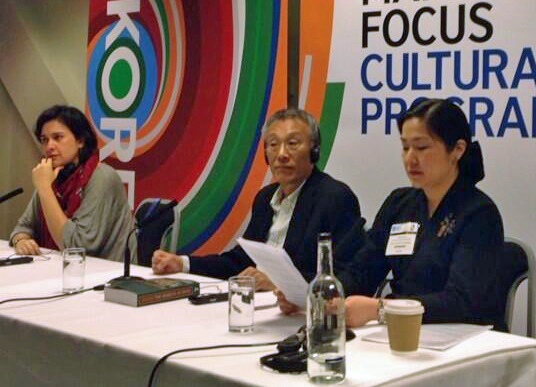
But outside of the formal discussion sessions, while people were appreciative of the richness of literary fiction that was being presented at the Fair they were also asking: where is the Korean genre fiction? Where are the Korean murder mysteries, science fiction and thrillers?
And some of the more recent publications have answered those questions. We’ve had some great thrillers from the likes of Gu Byeong-mo, Jeong You-jeong and Kim Un-su; and some great science fiction from the likes of Kim Bo-young, Bae Myung-hoon and Djuna. And we’ve had some things that we weren’t, perhaps, expecting: the weird and the quirky (Yun Ko-eun, Chung Bora), the feminist and the queer (Cho Nam-joo, Park Sang-young). I could go on. The range of Korean literature available in translation is now showing a breadth that we could not have imagined fifteen years ago, while still containing titles of quality. It’s as if Korean literature has emerged from murky historical darkness into zesty, contemporary light.
The warm hug of healing fiction
A genre that dominates the table space in many booksellers nowadays is that of healing fiction. Here’s a great example of a bookshop display:
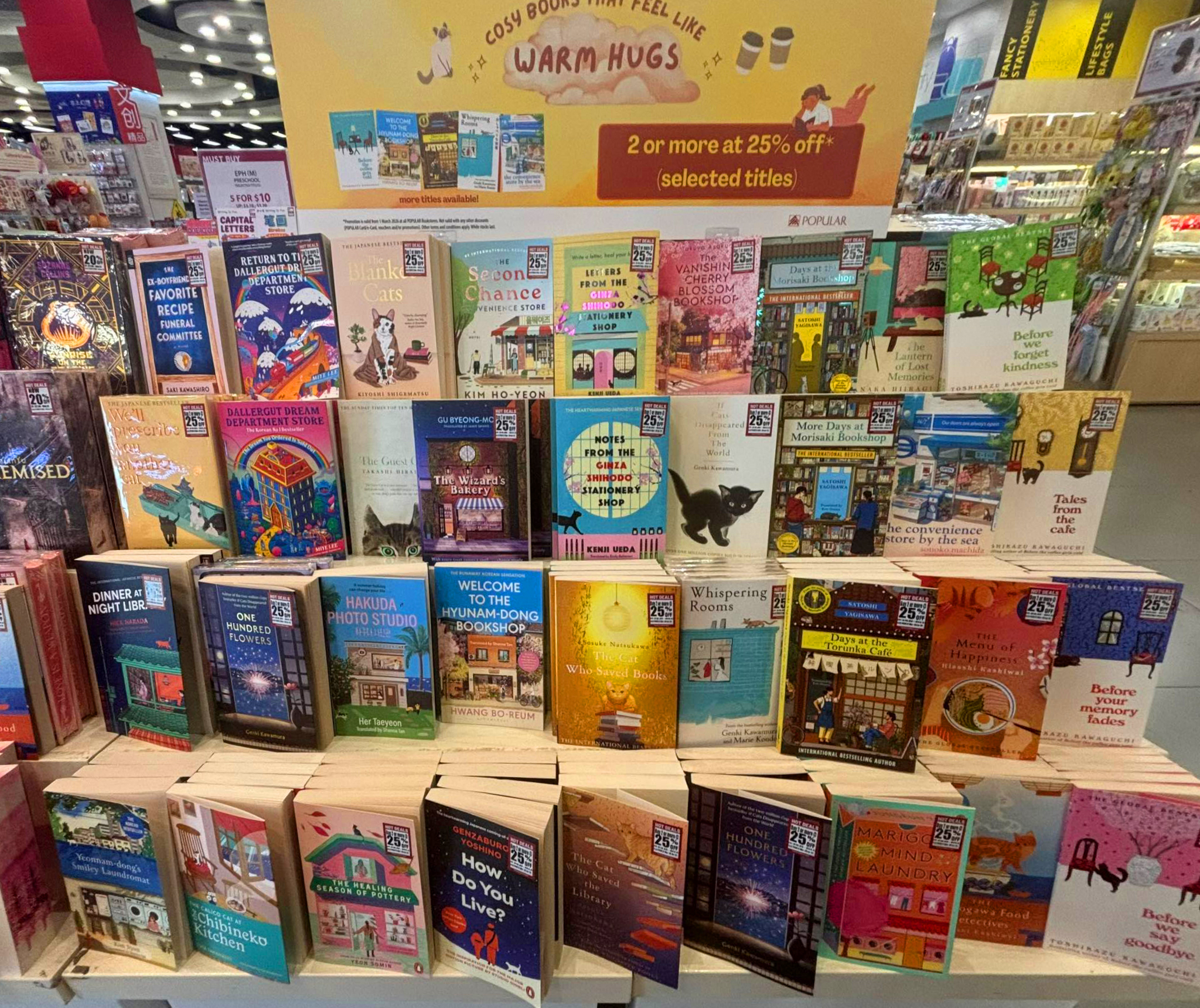
This photo is from a Singapore bookshop, posted in a Facebook group entitled “Asian Book Lover’s Club”. And at the moment a lot of the posts in that group relate to healing fiction, as are the posts in BookTok. The popularity comes perhaps from a wish to escape from the pressures of daily life, and a growing appreciation of mental health issues. But they do not appeal to every reader. Here’s a quote from one responder to my survey, in response to my question around genre preferences:
I try to read as much as possible, but these days I tend to skip healing fiction titles… I dislike healing fiction as it’s too predictable and boring… When I start reading such a book, I know what is going to happen. Cats meow and cherry blossoms flutter and people have hardships but overcome them when they come to a bookshop / café / library etc… Books should challenge me, not make me feel good.
I agree with the sentiment that books should be challenging, but I’m not averse to the occasional comforting read, just as with movies I like to mix arthouse productions with a cosy rom-com. And to counter the above quote, here’s the diametrically opposite view from a reader in Sri Lanka:
Healing fiction is what I enjoy the most. Also genres such as sci-fi, historical, nonfiction, fantasy, horror, mystery, literary fiction, suspense and a bit of YA. These genres are what I find fascinating when I read.
What are the bestsellers?
What are people actually buying? I would love to see global sales data, over time, for some of the key translated titles over the months and years, seeing how sales respond to various external events such as book prizes and celebrity endorsements. But if that data is available, it’s beyond my own ability and budget to assemble. So unfortunately I am thrown back on to anecdote, and to snippets that you see in newspapers.
Some books sell well on initial release and then fade from view. Others are consistent sellers. In the case of Korean translated literature Please Look After Mother is the only Korean translated title to have made it into the New York Times bestseller list: it debuted at #14 in the hardback fiction list. Other titles, while they might not make it into the lists are consistent sellers. Han Kang is of course the prime example of this: an author that is “not just a great writer and high literature, but also very commercial” (4). Specifically in relation to The Vegetarian, the administrator of the International Booker Prize commented in 2023 “This is a book that had sold 2,000 copies in Korean over 10 years. It’s now sold half a million in English, and a lot more in Korean as a result.” And it’s still selling now, as a new generation of readers discover her work. Here are the top 20 translated fiction titles for Waterstones, the UK’s largest chain of quality bookshops, on 20 March 2026:
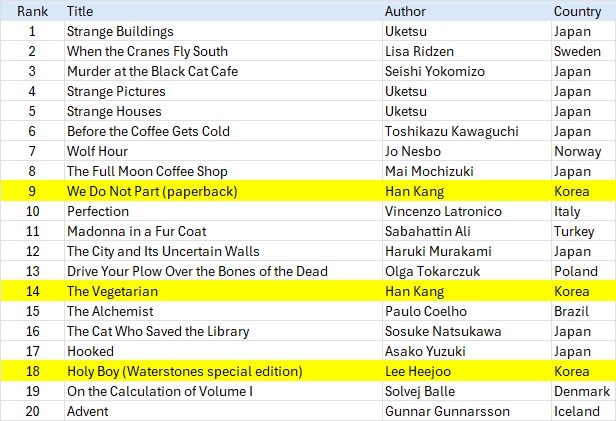
Note the predominance of Japanese titles. And this has been the case for a while. But according to the administrator of the International Booker Prize, while Japanese is the most popular origin language for translated fiction, Korean comes second – at least in 2022. And according to the BBC, “sales of translated Korean books more than doubled in 2024, compared to the previous year”.
Further support for the strength of Korean sales can be taken from the fact that further down the list in the Waterstones top 100 are the hardback edition of We Do Not Part (#82) and the normal edition of Lee Heejoo’s Holy Boy (#42). Also down the list are Han Kang’s Human Acts (#65) plus healing fiction titles such as Kim Ho-Yeon’s The Second Chance Convenience Store (#56), Song Yu-jeong’s The Memory Bookshop (#91) and Yeon Somin’s The Healing Season of Pottery (#99). Of course, these are the ones that are selling well at the moment. According to Foyles, we should expect translations such as Kang Minyoung’s Plant Lady or Kang Jiyoung’s Mrs Shim is a Killer to gain prominence when they are published later in the year – both of them thrillers. In another genre, Barbara Zitwer expects Seen Aromi’s So What If I Love My Single Life to do well as readers move on from commiserating with the harsh lives of women in Korea (as seen in Cho Nam-joo’s, Kim Ji-young Born 1982) and instead celebrate their positive life choices (of which Kim Hana and Hwang Sunwoo’s Two Women Living Together is an example).
Who are the readers?
So, who are the people who are buying these titles? Well there are all sorts. Responders to my survey ranged from females in their 20s to males in their 60s. Most of them actively seek out all forms of Korean content, or have an interest in Asian cultures more broadly and follow Korean literature within that context. That sort of active interest in things Korean is not surprising given the readership of my website.
Foyles identifies two main categories of reader of translated fiction: first, a category of people who have a broad interest in literature, and consume Korean literature within their overall consumption of world literature. This would tend to be an older demographic, though not necessarily so. We might think of these readers also as the audience to whom The Guardian is addressing its book reviews.(5)
And secondly, there is a younger demographic of readers who are very much focused on things Korean, and very well-informed. This maybe reflects Foyles’s geographical position in London, in an area which has in the last few years become something of a Korean hotspot – with K-beauty stores, a Korean supermarket, fast food places and cafes all nearby.
“Since Hallyu started, now there is a consistent fan base of Korean literature: they can’t wait for the next one, and the next one, and the next one. So we have people actually asking us when this is coming out. They already know – many people know. They’re very “in the world”, mostly online. There’s also these groups – the Goodreads BTS Reads list – but there’s so much more such as BookTok.”(6)
This second demographic which Foyles identifies is a subset of the typically younger translated fiction readership: an interesting statistic, highlighted in an article on the Booker Prize website is that 48% of the readers of translated fiction in the UK are under the age of 34, which is perhaps surprising. And while in general males represent only a third of fiction readers, when it comes to translated fiction they represent around a half.
The impact of Hallyu
According to Foyles, and as highlighted by some of the above quotes, literature in translation in general has seen a gradual increase in market share over the past ten years or so. So is the recent growth of Korean literature simply a reflection of that broader growth? Foyles thinks not: “I think Korean literature is a specific success story that needs to be seen on its own.” I tend to agree. The increase in number of Korean literature translations published commercially shows a similar trend to the increase in live k-pop and k-hip-hop performances in London.(7)
There was, of course, a temporary drop in live music in 2020-2022 because of Covid, but the Covid lockdowns in a way reinforced the market for Korean contents: that is when we were all watching Squid Game at home. That experience increased the openness of audiences to Korean content in general (8), and this applies to people working at publishers too. Barbara Zitwer told me:
I’ve talked to a lot of young editors and they told me: “We are watching Squid Game, we’re reading Korean books, we’re learning the Korean language.”
…so staff at publishers are themselves more open to Korean content. And there is one commercial genre that is targeted specifically at that Hallyu audience: that of manhwa in translation that feature members of K-pop idol bands, particularly those from HYBE’s stable.
Are we now beginning to see a glut?
While in the earlier years of my interest in Korean literature it was possible to read just about every title published commercially in English in a year, that is now no longer possible. The inability to keep up with the pace of translations and publications induces a certain amount of stress and frustration, as this cartoon by fellow London-based Korean literature enthusiast Diya Mitra shows:
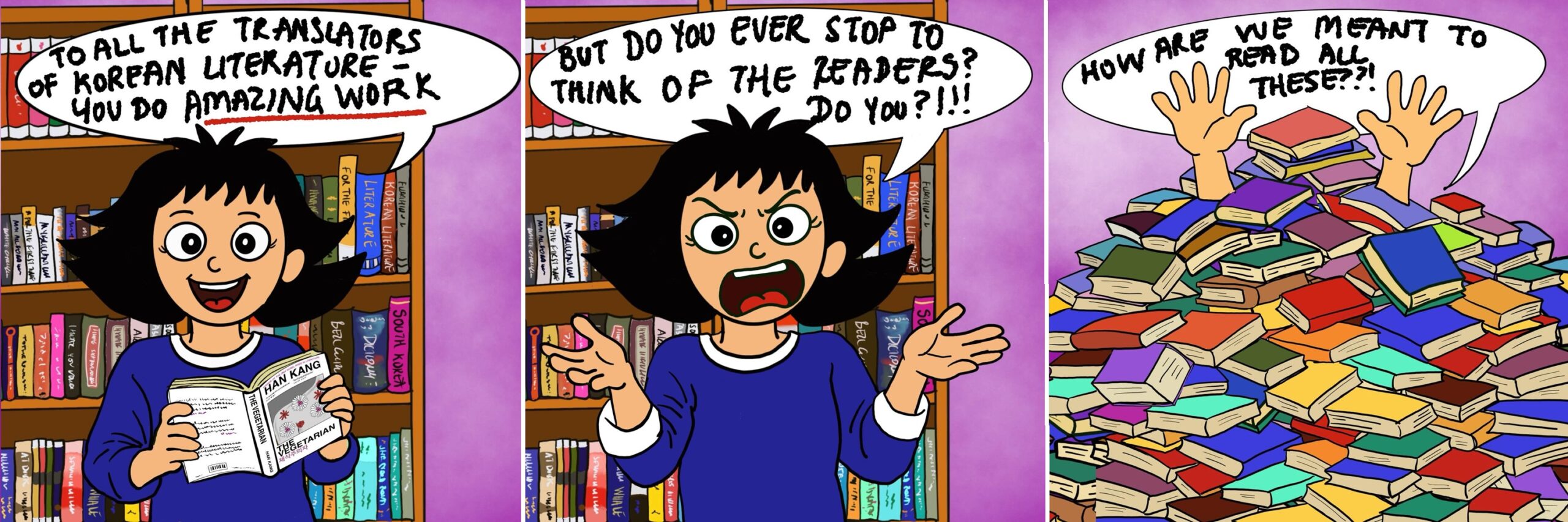
There are worse problems to have. In recent years, Korean literature in translation has become more visible, more accessible, and more widely discussed. That shift is not accidental. It reflects the sustained work of translators, editors, and publishers who have made these stories available beyond their original language.
This cartoon begins from a place of genuine appreciation. Without that work, many of these books would simply not reach readers like me.
And yet, as the number of titles grows, so does a quieter tension — the sense that there is always more to read than time allows.
In a way, this is a healthy state of affairs. After all, I would never hope to read every translated Japanese book; and of course it would be impossible to read every novel written in English published in a particular year.
What draws people to Korean literature?
This seemingly ever-expanding volume and variety of content means that readers can focus on genres, authors and topics they find appealing. In order to meet the brief for this talk I asked readers questions such as what themes they found appealing, what authors they would recommend. As expected, I got a wide variety of answers, and no particular trend emerged. I gave readers a choice between a story that displays (a) a uniquely Korean experience (eg the Colonial period, scars of the Korean War, Gwangju etc), (b) a Korean angle on more universal themes (eg family, gender issues, mental health, societal pressure), or (c) an innovative variation on genres that could be set in or derive from any society (eg thrillers, speculative fiction). One of my respondents said:
All three sound great! No matter the genre or theme every book has something to give us. Why be picky? That’s like refusing to try banchan you’ve never even eaten before.
As noted above, some people liked healing fiction, other people found it boring. And while my survey was specifically addressing the topic of literature in translation, some respondents talked about fiction written in English by Korean diaspora authors such as June Hur and Min Jin Lee, as if there was no particular importance attached in their minds to the language a novel had been written in: what was important was the story-telling and theme of the book.
Favourite authors included some names which weren’t a surprise, including Han Kang, Chung Bora, Hwang Sok-yong, Shin Kyung-sook, Bae Suah and Hwang Bo-reum; and two from a slightly earlier generation which were perhaps less mainstream: Oh Jung-hee and Cho Se-hui. The Cho Se-hui fan commented that “reading The Dwarf was one of the things that got me into Korean literature”.
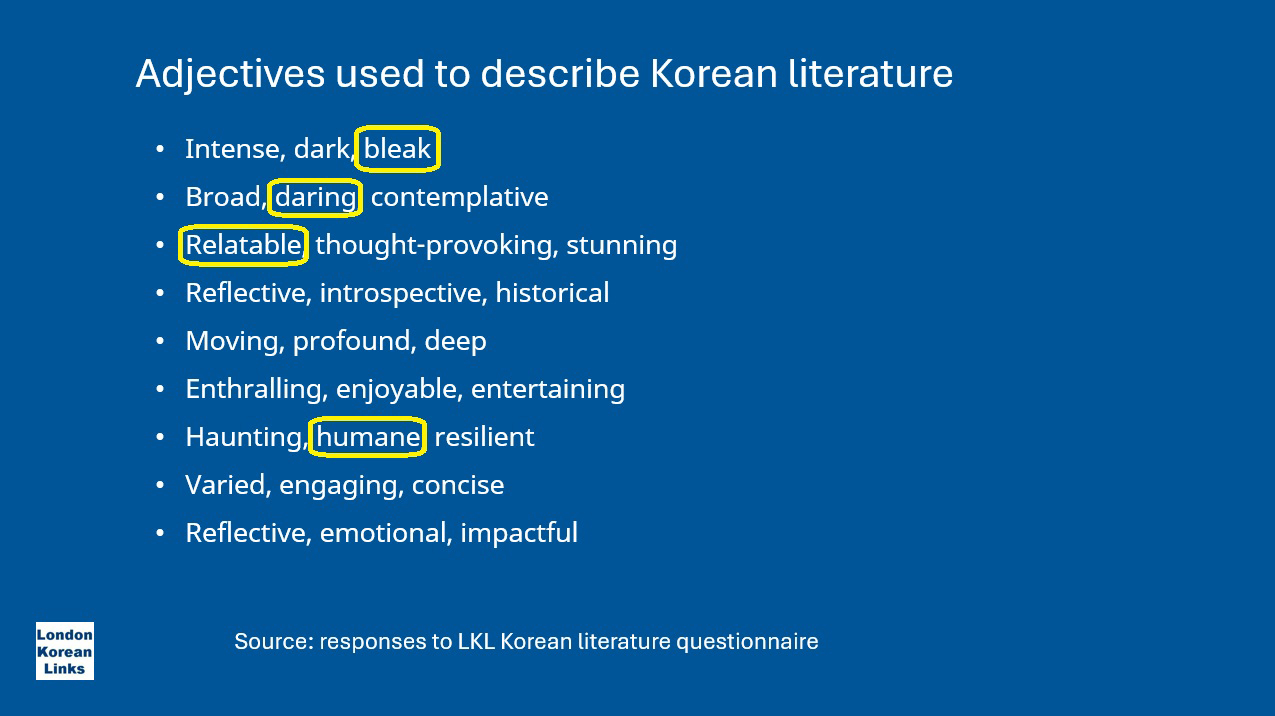
And I asked what three words the reader would use to describe Korean literature as a whole and got answers that ranged from “enthralling, enjoyable, entertaining” to “intense, dark, bleak” via “relatable”, “humane” and “daring”, though words like “reflective / contemplative” and “historical” appeared more than once. In summary, there would appear to be as many ways of describing Korean literature as there are readers.
So as I expected, the quest to address the brief presented by LTI was indeed an impossible one. At the end of the day, I have to fall back on what basically drew me to Korean literature in the first place: to understand Korea better. And along the way I find surprises that tell me not very much about Korea but instead give me a weird, engaging, sometimes comforting but usually stimulating, ride.
Before I move on to conclude, here are two quotes from the survey responses that particularly resonate with me:
Books have always been an excellent way to immerse myself in different parts of Korean culture, society, history, arts and politics
And
For me, translation opens a door. It allows readers like me to encounter voices, experiences, and forms of cultural memory that we might otherwise never fully reach.
Conclusions
To bring together some of the themes of this discussion.
- Korean literature in translation has moved from niche to a place where it has a toehold in the mainstream
- It has benefited from a broader acceptance of literature in translation in general. But while world literature is now receiving greater prominence in our reading lists, Korean literature has additionally benefited from the hallyu effect.
- Among translated literature, Japan still dominates, though Korean literature is increasingly prominent.
- Literature in translation is no longer seen as a genre in itself: works by Min Jin Lee are displayed on the same table as works by Han Kang.
- People read Korean literature for a wide variety of reasons, which can perhaps be summarized as (a) specialist: to feed their broader interest in Korea and (b) generalist: to encounter different perspectives and different voices from the mainstream Anglophone literature.
And to finish with a quote from a respondent who captures much of why I myself read Korean literature:
If I were asked what most draws me to Korean literature, I would say that it is the combination of captivating storytelling, emotional depth, and history… Korean literature stands out to me because it seems to carry both the beauty of storytelling and the weight of history so powerfully, and that makes it especially meaningful to me.
— — — —
Key sources:
- “‘It’s exciting, it’s powerful’: how translated fiction captured a new generation of readers”, John Self, The Guardian, 29 July 2023
- “The South Korean authors rising above a tide of hate to become bestsellers”, Leehyun Choi, BBC, 18 April 2026
- “Generation TF: who is really reading translated fiction in the UK”, Booker Prize website 13 April 2023
- “How I learned the truth about young, open-minded readers of translated fiction”, Anton Hur, Booker Prize website, 14 June 2023
- “London Hallyu Festival: the Symposium’s culture panel takes a look at UK Hallyu trends”, London Korean Links 16 October 2025
- “‘Like turning your soul inside out’: Barbara Hannigan and Laura Bowler on their devastating composition The White Book”, Flora Willson, The Guardian, 3 March 2026
- “Ten Korean writers on a country sawn in half”, Claire Armitstead, The Guardian, 7 April 2014
- A summary of the results of the LKL Korean Literature in Translation survey, together with a spreadsheet of the actual survey responses.
Special thanks to:
- LKL interviews with Barbara Zitwer (26 March 2026), Carmelo Puglisi, (Foyles Bookshop, 23 March 2026), Bruce and Ju-chan Fulton, (8 June 2026)
- Email correspondence with Dean at Waterstones Covent Garden book store
Links:
- Literature Translation Institute of Korea website
- LTI Korea YouTube Channel: a video of the afternoon’s session (LKL talk is around 1 hr 17 minutes into the video)
- Other videos from the conference:
- For graphs showing the increase in number of books published and of active translators, together with discussion, see “London Hallyu Festival: the Symposium’s culture panel takes a look at UK Hallyu trends”, Philip Gowman, London Korean Links 16 October 2025, https://londonkoreanlinks.net/2025/10/16/london-hallyu-festival-the-symposiums-culture-panel-takes-a-look-at-uk-hallyu-trends/ [↩]
- Professor Kim Joo-youn, director of LTI Korea, is on record as saying “A woeful lack of adequate translation is the main reason our literature has failed to draw the attention befitting its status.” Quoted in “Korea Needs More Professional Translators”, Korea Times, 15 January 2009, https://www.koreatimes.co.kr/lifestyle/people-events/20090115/korea-needs-more-professional-translators (accessed 19 April 2026) [↩]
- See for example “Ten Korean writers on a country sawn in half”, Claire Armitstead in The Guardian, 7 April 2014, https://www.theguardian.com/books/2014/apr/07/inside-story-korea-london-book-fair (accessed 19 April 2026) [↩]
- LKL interview with Carmelo Puglisi, Foyles Bookshop, 23 March 2026[↩]
- In the UK, one of the first mainstream quality newspapers to cover translated literature was The Guardian. On their website, they introduced a special “Literature in Translation” tag (https://www.theguardian.com/books/fiction-in-translation) which since the beginning of 2014 has hosted at least one article or review devoted to the topic every month. When it comes to reviews of Korean literature, it is the Guardian that has the broadest coverage, having reviewed six Han Kang titles, along with titles Hwang Sok-yong, Shin Kyung-sook, Kim Young-ha, Bae Su-ah, Yun Ko-eun, Chung Bora and Kim Un-su. [↩]
- LKL interview with Carmelo Puglisi, Foyles Bookshop, 23 March 2026. The question that elicited this quote was whether he thought the recent rise in Korean literature really just reflected the broader rise of translated literature as a whole, or whether the rise was more remarkable than that. [↩]
- For a graph showing the increase in number of live k-pop performances in London over the years, see “London Hallyu Festival: the Symposium’s culture panel takes a look at UK Hallyu trends”, Philip Gowman, London Korean Links 16 October 2025, https://londonkoreanlinks.net/2025/10/16/london-hallyu-festival-the-symposiums-culture-panel-takes-a-look-at-uk-hallyu-trends/ [↩]
- I know personally several people who were drawn to Korean contents more broadly after becoming enthralled with Squid Game and other K-dramas during lockdown.[↩]