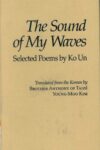
This selection of poems by Ko Un, Korea’s leading writer, offers unique insights into how a great poet responds to the violence, war, and oppression that have ravaged Korea in this century. His first poems were written when Ko Un was a Buddhist monk. Later, he returned to a society where nihilism and doubt seemed … [Read More]

Archives: Books (page 105)
Singing Like a Cricket, Hooting Like an Owl

From the publisher’s website: Kyu-bo Yi (1168–1241), the greatest of the classical Korean poets, was born into a very turbulent period of history, when the Koryo kingdom was threatened from the north by barbarians and from within by the ongoing struggle for supremacy among the various factions. His poems, confessional and transcendent, describe moments of … [Read More]
The Snow Falling on Chagall’s Village

From the publisher’s website: Kim Ch’un-Su is one of the most original poets in modern Korean poetry. He was influenced by Rilke for a while, but embarked on a series of his own poetic experiments culminating in what he calls “the poetry of meaning.” An avowed purist, he would not believe in ideas, ideologies, or … [Read More]
Sending the Ship Out to the Stars
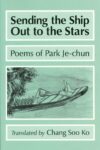
From the publisher’s website: Park Je-chun is a major poet in Korea today. His works are marked by a poetic imagination and a sensibility which draw largely on Korean Buddhist and Taoist traditions, as well as Korean classical literature. Though he is widely read in the Oriental classics and Western poetry, Park’s emotions, imagery, and … [Read More]
Selected Poems of Kim Namjo

From the publisher’s website: A generous selection of poems by one of Korea’s most honored and highly regarded poets. Kim Namjo published her first book of poems, Life (Moksum), in 1953. In the years since then, in another ten collections of poems, she has explored in her books, an intensely experienced religious faith, and a … [Read More]
Vision of a Phoenix

From the publisher’s website: The biography and writings of Ho Nansorhon (1563–1589), one of the finest poets of the entire Choson dynasty, who wrote during the Golden Age of Sino-Korean poetry. This period also witnessed the Confucianization of Korean society, when government-imposed sanctions greatly restricted the lives of Korean women, particularly those of the ruling … [Read More]
Farmers’ Dance

From the publisher’s website: Shin Kyong-Nim’s first volume of poems, Farmers’ Dance (Nong-mu), marked a major new step in the development of modern Korean poetry when it was published in 1973. The life of Korea’s oppressed rural masses had never before been highlighted in such a manner. For years, the poet had shared that life … [Read More]
Back to Heaven: Selected Poems of Ch’on Sang Pyong

From the publisher’s website: These poems by “the happiest man in the world” are full of light though written in dark times. Ch’ōn had the art of seeing the beauty of life beyond all the pain, and of putting it into the music of words. Recently, many young Koreans have discovered in these poems and … [Read More]
Day-Shine

From the publisher’s website: Powerfully inventive poems of love in contemporary life by Chong Hyon-jong, one of the most respected poets writing in Korea. The novelty of his poetic language with its narrative lyricism and provacative philosophy makes it impossible to classify Chong’s poetry, and yet it is a holder of tradition which embodies the … [Read More]
The Early Lyrics, 1941–1960
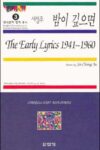
From the publisher’s website: So Chong Ju, also known by the penname Midang, was born in Sonum village in the North Cholla Province of Korea, in 1915. His first poems were published in the late 1930s; his first collection of poems dates from 1941. The present volume contains the complete poems of his first four … [Read More]
Variations: Three Korean Poets
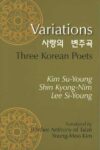
From the publisher’s website: This book showcases the work of three major Korean poets born at fourteen-year intervals, in 1921, 1935, and 1949. Each has tried to renew Korean poetry by bringing it into closer contact with everyday speech, social issues, and ordinary people’s lives. Kim Su-Young was a major pioneer, first developing as a … [Read More]
The Book of Korean Poetry: Songs of Shilla and Koryo

From the publisher’s website: “Here at last in one English-language volume is the heart and soul of the Korean lyric tradition, brought to sensuous life by a poet who is our finest all-around translator of Korean literature.”—Bruce Fulton, Young-Bin Min Chair in Korean Literature and Literary Translation, University of British Columbia Korea’s history is divided … [Read More]
On an Autumn Night: Classical Korean Poetry

From the back cover: The poems collected here are in classical Chinese, the language of learning in Korea before the turn of the twentieth century. Though they range from the seventh to the nineteenth century, most were written during the Joseon Dynasty (1392-1910). They are five-character line quatrain poems written in the New Style, the … [Read More]
Abiding Places, Korea South & North
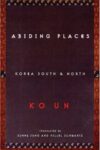
From the publisher’s website: In Abiding Places, Korean poet Ko Un has transfigured his homeland in lovely, observant, and penetrating poems uniting ancient and modern, secular and spiritual, art and politics, South and North. When his former political cellmate Kim Dae-Jung became President of Korea in 1998, Ko Un became the first citizen from the South … [Read More]
The Three Way Tavern

From the publisher’s website: Ko Un, the preeminent Korean poet of the twentieth century, embraces Buddhism with the versatility of a master Taoist sage. A beloved cultural figure who has helped shape contemporary Korean literature, Ko Un is also a novelist, literary critic, ex-monk, former dissident, and four-time political prisoner. His verse—vivid, unsettling, down-to-earth, and … [Read More]
Enough to Say It’s Far: Selected Poems of Pak Chaesam
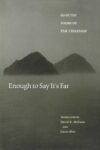
From the publisher’s website: This is the first English translation of selected poems by one of the most important and unusual modern poets of South Korea. In contrast to the strident political protests found in the poetry of many of his contemporaries, Pak Chaesam’s work is characterized by intimate portraits of place, nature, childhood, and … [Read More]